
By Arthur Descazeaud.
What motivated the return of Jews to Palestine and can it be compared to an aggressive theft and coordinated land-grabbing policy ?
Two main factors can explain the return of Jewish populations to Palestine, particularly from the 1880s: political and religious. Although some tensions and unconventional means were applied in a minority of cases, the overall movement was done quite slowly, strategically and peacefully. Moreover, although there was some level of coordination at times and between specific people, it would be hard to affirm that some designated leaders fully orchestrated Jewish immigration in the region over the years. There was a multiplicity of situations and actors.
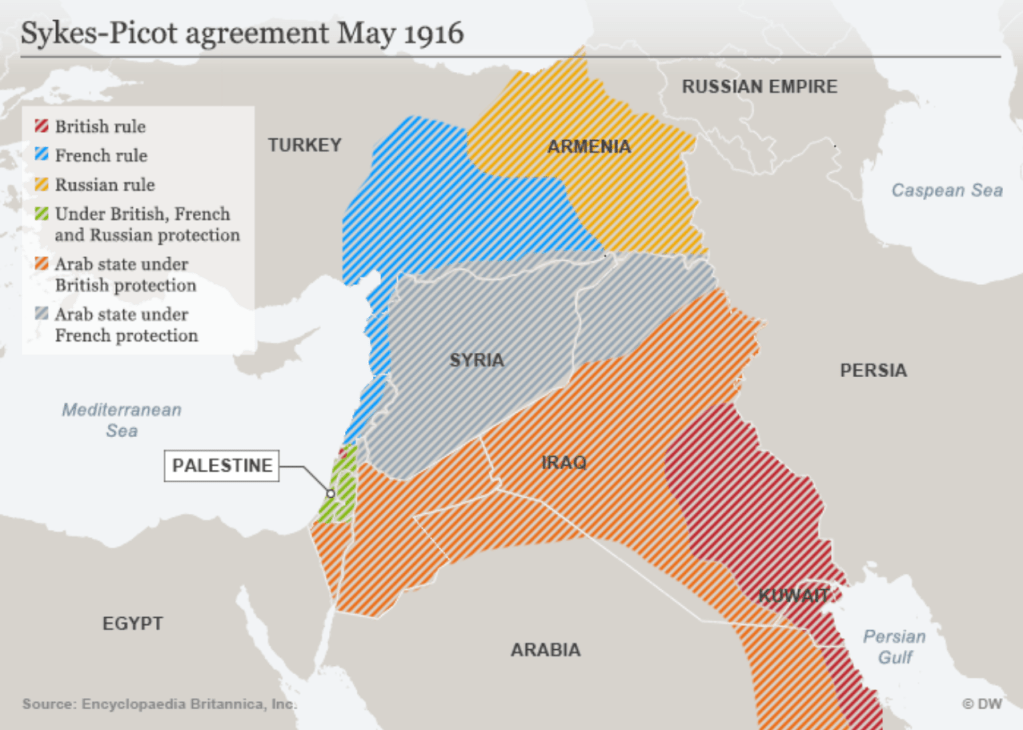
The Sykes-Picot Agreement on a map [25]
Let’s come back to 1916. The Ottoman Empire had been divided (see the figure above) among the French, British, and Russians in the Sykes-Picot Agreement. As shown on the map, all territories were under some form of influence. The disclosure of this agreement by the Bolsheviks led to a political scandal. Although its dispositions never came into force after the war, much of it inspired what would be next decided at the Conference of San Remo in 1920. After November 2nd’s Balfour Declaration and the publication in the Izvestia newspaper by Trotsky of a copy of the Sykes-Picot Agreement on November 24th, the Arabs started to grasp the British hypocrisy. While Great Britain had promised all Arab territories under Ottoman occupation to the Emir and Sharif of Mecca Hussein bin Ali, the Balfour Declaration from the British foreign secretary addressed to Lionel Walter Rothschild (a leader of the Anglo-Jewish community), stated otherwise. The open letter stipulated that the British government was willing to support the “establishment in Palestine of a national home for the Jewish people” [26]. The idea behind that was to rally Jewish opinion on the side of the Allied powers. At the time, Jews – particularly the ones from the United States – did not hide their sympathy for Germany and Austria, considering these nations as more tolerant of their community than Russia or even France [27].
Words here matter: It should be noted that the British were playing a two-sided game with the Arabs on one side and the Jews on the other. Indeed, just like the promise made to Hussein bin Ali was most probably not going to be kept, Great Britain and the Jews were not on the exact same page either. The statement mentions a “national home” for Jewish people, not a state. The difference is major. Actually, one of Britain’s goals was to establish a pro-British Jewish settlement in Palestine that would be able to protect the approaches to the Suez Canal to keep this communication route to India [28]. However, although it might not have been the British initial desire, it set the path for what would come next.
Six weeks after the Balfour Declaration, on December 11th, 1917, the British plan started to become a reality with General Allenby and his army, which included 3 Jewish battalions. At the end of an almost 80-mile progression marked by fighting, they finally managed to enter Jerusalem after the Turks had withdrawn from the city overnight. Sources say this was probably due to the growing military pressure the British concentrated on it [28]. London had delivered strict instructions to the general: it was important not to appear disrespectful to the city, its people (which included many different ethnicities and religious beliefs), or its traditions. These were applied, and as Allenby promised to maintain and protect all three religions present in Jerusalem, the peaceful British arrival in the city was celebrated by church bells in Rome and London [29]. This event marks the end of the Muslim domination of the city through the Ottoman Caliphate.
In parallel, the Jews in Europe were trying their best to assimilate in order to respond to the growing anti-Semitism in the region. However, a Jewish Austrian writer called Theodor Herzl, who was considered by many as the father of the ideology of Zionism, developed the idea that this strategy was not the right one. This conclusion was directly derived from his own experience as a Jew in Austria and later France, where the Dreyfus affair which he covered as a journalist, reinforced his conviction [30]. Though imagined by many before him, he was a pioneer in popularising the creation of a Jewish state as the only remaining solution for Jews to live freely. His innovative approach of making the Jewish question political rather than social or religious, led him to publish “The Jewish State” in 1896. In this famous pamphlet, he writes that the Jewish question is: “a political world question to be discussed and settled by the civilized nations of the world in council.” He also discusses the two options, Argentina and Palestine, for creating a Jewish state. These two countries were considered because Jewish colonisation experiments had been conducted in them both. Although Herzl leaves the door open, his text seems more in favour of “our ever-memorable historic home” [31]. He believed so firmly in this solution that he went to Constantinople (Istanbul) in 1896, hoping to meet the Ottoman sultan to discuss the possibility of making Palestine an independent country. However, he could not reach him and left eleven days later [30].
Even though many European Jewish leaders disagreed with his political approach he managed to organise the First Zionist Congress in Basel in August 1897. Around 200 delegates made the trip, most of whom came from Eastern Europe, Russia, and, to a lesser extent, from Western Europe and the United States. At the end of the three-day congress, participants had agreed on the Basel Program which set in stone the Zionist movement’s aspiration “to create a publicly guaranteed homeland for the Jewish people” in Palestine and the Zionist Organization was born with Herzl as president [30]. Although his call for international support to back the Zionist cause failed during the congress, the organisation survived and became a major instrument for the settlement of an increasing number of Jewish people in Palestine in the years following Herzl’s death in 1904. Effectively, it played an important role in securing Jewish ownership of land through the Jewish National Fund (JNF) [32]. This could only be done on a small scale while Palestine was under Ottoman rule. However, the Balfour Declaration, resulting from the Zionists’ lobbying that influenced both Great Britain and French authorities, shows that it did not stop the organisation from acting [33].
Indeed, even though the British had secretly agreed with France on the partition of Palestine into two equal shares [33], David Lloyd George, who was Prime minister at the end of 1916, claimed the Sykes-Picot agreement was unfair towards Great Britain who would bear most of the fighting against the Ottomans in the Sinai and in Palestine. Therefore, he asked Sykes to revise the Palestine share. When the latter discovered Zionism, he thought the movement could be part of his strategy, and decided to meet its leaders. He immediately tasked them with convincing Picot (representing the French side) that the Zionist project was feasible and that Palestine should become a full British protectorate (Sykes did not share the agreement details with the Zionists though). Nahum Sokolow did so brilliantly, to the point of getting an actual written letter from Jules Cambon, secretary-general of the French foreign ministry, on June 4th, 1917. Sokolow emphasized the fact that both Russian and American Jewish opinions were in favour of this project [33]. The Cambon letter details the Zionist project presented to French authorities as “the development of Jewish colonisation in Palestine” if “the circumstances allow it and the independence of the Holy Places is ensured” [34]. Following this description, the French government states that it feels “sympathy” for such a cause, considering that its “triumph is linked to that of the allies” [34]. Needless to say that this letter was a real victory for the Zionist movement by clearing the way for the Balfour Declaration which followed five months later.
Those in favour of the Jewish settlement cause in Palestine, fostered the political strategy of purchasing land in the region. Effectively, the Ottoman government published its first Land Code in 1858 in an attempt to decrease the power of intermediaries between the state and the peasants (of local notables, large landlords, or tribal leaders), keep the ownership of arable land and tax each plot [35]. The Ottoman government seized some properties, and others just became less profitable for their owners, but all in all, the promulgation of this Code led to more land being sold to Europeans. One of the most notable buyers was Baron Rothschild who spent an estimated 10 million pounds sterling (around 40 million given today’s value) on land purchases. His underlying motives were building settlements, and establishing plantations and manufacturing plants, whilst guaranteeing Jewish settlers who came to work on these plantations a minimum income. With the combined efforts of investors like Rothschild and the Keren Kayemet fund (JNF), which was established in 1899 for the purpose of acquiring land, the amount of Jewish-owned land in Palestine grew from 25,000 dunums (approximately 25 million square metres) in 1882 to 1.6 million dunums (around one billion and 600 million square meters) by 1941 [36].
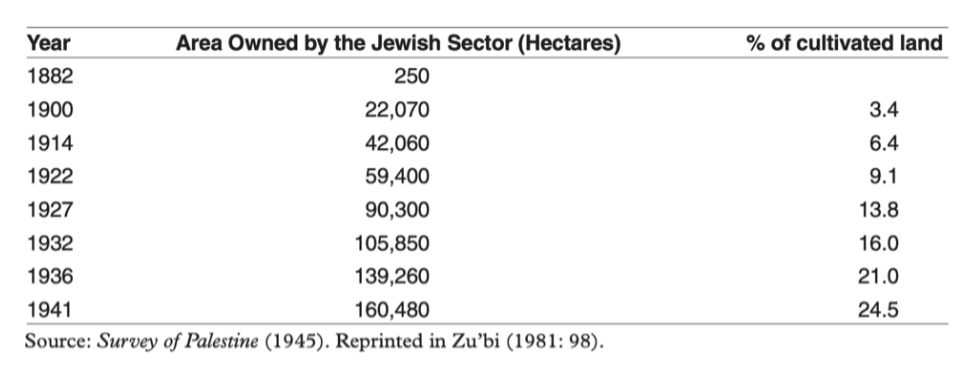
Expansion of cultivated land owned by Europeans (Jewish) in Palestine (1882-1941) [37]
It is important to note that this increase in area owned by Jews is not only the result of some sort of machiavellian plan put in place by the Zionist leaders, but also the consequence of the anti-Semitic conditions in which Jewish people had to live in many European countries. For instance, in addition to discrimination in France, Jews from Eastern Europe and Russia suffered from persecution. Following the assassination of Tsar Alexander II, the pogroms – a Russian term which refers to violent attacks by local non-Jewish populations on Jews – that occurred between 1881 and 1884 in the Russian southern and western provinces forced many Jews to flee the region [38].
These political approaches to explain ongoing Jewish settlements in today’s Israel have of course to be put in perspective with the religious motivations behind creating a Jewish state in what was Judea at the time when the Romans forced the Jews to flee. Indeed, one of the primary reasons for Jews to come back to Palestine is the belief that there is a biblical prophecy about the return to their homeland [39]. One of the main prophetical books of the Old Testament is the Book of Ezekiel, and Chapter 39 is particularly interesting to understand why many Jews saw their return to Palestine and the restoration of a Jewish state as the literal fulfillment of a prophecy – this belief being known as “restorationism”. In his book, Ezekiel, a priest turned prophet, explains that Jerusalem’s destruction and the Jewish exile’s condamnation, were consequences of breaking God’s covenant – initially agreed on with Abraham – [39].
According to this mutual promise, God would protect and guarantee a land to Abraham and his descendants as long as they followed his path [40]. It is interesting to note that nowhere in the book is the blame put on outside forces. The Jews are the first responsible for what happened to them and the fall of Jerusalem is just a consequence of their own negligence. However, Ezekiel then gives a touch of hope to his people by stating that they will one day return to their land while witnessing a real renewal of it conducted by God himself. This renewal has been subject to many interpretations over the years, and debates persist about whether it has already happened. Although many now claim that Ezekiel prophesied the creation of the modern State of Israel in 1948, it is possible that he was just using imagery available to him at the time (related to the land, city, temple, etc) to predict something much more glorious than the return to the land, i.e., the revival of the nation and the restoration of the temple [39]. Some texts that followed the Book of Ezekiel actually hinted at this possibility. For instance, in the Letter to the Hebrews, which is part of the New Testament and believed to be addressed to Jewish Christians [41], the author (anonymous) decentred traditional Jewish hopes from the actual city of Jerusalem: “But you have come to Mount Zion, to the heavenly Jerusalem, the city of the living God…You have come to thousands upon thousands of angels in joyful assembly…You have come to God…to Jesus the mediator of a new covenant” [42]. Thus, if God came to the world through the figure of Jesus, one should not hope for any different occurrence to fulfill Ezekiel’s original vision, whether it is establishing the State of Israel or anything else in the future [39].
These religious considerations can help explain what has happened over the years. It is clear that both dimensions – political and religious – participated in giving a frame, officialising and boosting what has been an ongoing Jewish immigration movement of return since the late 1800s to the land their ancestors lived on in the 1st century.
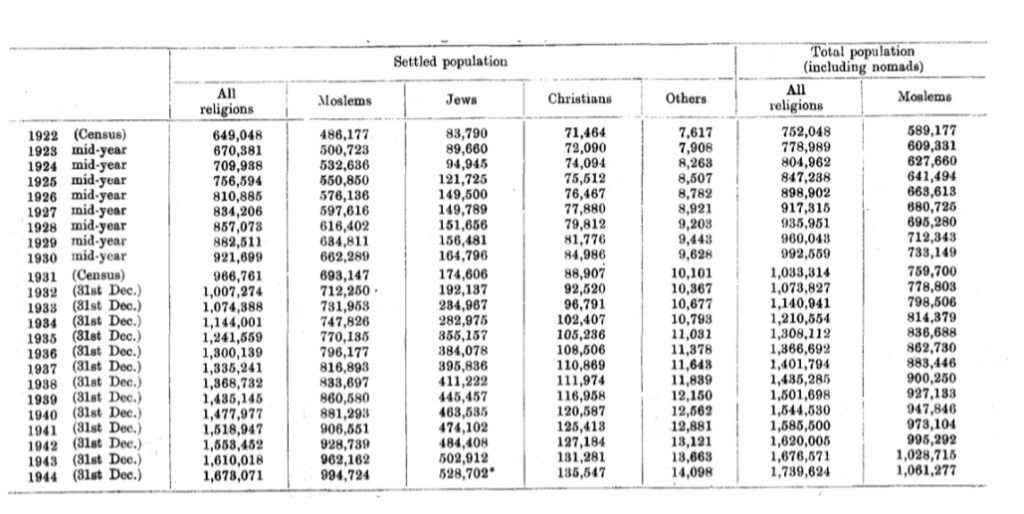
Population of Palestine by religion (1922-1944) [43]
Indeed, several immigration waves, also known as aliyot, can be highlighted since the 1880s, and the more we approach recent times, the more important these waves have been. As described in the above table, the percentage of Jews compared to the total settled population in Palestine went from 12,9% in 1922 to 31,6% in 1944, while the percentage of Muslims compared to the total settled population consequently decreased from 74,9% to 59,5%. The “First Aliyah” ran from 1882 to 1903 and saw around 25,000 Jews emigrate from Russia and Roumania, and around 2,500 from Yemen. Although around one-quarter Jews went to existing agricultural settlements, the majority chose to settle in cities, especially Jaffa and Jerusalem. However, the Jewish community faced economic difficulties: lack of housing and unfriendly treatment by other residents (Arabs and Jews alike) [44]. Indeed, most of the Jewish newcomers believed in socialist ideas and when they requested a job in rural settlements called moshavot, tensions between them and the previously settled Jewish farmers arose. These moshavot farmers were supported by philanthropic organisations and were expected to become self-sufficient at some point. In addition to being ideologically opposed to new Jewish immigrants, farmers actually preferred employing Arabs as they represented a cheaper workforce [45]. This led to rising tensions between the Jews and the Arabs too, and in the 1920s, the Zionist leadership ordered farmers to only employ Hebrew workers. However, the economic reality at that time made this exclusivity impossible to implement in practice [45].
Interestingly, even though agricultural settlements represented a small portion of the overall Jewish settlements, they would become one of the pioneering foundations of the later arrivals [44]. In total, there were five aliyahs between the 1880s and World War II; the final one coinciding with the rise of Nazism in Germany and nationalism in Eastern Europe. This was the largest wave, with around 250,000 Jews settling in Palestine – back then under British mandate – between 1929 and World War II. This fifth immigration wave was marked by heterogeneity given that many Jewish professionals were doctors, lawyers and artists [46].
If it is certain that these aliyot set the path to the future creation of the State of Israel, the immediate and direct consequence has been the emergence of tensions in Palestine. We will detail them in the next section focusing on the existence of a Palestinian land and identity when such a state was created.
Edited by Justine Peries.
*This is the second section of a research paper entitled An objective historical analysis of the Israeli-Palestinian conflict and potential perspectives to walk towards peace. For the first part, click here.
References
[25] Schuster, Kathleen. “Balfour Declaration: Still important 100 years later? – DW – 11/02/2017.” DW, 2 November 2017, https://www.dw.com/en/balfour-declaration-is-it-still-important-to-the-middle-east-100-years-later/a-41202230. Accessed 13 December 2023.
[26] Britannica. “Balfour Declaration | History & Impact.” Britannica, 8 December 2023, https://www.britannica.com/event/Balfour-Declaration. Accessed 13 December 2023.
[27] Dignat, Alban. “2 novembre 1917 – La Déclaration Balfour.” Herodote.net, 11 May 2023, https://www.herodote.net/2_novembre_1917-evenement-19171102.php. Accessed 13 December 2023.
[28] NUÑO, GERONIMO. “Incomplete Victory: General Allenby and Mission Command in Palestine, 1917-1918.” DTIC, 14 December 2012, https://apps.dtic.mil/sti/pdfs/ADA569743.pdf. Accessed 13 December 2023.
[29] History. “Jerusalem surrenders to British troops.” Jerusalem surrenders to British troops, 5 November 2009, https://www.history.com/this-day-in-history/jerusalem-surrenders-to-british-troops. Accessed 13 December 2023.
[30] Ben-Gurion, David. “Theodor Herzl | Austrian Zionist, Political Activist & Journalist.” Britannica, 1 December 2023, https://www.britannica.com/biography/Theodor-Herzl#ref26684. Accessed 13 December 2023.
[31] Oxford University Press. “Document – Excerpts from Theodor Herzl, The Jewish State (1895) – Patterns of World History 3e Dashboard Resources – Learning Link.” Learning Link, https://learninglink.oup.com/access/content/von-sivers-3e-dashboard-resources/document-excerpts-from-theodor-herzl-the-jewish-state-1895. Accessed 13 December 2023.
[32] Ruppin, Arthur. “interactive encyclopedia of the palestine question – palquest | world zionist organization.” Interactive Encyclopedia of the Palestine Question, https://www.palquest.org/en/highlight/156/world-zionist-organization. Accessed 13 December 2023.
[33] Kramer, Martin. “THE FORGOTTEN TRUTH ABOUT THE BALFOUR DECLARATION.” Scholars at Harvard, 5 June 2017, https://scholar.harvard.edu/files/martinkramer/files/forgotten_truth_balfour_declaration.pdf. Accessed 13 December 2023.
[34] Manor, Yohanan. “Paris-Londres-Jérusalem : les deux déclarations de 1917.” CAIRN, 5 November 2023, https://www.cairn.info/revue-outre-terre1-2004-4-page-353.htm. Accessed 13 December 2023.
[35] AYTEKİN, E. ATTİLA. “Agrarian Relations, Property and Law: An Analysis of the Land Code of 1858 in the Ottoman Empire.” JSTOR, 2 March 2023, https://www.jstor.org/stable/40647178. Accessed 13 December 2023.
[36] Temper, Leah. “Historia Agraria.” Creating Facts on the Ground: Agriculture in Israel and Palestine (1882-2000), SEHA, 2009, p. 80. Historia Agraria, https://www.historiaagraria.com/FILE/articulos/48leah.pdf.
[37] Temper, Leah. “Historia Agraria.” Creating Facts on the Ground: Agriculture in Israel and Palestine (1882-2000), SEHA, 2009, p. 81. Historia Agraria, https://www.historiaagraria.com/FILE/articulos/48leah.pdf.
[38] United States Holocaust Memorial Museum, Washington, DC. “Pogroms | Holocaust Encyclopedia.” Holocaust Encyclopedia, https://encyclopedia.ushmm.org/content/en/article/pogroms. Accessed 13 December 2023.
[39] Paul, Ian. “Does the State of Israel fulfill biblical prophecy?” Psephizo, 4 June 2018, https://www.psephizo.com/biblical-studies/does-the-state-of-israel-fulfil-biblical-prophecy/. Accessed 13 December 2023.
[40] Jewish Museum London. “The Covenant.” The Jewish Museum London, https://jewishmuseum.org.uk/schools/asset/the-covenant/. Accessed 13 December 2023.
[41] United States Conference of Catholic Bishops. “Hebrews, THE LETTER TO THE HEBREWS.” Daily Readings, https://bible.usccb.org/bible/hebrews/0. Accessed 13 December 2023.
[42] Wilson, Ralph F. “Text of the Epistle to the Hebrews (NIV) — Disciple Lessons from Hebrews.” The JesusWalk Bible Study Series, https://www.jesuswalk.com/hebrews/hebrews-text-niv.htm. Accessed 13 December 2023.
[43] Government of Palestine. “Chapter 6 – Population.” A survey of Palestine, Palestine Government, 1946, p. 141. BJPA, https://www.bjpa.org/content/upload/bjpa/a_su/A%20SURVEY%20OF%20PALESTINE%20DEC%201945-JAN%201946%20VOL%20I.pdf.
[44] Ministry of Aliyah and Integration. “Immigrants to Israel | Ministry of Aliyah and Integration.” Gov.il, https://www.gov.il/en/departments/general/aliyah_1. Accessed 13 December 2023.
[45] Seltenreich, Yair. “Jewish or Arab Hired Workers? Inner Tensions in aJewish Settlement in Pre–state Israel.” Cambridge University Press, 29 October 2004, https://www.cambridge.org/core/services/aop-cambridge-core/content/view/ACBF4B6FA27FB9A62623FE738273820C/S0020859004001506a.pdf/jewish-or-arab-hired-workers-inner-tensions-in-a-jewish-settlement-in-pre-state-israel.pdf. Accessed 13 December 2023.
[46] “History of Jewish Immigration to Israel (Aliyah).” Reform Judaism, 2 March t2023, https://reformjudaism.org/history-jewish-immigration-israel-aliya. Accessed 13 December 2023.
[Cover image] Photo of Bâtiments En Béton Beige Sur Terrain élevé by Haley Black, licensed under CC.


Leave a comment