By Adrián Rojo.
Nayib Bukele’s assumption of the presidency of El Salvador marked the beginning of a new chapter in the war against gangs that have afflicted the country since the early 1990s. As a determined businessman with strong convictions, Bukele has captured the attention of the international public for the outcomes of his government’s security policies and, above all, for the questionable methods he has employed, which keep him at the center of controversy [1].
The Gang Problem
Crime is one of El Salvador’s main challenges in its recent history. The Salvadoran Civil War, during which the Salvadoran armed forces fought left-wing rebel groups and ended in 1992, left a legacy of violence. Coupled with poverty, inequality, growing social issues, and lack of opportunities, it has facilitated the joining of young people and ex-combatants to criminal groups like Mara Salvatrucha and Mara 18, which were founded in Los Angeles, CA, by Central American gang members later deported by the United States [2].
The gang problem in El Salvador is particularly delicate because its characteristics and modus operandi are more complex than usual. It involves not only youths engaged in substance abuse and petty crimes but also territorial conflicts between different sophisticated criminal organisations. These latter gradually expanded their targets to the public force, activists, journalists, and civilians who refuse to pay extortion or join the organisation. Due to their criminal activities, El Salvador became one of the most dangerous countries in the world [3].
Bukele’s Approach
On June 1, 2019, Nayib Bukele took office as president of El Salvador with a clear mandate to combat crime. Three weeks later, on June 19, Bukele announced the “Territorial Control Plan,” which began implementation at midnight of the same day in 12 municipalities across the country by deploying over 5,500 police and military personnel in city centers to prevent extortion payments, aiming to weaken gang finances [4].
Additionally, the government declared a state of emergency in the country’s prisons, leading to the intervention of 28 prisons, confining prisoners to their cells and prohibiting visits [5]. In subsequent phases, the government initiated a process to modernise weapons, vehicles, helicopters, and technological supplies for the public force, culminating in July 2021 with the recovery of territories dominated by gangs, previously off-limits even to the public force [6].
A year later, in July 2022, the government announced the construction of a mega-prison called the “Terrorism Containment Center” with a capacity for 40,000 inmates, the largest in Latin America, aimed at reducing overcrowding by receiving prisoners from other prisons as well as those detained during the crackdown [7]. Later on, in November of the same year, a massive deployment of the armed forces around major cities to apprehend terrorists hiding in communities [8].
However, Bukele’s policy also includes a deterrent component. Within the strategy, the government aimed at creating opportunities for young people by promoting education and providing scholarships, as well as building schools and sports centers, in order to prevent Salvadoran youth from falling into the clutches of gangs. The seriousness of this commitment is evident in the fact that the government sought a loan of USD 158 million from the Central American Bank for Economic Integration to finance this strategy, of which it secured an allocation of USD 91 million [9].
Reactions and Controversies
While Bukele’s security policy has yielded favorable results with reduced crime rates [10], his work has not been without criticism, particularly regarding human rights violations. Both the U.S. Department of State and Human Rights Watch have published detailed reports documenting violations such as arbitrary arrests, forced disappearances, torture, lack of due process guarantees, and inhumane conditions in prisons [11] [12]. Likewise, Amnesty International criticises that the mega-prison does not “address the root causes of violence,” suggesting that the problem is not being fundamentally resolved [13].
And it’s no wonder, as Bukele himself, to justify the excesses of his security policy, has publicly stated that the rights of criminals are not more important than those of law-abiding citizens [14]. This stance has led to arrests based on physical appearance and other conjectures, with inmates facing overcrowded conditions, inadequate necessities such as lack of mattresses and sufficient clothing, as well as deficient food, the quantity of which depends on discipline within the prison and even on the behavior of gangs outside [15].
Overall, while Bukele’s security policy methods are controversial, their results have allowed him to enjoy a high degree of popularity among Salvadorans, leading to his reelection in February 2024 [16]. Between 2022 and 2023, the country set a record of over a year without a single murder, making it today the safest country in Latin America [17] [18]. These results have given rise to a sort of cult of Bukele [19], particularly among political leaders in the region who view his outcomes favorably.
Edited by Justine Peries.
References
- CNN (2024). In El Salvador, self-styled ‘world’s coolest dictator’ Nayib Bukele heads for re-election amid human rights concerns. [online] Available at: https://edition.cnn.com/2024/02/03/americas/el-salvador-nayib-bukele-election-preview-intl/index.html.
- BBC (2017). MS-13 gang: The story behind one of the world’s most brutal street gangs. BBC News. [online] 19 Apr. Available at: https://www.bbc.com/news/world-us-canada-39645640.
- The Guardian (2023). El Salvador’s crime crackdown: a short-term, high-cost fix. [online] 2 Jul. Available at: https://www.theguardian.com/commentisfree/2023/jul/02/the-guardian-view-on-el-salvadors-crackdown-a-short-term-high-cost-fix.
- Calderón, B. and Alemán, F. (2019). Lo que se sabe del ‘Plan Control Territorial’ implementado este jueves por el Gobierno. [online] La Prensa Gráfica. Available at: https://www.laprensagrafica.com/elsalvador/Lo-que-se-sabe-del-Plan-Control-Territorial-implementado-este-jueves-por-el-Gobierno-20190620-0254.html.
- AS/COA. (2019). El Salvador’s Nayib Bukele Marks 100 Days in Office | AS/COA. [online] Available at: https://www.as-coa.org/articles/el-salvadors-nayib-bukele-marks-100-days-office.
- Alvarado, I. (2021). Bukele retoma disposiciones de gestión Funes al reforzar Plan Control Territorial con militares. [online] La Prensa Gráfica. Available at: https://www.laprensagrafica.com/elsalvador/Bukele-retoma-disposiciones-de-gestion-Funes-al-reforzar-Plan-Control-Territorial-con-militares-20210719-0072.html.
- Reuters (2023). El Salvador opens 40,000-person prison as arrests soar in gang crackdown. Reuters. [online] 1 Feb. Available at: https://www.reuters.com/world/americas/el-salvador-opens-40000-person-prison-arrests-soar-gang-crackdown-2023-02-01/.
- Reuters (2022). El Salvador’s Bukele scales up anti-gang push with new deployments. Reuters. [online] 24 Nov. Available at: https://www.reuters.com/world/americas/el-salvadors-bukele-scales-up-anti-gang-push-with-new-deployments-2022-11-24/.
- Nagovitch, P. (2020). Explainer: Nayib Bukele’s Territorial Control Plan. [online] AS/COA. Available at: https://www.as-coa.org/articles/explainer-nayib-bukeles-territorial-control-plan.
- Reuters (2024). El Salvador says murders fell 70% in 2023 as it cracked down on gangs. [online] Available at: https://www.reuters.com/world/americas/el-salvador-says-murders-fell-70-2023-it-cracked-down-gangs-2024-01-03.
- Human Rights Watch (2022). ‘We Can Arrest Anyone We Want’. Human Rights Watch. [online] 7 Dec. Available at: https://www.hrw.org/report/2022/12/07/we-can-arrest-anyone-we-want/widespread-human-rights-violations-under-el.
- U.S. Department of State (2023). El Salvador – United States Department of State. [online] United States Department of State. Available at: https://www.state.gov/reports/2022-country-reports-on-human-rights-practices/el-salvador/.
- Bernal, D. (2023). Amnistía Internacional expresa preocupación por megapenal de El Salvador. [online] La Prensa Gráfica. Available at: https://www.laprensagrafica.com/elsalvador/Amnistia-Internacional-expresa-preocupacion-por-megapenal-de-El-Salvador-20230203-0053.html.
- El Tiempo (2022). ‘Defienden derechos de los delincuentes y no los de la gente honrada’: Bukele. [online] El Tiempo. Available at: https://www.eltiempo.com/mundo/latinoamerica/nayib-bukele-pide-defender-derechos-de-gente-honrada-y-no-de-delincuentes-710363.
- France 24. (2023). Inside El Salvador’s mega-prison holding 12,000 alleged gangsters. [online] Available at: https://www.france24.com/en/live-news/20230823-inside-el-salvador-s-mega-prison-holding-12-000-alleged-gangsters.
- Le Monde (2024). El Salvador’s Bukele proclaims ‘historic’ victory in re-election defying constitution. Le Monde.fr. [online] 5 Feb. Available at: https://www.lemonde.fr/en/international/article/2024/02/05/el-salvador-s-bukele-proclaims-historic-victory-in-re-election-defying-constitution_6495179_4.html.
- Millward, D. (2023). El Salvador claims zero murders committed for a year after gang crackdown. The Telegraph. [online] 14 May. Available at: https://www.telegraph.co.uk/world-news/2023/05/14/el-salvador-claims-zero-murders-gang-prison-crackdown/.
- UnHerd. (n.d.). Is El Salvador the safest country in Latin America? [online] Available at: https://unherd.com/newsroom/is-el-salvador-the-safest-country-in-latin-america/.
- Los Angeles Times (2023). Inside the growing cult of El Salvador’s Nayib Bukele, Latin America’s political star. Los Angeles Times. [online] 25 Jul. Available at: https://www.latimes.com/world-nation/story/2023-07-25/growing-cult-of-nayib-bukele.
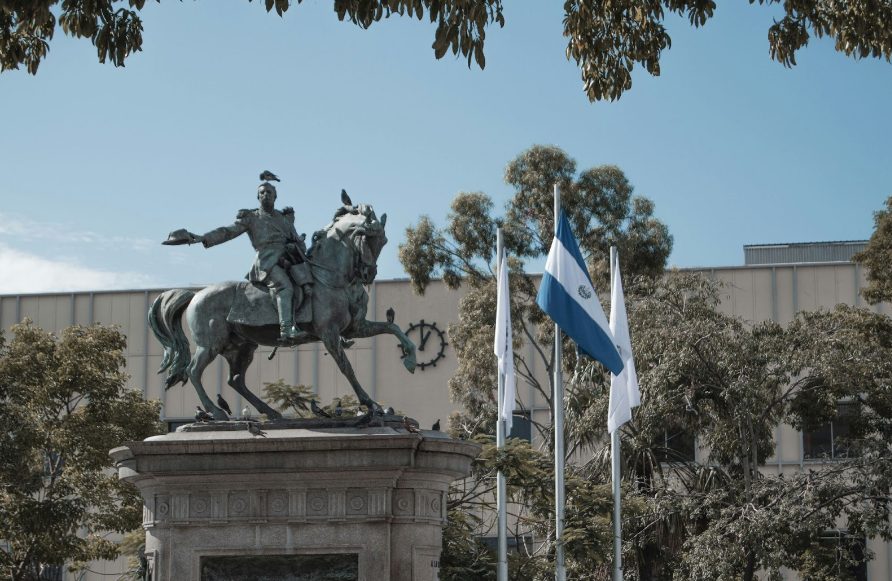
[Cover Image] Photo by Esaú Fuentes González licensed under Unsplash


Leave a comment