
By Taufeeq Nihal Khan.
In 2021, General Abdel Fattah al-Burhan became the de facto ruler of Sudan after seizing power through a coup with the backing of the military. This came just two years after the previous ousting of President Omar al-Bashir following widespread protests. During the 2021 coup, one of Burhan’s main supporters was General Mohamed Hamdan Dagalo, commander of the Rapid Support Forces, or RSF [1]. This paramilitary group was established as a counterinsurgency militia to target dissident movements in the region of Darfur and has been continuously accused of human rights abuses and ethnic cleansing. As Degalo began acquiring economic assets throughout the country, including controlling some of Sudan’s gold mines and key infrastructure, a conflict between both generals soon became inevitable [2].
Fighting eventually broke out in April 2023 after the RSF carried out coordinated attacks on government sites and infrastructure across all Sudan. Most of the capital city of Khartoum quickly fell under the hands of the RSF, forcing the Sudanese military to withdraw and set up base in Eastern Sudan and along the Red Sea coast [3]. As fighting continues, both sides are attempting to secure more support for their respective war efforts. Burhan has stated that he favors the idea of returning to civilian rule, but only under the condition that democratic elections are held. Dagalo has accused Burhan of leading a government of “radical Islamists,” claiming that he and the RSF were “fighting for the people of Sudan to ensure the democratic progress for which they have so long yearned” [1].
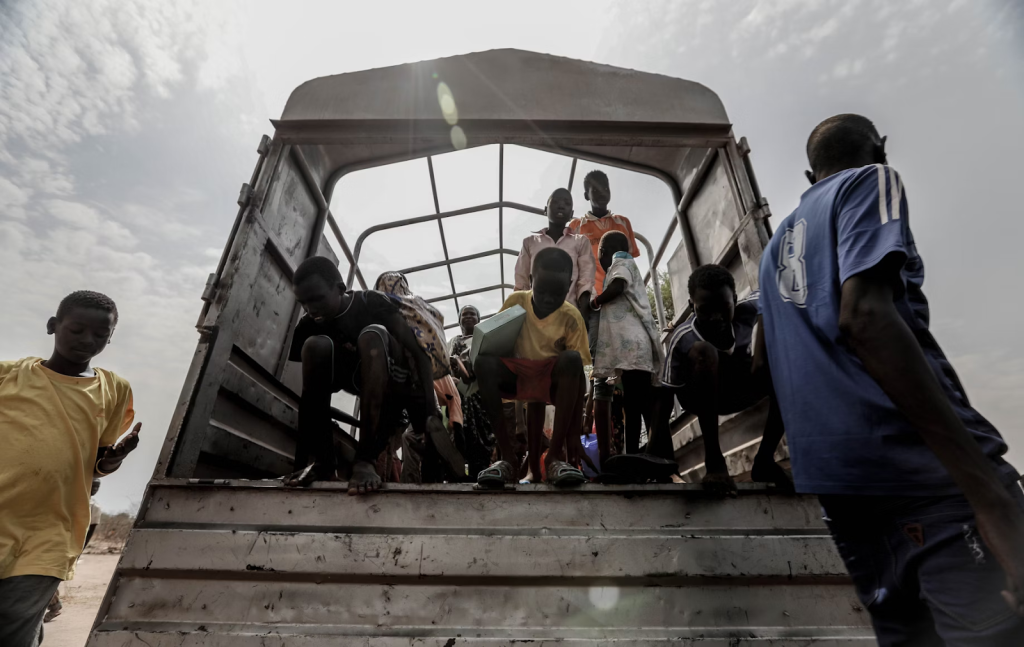
As the war continues to drag on, the country and its population are further plunged into a devastating humanitarian crisis. While direct fighting has left a toll of at least 12,000 deaths, the spillovers on the civilian population are far greater. Indiscriminate attacks on hospitals, schools, and public services has left around 25 million people in need of immediate humanitarian assistance [4]. This has forced a huge exodus inside and out of the country. Reports from the International Organization for Migration (IOM) estimate that more than 10 million people have been forced out of their homes, 90% of whom are currently internally displaced [5].
Recently, Edem Wosornu, director of operations at the UN Office for the Coordination for Humanitarian Affairs, stated that: “By all measures – the sheer scale of humanitarian needs, the numbers of people displaced and facing hunger – Sudan is one of the worst humanitarian disasters in recent memory” [6].
Children are particularly suffering from conflict-related violence, including rape, mutilation, and death. According to UNICEF, around 7.4 million children lack safe drinking water, while nearly 700,000 are currently suffering from extreme malnutrition. Compounding the already precarious situation, deathly diseases (e.g., cholera, dengue, measles, and malaria) have begun spreading due to the lack of hygiene and proper medical attention [7]. This has left most of the children to live a life of constant fear, which will have a severe and long-lasting impact on their mental health and development [8].
In early March 2024, the UN Security Council adopted a resolution calling for an immediate cessation of hostilities in Sudan during the month of Ramadan. While it gained political support from both the African Union and the League of Arab States, fighting shows no signs of ceasing neither in the short nor long run [9]. Without an effective ceasefire, the country and its people will continue to suffer. When the war finally ends, which may take months or even years, the country will be left with a wrecked economy, non-existent political institutions, and a devastated social fabric, perpetuating the cycle of misery for its population [10].
Edited by Justine Peries.
Disclaimer: the views expressed in this article are solely the views of the author, and do not reflect the views of any institutional stances.
References
[1] Ochieng, Beverly. “Sudan: Why has fighting broken out there?” BBC, 24 April 2023, https://www.bbc.com/news/world-africa-65284948. Accessed 25 March 2024.
[2] The Guardian. “What caused the civil war in Sudan and how has it become one of the world’s worst humanitarian crises?” 22 March 2024, https://www.theguardian.com/global-development/2024/mar/22/what-caused-the-civil-war-in-sudan-and-how-has-it-become-one-of-the-worlds-worst-humanitarian-crises. Accessed 25 March 2024.
[3] Rondos, Alex. “After Six Months of Civil War, What’s the State of Play in Sudan?” United States Institute of Peace, 19 October 2023, https://www.usip.org/publications/2023/10/after-six-months-civil-war-whats-state-play-sudan. Accessed 25 March 2024.
[4] Ogao, Emma, and Olivia Osteen. “Sudan faces ‘perfect storm’ as civil war sparks humanitarian crisis, aid groups warn.” ABC News, 22 February 2024, https://abcnews.go.com/International/sudan-faces-perfect-storm-civil-war-sparks-humanitarian/story?id=107440299. Accessed 25 March 2024.
[5] Osman, Mohamed. “Sudan Conflict Fuels World’s Largest Internal Displacement.” Human Rights Watch, 31 January 2024, https://www.hrw.org/news/2024/01/31/sudan-conflict-fuels-worlds-largest-internal-displacement. Accessed 25 March 2024.
[6] Al Jazeera. “Sudan crisis one of the ‘worst humanitarian disasters in recent memory’: UN.” 20 March 2024, https://www.aljazeera.com/news/2024/3/20/sudan-is-one-of-the-worst-humanitarian-disasters-in-recent-memory-un. Accessed 25 March 2024.
[7] UNICEF. “UNICEF Statement: Over 200 days of war leaves a generation of children in Sudan on the brink.” 06 November 2023, https://www.unicef.org/sudan/press-releases/unicef-statement-over-200-days-war-leaves-generation-children-sudan-brink. Accessed 25 March 2024.
[8] Save the Children International. “What is happening in Sudan?” https://www.savethechildren.net/what-we-do/emergencies/what-happening-sudan. Accessed 25 March 2024.
[9] Marsden, Rosalind. “Sudan’s forgotten war: A new diplomatic push is needed.” Chatham House, 14 March 2024, https://www.chathamhouse.org/2024/03/sudans-forgotten-war-new-diplomatic-push-needed. Accessed 25 March 2024.
[10] Royal African Society. “What Will Happen in Sudan?” 19 April 2023, https://royalafricansociety.org/what-will-happen-in-sudan/. Accessed 25 March 2024.


Leave a comment