
By Gauthier Perdereau-Bilski.
While officially declared wars between nations are fewer in contemporary geopolitics, at least in the context of the Middle East, disputes between Lebanon and Israel do manage consistently to escalate into military engagement. The geopolitical relationship that has been going on between these two nations is one of shifting alliances, influenced by non-state actors such as Hezbollah, and foreign interventions headed primarily by Iran and the United States.
These factors fuel instability, as recent fighting has led to increased Israeli bombings, highlighting the fragile nature of any peace that might exist in the region [1]. The 2006 war between Israel and Hezbollah, commonly known as the Second Lebanon War, lasted 34 days and was marked by rocket attacks on Israeli cities by Hezbollah, heavy aerial strikes on southern Lebanon by Israeli forces, and a ground invasion from the south. This conflict caused significant casualties among both civilians and the military, devastated much of Lebanon’s infrastructure, and remains one of the most serious escalations in the long history of hostilities between Israel and Hezbollah. It set a new benchmark for the intensity and brutality of future wars in the region. To this day, it stands as the peak of conflict defining the tense relationship between Lebanon and Israel [2].
Yet, the political aim of Benjamin Netanyahu seems to be the recreation of the 2006 scenario, wishing that the engagement of the Israeli army in a war-which military statements point to as unlikely to bring a positive result-is bound to happen. In 2006, Israel’s military policy witnessed a major change as a result of the region’s dynamic and complicated geopolitical environment [3]. This scenario entailed a burgeoning conflict with the Lebanon-based Hezbollah, axes in flux among regional states, and the roles at play from international actors, most especially the United States and Iran [3]. The interaction of these relationships, coupled with on-going conflicts and the broad dynamic of the Middle East, factored into the military operations and decisions that Israel carried out during this time [4].
But the 2006 hostility, however, viewed by some as a geopolitical setback, shows the nature of asymmetric conflicts; and, for today, 24th of September 2024, the Israeli army knew very well that this situation would not permit precise results or even concrete military success [5]. Despite these reservations, Netanyahu appears willing to lead his country into another similar crisis without popular support or consultation with the army [6]. Actually, Israeli public opinion, though divided, shows some sympathy for the intervention in Lebanon [6]. The consequences have been theatrical: more than 275 people reportedly killed and between 1,000 and 3,000 injured as reported by different sources [7]. One blast killed 37 civilians in Beirut [8].
The military operations by the Israeli Defense Forces (IDF) exceeded immediate strategic military aims while it launched airstrikes against warehouses with ammunition and infrastructure facilities of different types [9]. The civilian fatalities grew sharply and further complicated the situation on the ground. Hezbollah, a Shiite militant organization and a political party in Lebanon heavily supported by Iran, responded by intensifying its rocket attacks. The rockets reached deep into Israeli territory, including major urban centres such as Haifa. The military wing of Hezbollah, which first emerged in the 1980s, has continually used hostilities against Israel; renewed hostility has raised concerns once again about a larger conflict [10].
The recent flare-up has stirred raw emotions in Israel, boosting public support for an all-out ground incursion into Lebanon, as was the case in 2006. That summer, a similar pattern of attacks and counter attacks led to a month-long military conflict between the IDF and Hezbollah. Frustrated by a decade of violence and the constant threat to their north, many in Israel now see invasion as at least one option toward undermining Hezbollah capabilities, though carrying very considerable risks [11].
The governments of China and the United States, among others, have issued a call to withdraw their nationals from Lebanon and Israel in light of the widening war that is rapidly transforming into a thoroughgoing regional disaster [12]. This is just another warning of how quick this conflict has jumped in gravity and unpredictability with growing tensions and an increased possibility for broader international involvement. Issuing these warnings indicates increased danger to human safety in the region [12]. This stoppage of commercial airlines has made the current economic crisis in the Middle East worse because it has affected so many industries related to tourism, trade, and foreign investments. Disruptions in air travel added to the already isolated economies that suffer from failure to control inflation, unemployment, and decaying infrastructure. The economic problems of economies are turning into more severe social unrest and political instability for countries like Lebanon, which is currently going through a huge financial crisis. Such an uncertain era gives regional players like Iran greater opportunity and ease with which to enhance their foothold in the area by using surrogates and especially economic facilitation [13].
On the diplomatic level, Russia expressed its concern about the increasing escalation and warned of the possibility of a prolonged conflict [14]. Meanwhile, India seems to be more engaged with the Palestinian cause than ever, which might seem surprising given the current Indian government’s stance toward its Muslim population. However, India’s support for Palestine is deeply rooted in its historical foreign policy, which has long aligned with the Non-Aligned Movement and championed anti-colonial struggles. Additionally, India’s growing economic and energy ties with the Arab world may explain this renewed focus, despite the domestic tensions related to its Muslim minority [15].
Occupied by the Israeli army at the Al Jazeera headquarters, this is a region that has been the center of focus for the Israeli-Palestinian conflict for an extended period. The West Bank has been allocated along this border between Israel and Jordan and encompasses gigantic challenges within its territory. The region hosts a huge Palestinian population and has been under Israeli occupation since the outbreak of the Six-Day War in 1967 [16]. Israeli control covers large areas, including military zones and settlements, many of which are associated with ongoing violence and political conflict. However, in certain parts of the region, Palestinian authorities have dominance [16].
Senior Israeli generals have spoken in anger about the political stand of Likud (Major right-wing political party in Israel, founded in 1973. It has traditionally promoted free-market policies and a strong national defense, with a focus on security and maintaining Israeli sovereignty) and its leader Prime Minister Netanyahu, saying that what they are facing now-a long-term war on many fronts, together with severe economic hardship-is something that has never taken place in the history of the Israeli military. Both short-term military clashes and economic hardship had been faced by Israel in the past, but never together and with this intensity. A long, multi-front war with high economic pressure are conditions the Israeli military has never seen before [17].
Furthermore, the deployment of improvised explosive devices, characterised by global intelligence agencies as a “well-executed strategic move” aimed at undermining Hezbollah, has ignited significant debate [17]. Although the operation was deemed successful initially, the casualty counts were mixed with regards to favor for the Hezbollah side, as there were relatively few of them. An incursion into southern Lebanon would likely bolster the armed group, a factor that appears to be downplayed by Israeli planners, casting doubt over the rationality of launching a military operation at such an important juncture. This may be more of a political decision than a military one. How would Netanyahu’s use of intelligence serve to justify escalating military operations? The strategy is starting to look like a political ploy to help position himself with increased national standing and, through provocation, American involvement, which is already scaling up with more U.S. military personnel being deployed in the region [18].
The recent round of hostilities between the state of Israel and Hezbollah combined with the operation of the Israeli military in the region have raised many questions regarding the political and strategic motivations of this action. This situation is very complicated and requires profound study. According to army reports, around 400 Hezbollah rocket launchers were targeted across multiple locations, including ammunition warehouses. These launchers were spread out over various sites rather than concentrated in one area. Although some sites were hit, it is quite hard to say whether these attacks were targeted at purely military targets or not [19]. According to Rear Admiral Daniel Hagary, following the detection of preparations by Hezbollah to launch attacks on Israel, the Israeli army, also known as TSAHAL, extended its operations into southern Lebanon [20].The attacks killed 275 and wounded nearly 2,000, including prominent figures such as Ibrahim Akhil, the founder of the elite Al-Radwan unit, a special operations wing of Hezbollah, and leaders of Hamas, a Palestinian militant group and political organization [20].
The tremendous explosions from the Israeli side triggered a panic response among some of the citizens of Lebanon who surrendered their appliances fearing further attacks. The US State Department called for its citizens to leave Lebanon before air transport stopped [21].
The tactics employed by Israel and International Community Response
The situation also worsened in Gaza, where Israeli strikes hit a school hosting refugees, killing at least 22 people, including 13 children and a pregnant woman [2]. The Israeli army maintains that the attack targeted a Hamas command centre [22]. Chilling photographs showing Israeli soldiers removing corpses from the roof of a building on the West Bank also attracted international criticism, with the White House describing the actions as extremely worrying [23]. Israeli politics are unstable with large rallies demanding the resignation of Prime Minister Benjamin Netanyahu. Such rallies point out that really deep popular unhappiness exists with the government failure to end violence and socio-economic troubles. With rising tensions at both domestic and geopolitical levels, many Israelis feel a need for someone to be held accountable for their woes and to bring a change in leadership [23]. The relatives of the hostages held by Hamas are openly accusing Netanyahu of stretching out the clash in a way that would not possibly let the hostages be released. The mother of one of the hostages declared: ‘It is now clear that Mr Netanyahu has opted for a regional escalation and has decided to risk the lives of the hostages in the name of preserving his authority’ [24]. It is a declaration showing growing alienation and discontent in the Israeli population.
Political Analysis on Mr Netanyahu
Mr Netanyahu capitalizes on this scenario to improve his image by taking advantage of such fears that are associated with anti-Zionism [28]. He was able to capitalize on this dynamic for political ends, declaring to the Israeli people: ‘I’m looking after your security’, though his policies have been severely attacked for their lack of efficiency. His record of good relations with the United States, particularly through the American Israel Public Affairs Committee (AIPAC), cements his position as a statesman capable of drawing the world’s sympathy toward him: a matter no other Israeli politician has ever managed to do better [25].
This is unlike past military failures, including that of the 2006 battle. Someone can think about factors that this time can place Israel at an advantage that did not exist in previous attempts. The presence of a strengthened Hezbollah and growing regional tensions create a volatile atmosphere. These airstrikes are no isolated act; instead, they complement a larger trend of regional escalation. Prime Minister Netanyahu seems to employ this issue to give a boost to his political standing, taking much advantage of the resistance against Zionist goals and the present chaos to legitimize his acts [26].
In a nutshell, Netanyahu’s political strategy is characterized by Israeli military operations in the Middle East, raising the question of what his ultimate motivations are. Again, the recent surge in violence does not seem to augur well for neither Israel nor Lebanon, though it may help Netanyahu with his power plays. It is certainly a complicated situation and calls for close analysis of its after-effects on the stability of the region and protection of civilians. The current situation between Israel and Lebanon is involving military, political, and economic dynamics that require constant vigilance. The choices made today might ultimately determine the destiny of stability in this region, and the prospect of a long-standing conflict does not bode well for the future [27].
Edited by Arthur Descazeaud.
Disclaimer
This essay was written on September 24, 2024. Since then, further events have not been taken into consideration and are discussed nowhere in this article. Certain aspects of the above analysis and geopolitical environment may change when current events get consideration.
References
[1] France 24. “Israël intensifie ses frappes au Liban alors que les tensions montent.” France 24, 2024, http://www.france24.com.
[2] Le Monde. “Conflit Israël-Liban : 3 000 blessés et 275 morts dans les frappes.” Le Monde, 2024, http://www.lemonde.fr.
[3] The Guardian. “Israel’s Military Response: Escalating Tensions in the Region.” The Guardian, 2024, http://www.theguardian.com.
[4] Al Jazeera. “Hezbollah Strikes Haifa: A Shift in the Conflict.” Al Jazeera, 2024, http://www.aljazeera.com.
[5] Haaretz. “Netanyahu’s Political Goals Amidst the Conflict.” Haaretz, 2024, http://www.haaretz.com.
[6] The Times of Israel. “Israeli Military Leaders Disagree on Next Steps.” The Times of Israel, 2024, http://www.timesofisrael.com.
[7] Middle East Institute. “Geopolitical Implications of the Israel-Lebanon Conflict.” Middle East Institute, 2024, http://www.mei.edu.
[8] International Crisis Group. “The Israel-Lebanon Tensions: A Historical Perspective.” International Crisis Group, 2024, http://www.crisisgroup.org.
[9] Foreign Affairs. “Regional Dynamics: Israel, Iran, and the New Conflict.” Foreign Affairs, 2024, http://www.foreignaffairs.com.
[10] The Diplomat. “The Role of Russia in the Middle East Conflict.” The Diplomat, 2024, http://www.thediplomat.com.
[11] Reuters. “Humanitarian Crisis in Lebanon: Evacuations Underway.” Reuters, 2024, http://www.reuters.com.
[12] Associated Press. “U.S. Advises Citizens to Leave Lebanon Amid Rising Tensions.” Associated Press, 2024, http://www.apnews.com.
[13] The Hindu. “India’s Position on the Israel-Palestine Conflict.” The Hindu, 2024, http://www.thehindu.com.
[14] The Economic Times. “India’s Changing Dynamics in the Middle East.” The Economic Times, 2024, http://www.economictimes.indiatimes.com.
[15] Al Jazeera. “Hezbollah Strikes Haifa: A Shift in the Conflict.” Al Jazeera, 2024, http://www.aljazeera.com.
[16] The Guardian. “Israel’s Military Response: Escalating Tensions in the Region.” The Guardian, 2024, http://www.theguardian.com.
[17] The Times of Israel. “Israeli Military Leaders Disagree on Next Steps.” The Times of Israel, 2024, http://www.timesofisrael.com.
[18] Haaretz. “Netanyahu’s Political Goals Amidst the Conflict.” Haaretz, 2024, http://www.haaretz.com.
[19] Middle East Institute. “Geopolitical Implications of the Israel-Lebanon Conflict.” Middle East Institute, 2024, http://www.mei.edu.
[20] International Crisis Group. “The Israel-Lebanon Tensions: A Historical Perspective.” International Crisis Group, 2024, http://www.crisisgroup.org.
[21] Associated Press. “U.S. Advises Citizens to Leave Lebanon Amid Rising Tensions.” Associated Press, 2024, http://www.apnews.com.
[22] Reuters. “Humanitarian Crisis in Lebanon: Evacuations Underway.” Reuters, 2024, http://www.reuters.com.
[23] The Hindu. “India’s Position on the Israel-Palestine Conflict.” The Hindu, 2024, http://www.thehindu.com.
[24] The Economic Times. “India’s Changing Dynamics in the Middle East.” The Economic Times, 2024, http://www.economictimes.indiatimes.com.
[25] Haaretz. “Netanyahu’s Political Goals Amidst the Conflict.” Haaretz, 2024, http://www.haaretz.com.
[26] Foreign Affairs. “Regional Dynamics: Israel, Iran, and the New Conflict.” Foreign Affairs, 2024, http://www.foreignaffairs.com.
[27] The Diplomat. “The Role of Russia in the Middle East Conflict.” The Diplomat, 2024, http://www.thediplomat.com.
[28] Aberkane, Idriss J. “Comment le Mossad a fait exploser trois mille bipeurs au Liban | Idriss Aberkane reçoit Eric Denecé.” YouTube, 19 Sept. 2024.
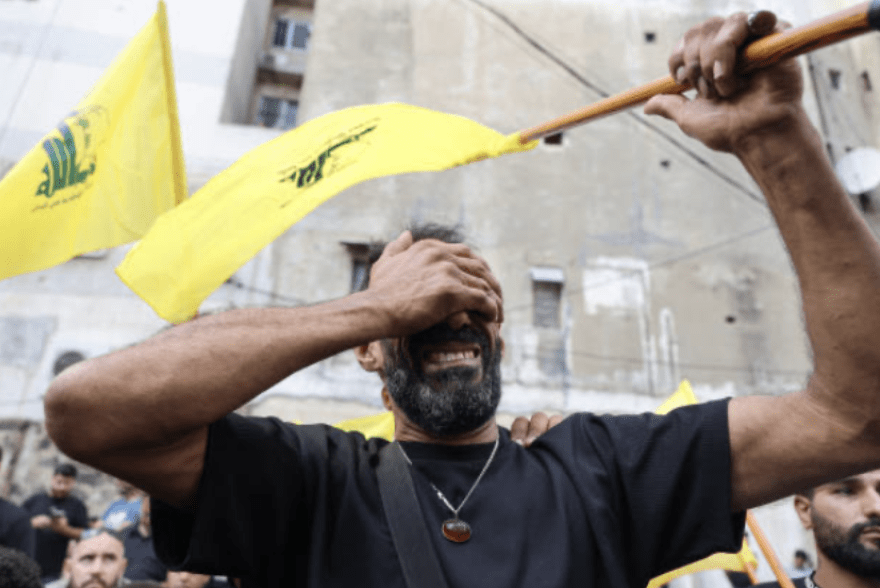
[Cover Image] TOPSHOT – A man reacts while holding a Hezbollah flag during the funeral of people killed after hundreds of paging devices exploded in a deadly wave across Lebanon the previous day, in a south Beirut district, on September 18, 2024. Hundreds of pagers used by Hezbollah members exploded across Lebanon on September 17, killing at least nine people and wounding around 2,800 in blasts the Iran-backed militant group blamed on Israel. (Photo by ANWAR AMRO / AFP).


Leave a comment