
1. Introduction
The architects of platforms such as Facebook, Twitter, Instagram or even Discord probably had no idea what they were really bringing to life. Not only would these platforms gain enormous followings, they would also vary broadly in terms of use.
Today, parents, schools, and States struggle to handle the addictions and other side effects that come with these platforms [1]. As the first generation born into this age, we are the living experiment of these platforms developing. And its founders likely had little idea of how shaping they would become in today’s world. Yet, to be fair, their founders likely had little idea of how much they would end up shaping us and today’s world.
2. Upheaval in Asia
Access to social media is currently creating upheaval in a multitude of countries. Most recently in Nepal, but Bangladesh, Sri Lanka, and Indonesia have faced the same consequences [2]. Other countries with young populations and easy access to social media might be bound for the same fate.
The truth is that, with social media in hand, it is both becoming easier and harder for States to control their people. While certain information and marketing campaigns can censor specific viewpoints and promote others, States also face an enormous stream of civilian media. Media that can go viral within seconds and create ripple effects in States’ interiors [3]. With this power in the hands of civilians, transparency gains a whole other meaning. For instance, a collective people power, or a 5th power of democracy.
3. Inequality as an Agitator
The widespread access, but also use of social platforms is evidently another factor coming into play in discussing the catalyst that is social media. Most users are using these platforms to promote their lives, lifestyles and wealth. This is the missing component and ember needed to spark upheaval in countries with large degrees of wealth inequality [4]. Similar dynamics are visible in Europe, for instance in Romania, where social media has played a controversial role in political mobilisation and interference. Read the International Politics Society’s article here for more details.
To put the income inequality into perspective, according to the Nepal Economic Forum, the 10% richest Nepalis make 26 times that of the poorest 40% [5]. Viewing the lifestyles of government officials and their immediate families online have become fruit for revolution. Contrast stark enough to start a fire. This is exactly what some countries have faced in the last weeks and years [2].
4. An Example from Nepal
Following the same trend, Nepal is the most recent of these countries to experience upheaval. It comes after the State attempted to ban access to all major social media platforms (28 of them) upon failing to register themselves with the government [6].
TikTok, one of the few compliant platforms, was ironically used as a tool for mass mobilisation in Nepal last week [8]. The reason being that TikTok has young users who are just now forming their political views and, persuaded by peers, are willing to take to the streets. This is a product of digital mobilisation and it can have similar implications for other young democracies. It allows young people to become watchdogs of their own governments and unite to fight it. As such, social media is becoming a tool for democracy [3].
What is happening now in Nepal is a wave of insurrection against the corrupt government. By mobilisation online, and hashtags such as #NepoBabies, directed at the children of government officials’ immediate family, young people of Nepal are attempting to challenge the existing abuse of the system and its people [2].
As The Financial Times noted this week, the parliament was set on fire, and left with the inscription: “From now, only Gen Z youth will be in this place. Corrupt leaders will be sent out of the country. Long Live Nepal. Long Live Gen Z youth” [2]. This reveals the general consensus of the revolting youth but has come at a devastating cost. While the police have declared 51 dead, close to 1,500 people are reported to be injured. This might only be the start of a Nepalese attempt to change the rules [2].
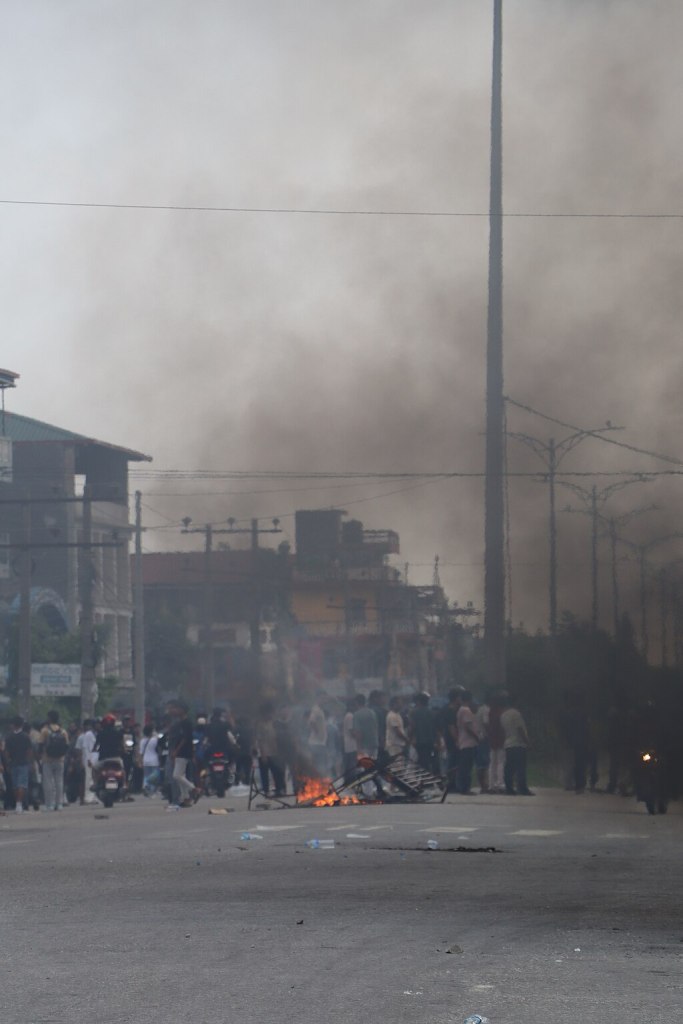
“Nepalese Gen Z protesters in Chitwan District”, 8 Sept. 2025. Photo by Himal Suvedi. Licensed by Wikimedia Commons, CC BY-SA 4.0
The protests gave quick results: Nepali President Ran Chandra Poudel has wiped the government and set elections to March 2026. The ban on social media has also been lifted. In only a couple of days, with the help of digital mobilisation on TikTok, Gen Z protesters were in a successful position to take to the streets and protest against the government and its corruption [7].
5. Social Media as a Revolutionary Catalyst
The complexities created by social platforms are ever more apparent. On one hand these platforms cause nothing but addictions and short attention spans, on the other however, functions as this powerful mobilisation tool and with a watchdog-esque function. Social media platforms are living and breathing, by continuous posts, stories, comments, reels, and likes that create consensus and mobilise masses to take to the streets. It is emerging as a missing piece in the power of the powerless. Mixed with proof of the immense differences between rich and poor, it is becoming so apparent that it has momentum to enrage the lower and middle classes [3]. These platforms increasingly function as the perfect catalyst for revolution.
It is worthwhile to note that on The RSF World Press Freedom Index, Nepal falls to the 90th place, 16 places down since 2024 [8]. Social media can play an active role in counteracting traditional media platforms and their narratives.
6. What Comes Next?
Our generation is still witnessing the evolution of mass media platforms created during our lifetime. While they cause addictions, short attention spans, and even increase in populism, they also function as a catalyst for positive social change. Furthermore, without them, future generations could face far more state repression than seen in the last two decades [9]. Examples from Nepal this week, and other Asian countries in the past years have come to show how effective these tools can be. As Nepal demonstrates, these platforms can shift political trajectories within days. Whether they weaken democracy or enable new forms of unrest in the long-term has yet to be seen.
Edited by Justine Dukmedjian.
References
[1]Chiappa, Claudia, et al. “Kids Are Addicted to Social Media. No One Can Agree on a Solution.” POLITICO, 18 Aug. 2025, www.politico.eu/article/kids-addicted-social-media-no-one-can-agree-solution/.
[2]Schipani, Andres. “Financial Times.” FinancialTimes, 15 Sept. 2025, www.ft.com/content/31ac1faf-9348-4ee1-a129-4be6f9dd002d.
[3]Earl, Jennifer, et al. “The Digital Repression of Social Movements, Protest, and Activism: A Synthetic Review.” Science Advances, vol. 8, no. 10, Mar. 2022, pp. 1–15, https://doi.org/10.1126/sciadv.abl8198.
[4]Bargain, Olivier, et al. “Social Gaps, Perceived Inequality and Protests.” SSRN Electronic Journal, dp. 17769, Mar. 2025, https://doi.org/10.2139/ssrn.5245208.
[5]Pradhan, Mahotsav. “Examining the Dynamics of Wealth and Income Inequality in Nepal.” Nepaleconomicforum.org, 31 Jan. 2024, nepaleconomicforum.org/examining-the-dynamics-of-wealth-and-income-inequality-in-nepal/.
[6]Desk, TOI Tech. “Nepal Bans Facebook, Twitter, WhatsApp and 23 Other Social Media Platforms, Here’s Why.” The Times of India, The Times Of India, 5 Sept. 2025, timesofindia.indiatimes.com/technology/tech-news/nepal-bans-facebook-twitter-whatsapp-and-23-other-social-media-platforms-heres-why/articleshow/123711022.cms.
[7]Ellis-Petersen, Hannah. “At Least 19 Killed in ‘Gen Z’ Protests against Nepal’s Social Media Ban.” The Guardian, The Guardian, 8 Sept. 2025, www.theguardian.com/world/2025/sep/08/nepal-bans-26-social-media-sites-including-x-whatsapp-and-youtube.
[8]Reporters without Borders. “World Press Freedom Index.” Rsf.org, Reporters without Borders, 2025, rsf.org/en/index.
[9]Schleffer, Guy, and Benjamin Miller. “The Political Effects of Social Media Platforms on Different Regime Types.” Texas National Security Review, 2021, tnsr.org/2021/07/the-political-effects-of-social-media-platforms-on-different- regime-types/.
[Cover image] “Nepalese Gen Z protesters in front of Bharatpur Mahanagarpalika office” (https://commons.wikimedia.org/wiki/File:2025_Nepalese_Gen_Z_protesters_infront_of_Bharatpur_mahanagarpalika_office.jpg) by Himal Suvedi, licensed under Wikimedia Commons, CC BY-SA 4.0.
[2sd image] “Nepalese Gen Z protesters in Chitwan District” (https://commons.wikimedia.org/wiki/File:2025_Nepalese_Gen_Z_protesters_in_Chitwan_District.jpg) by Himal Suvedi, licensed under Wikimedia Commons, CC BY-SA 4.0.


Leave a comment