
Over the past few years, India’s trade strategy has shifted from caution to acceleration. A flurry of Free Trade Agreements (FTAs) has been negotiated and signed: with the UAE (a Comprehensive Economic Partnership Agreement in force since May 2022) [1] and Australia (an interim Economic Cooperation and Trade Agreement in force since December 2022) [2], reopening trade lanes even as talks with larger partners progressed. In March 2024, India concluded a Trade and Economic Partnership Agreement (TEPA) with the EFTA bloc (Switzerland, Norway, Iceland and Liechtenstein) [3] after 16 years of negotiations. That pact is scheduled to take effect on 1 October 2025. Most recently, India and the United Kingdom inked a long-awaited free trade agreement [4] on 24 July 2025, featuring a standalone chapter on labour. These new deals build upon older FTAs with ASEAN, Japan, Korea, Singapore and others, but break new ground by linking trade access to labour standards.
Two aspects of the latest agreements stand out from a labour policy perspective. First, the EFTA–India TEPA pairs its tariff cuts with commitments on Trade and Sustainable Development [5], binding both sides to uphold environmental and labour protections. In essence, it contains a “non-regression” clause ensuring neither side weakens or waives labour laws to boost trade. Swiss officials emphasised that the deal reaffirms both party’s obligations under international labour treaties, “to ensure that neither the environmental and labour legislation of the partner countries nor international … social laws are violated in connection with the agreement,” underscoring that market access comes with maintaining labour standards. Second, the new UK–India FTA goes even further with a dedicated Labour Chapter [6]. Both countries commit to effectively enforcing their labour laws and to uphold the core principles of the International Labour Organisation (ILO). Notably, they promise not to “selectively disapply” or weaken labour protections to gain a trade advantage. These labour provisions signal that fair work practices are now firmly embedded in India’s trade agenda.
It’s no coincidence that these pacts were concluded just as global norms are tightening. The European Union’s new due diligence duty (CSDDD) obliges large companies operating in the EU to identify, prevent, mitigate, and remediate human rights and labour risks throughout their supply chains [7]. In effect, European buyers will be legally required to vet and monitor the labour conditions of their overseas suppliers. Put together, these trade winds blow straight through the factory gate: India’s major export markets are telling suppliers that access depends on treating workers fairly and proving it.
The State of Play in India’s Labour Reforms:
On paper, India has undertaken the most sweeping labour reforms in decades. Between 2019 and 2020, Parliament consolidated 29 central labour laws [8] into four comprehensive Labour Codes—on Wages, Industrial Relations, Social Security, and Occupational Safety, Health & Working Conditions (OSH). The aim was to simplify and modernise outdated regulations. However, passing laws was only half the battle. Under India’s federal setup, labour is a concurrent subject, meaning both the Union and state governments must frame corresponding rules under each code before the new system can take effect nationwide [9]. As of now, that process remains incomplete. The Labour Ministry informed Parliament in July 2025 that 32 States/UTs have pre-published draft rules under the four Codes. (Delhi had drafted rules only for the Wage Code, West Bengal and Lakshadweep hadn’t published any as of that date, and Tamil Nadu was still pending its Social Security Code rules). In short, much of the new legal framework is still stuck between Gazette and ground, not yet enforced in workplaces.
Let’s have a quick tour through these labour codes to see what’s beneath the surface:
The Code on Wages of 2019 extends the legal coverage of minimum wages to all industries (not just a scheduled list) and standardises the definition of “wages” for consistency. It also empowers the central government to set a national floor wage [10]. This has been set to reduce vast disparities across states. However, crucial provisions of this Code, including the section enabling a statutory floor wage, are not yet in force [11]. Thus, there is still no binding national floor wage today. Each state’s minimum wage stands on its own, often unevenly.
The Industrial Relations Code of 2020 consolidates laws on trade unions, layoffs and dispute resolution. It also legalises fixed-term employment contracts and mandates a reskilling fund for retrenched workers. However, these changes also await actual notification. Until the Code is brought into effect, the older Industrial Disputes Act framework technically still rules on the ground [12].
The Social Security Code of 2020 aims to universalise social protection. It extends the provident fund, pension, insurance and maternity benefit laws to cover unorganised workers and, notably, recognises gig- and platform-workers for the first time in Indian law. The Code provides for a Social Security Fund and stipulates that aggregators (food delivery apps, ride-sharing platforms, etc.) contribute 1–2% of their annual turnover (capped at 5% of the wages paid to gig workers) to finance schemes for these workers [13].
The Occupational Safety, Health and Working Conditions (OSH) Code of 2020 consolidates 13 existing laws (including the Factories Act, Mines Act, etc.) into one, with a goal of improving workplace safety and health standards. It streamlines factory registration and inspection, and explicitly permits women to work night shifts in all industries, so long as employers ensure safety measures, and take written consent [14].
The Implementation Gap: India’s Labour Laws vs. Ground Reality
The challenge and opportunity facing India can be summed up in a single statistic: around 90% of India’s workers are informal. According to the ILO’s India Employment Report 2024, roughly 82% of workers are employed in the informal sector (small or unregistered enterprises), and including informal workers within the formal sector, nearly 90% of all Indian workers lack secure contracts or social protection [15]. That is not a rounding error: for these tens of crores of workers, labour laws often exist only on paper. Minimum wage rates, limits on hours, safety requirements, social security provisions are frequently unmet or unenforced in the vast informal economy.
Even the enforcement of basic safety standards remains patchy. India’s National Human Rights Commission noted in early 2023 that on average three workers died and 11 were injured each day in registered factories across the country between 2017 and 2022 [16]. Such accidents not only cause human suffering, but also attract increasing global scrutiny.
Delays in operationalising the Wage Code have also kept India’s wage compliance uneven. The minimum wage for an unskilled worker can be less than ₹200 (under €2) per day in some states while in other states it may be double [17]. The new trade agreements cannot directly change India’s labour law enforcement, but they raise the cost of inaction. The EFTA deal, for instance, includes a headline pledge of $100 billion in investment and one million jobs over 15 years [18]. To sustain that kind of investment and export growth, India will need to demonstrate that those million jobs will be “decent work” by ILO standards.
Meanwhile, the labour market itself is evolving faster than regulations. Gig economy employment (ranging from food delivery to app-based drivers and freelancers) has certainly surged, especially since the pandemic [19]. Recognising this, the government launched the e-Shram portal in 2021 as a national database for unorganised workers. As of August 2025, over 309.5 million unorganised workers had registered on e-Shram [20]. Importantly, this includes over 337,000 self-identified gig and platform workers [21], and the Labour Ministry has onboarded a dozen major gig platforms as official “aggregators” sharing data with the portal [22]. This creates an infrastructure for portability of benefits [23]. At present, however, these remain pipes with relatively little water in them. The budget announced health insurance coverage for gig workers under the Ayushman Bharat scheme [21], but roll-out has been slow. The coming years will be crucial to see if e-Shram registration translates into tangible social security on the ground.
Another area of both progress and unfinished business is women’s employment. Notably, female labour force participation in India has been rising from historic lows. The latest official survey showed the women’s LFPR rose to 41.7% in 2023–24, up from just 23.3% in 2017–18 [24]. This signifies millions more women entering or seeking paid work, many for the first time. The OSH Code’s provisions allowing women to work night shifts with consent were forward-looking in anticipation of this trend. Now, the challenge is to ensure their safety and dignity at work.
Lastly, there is the issue of worker voice and representation. India has yet to ratify ILO Conventions No. 87 (Freedom of Association) and No. 98 (Right to Collective Bargaining) [25]. The labour reforms did not significantly strengthen collective bargaining rights, and in some cases (such as raising the threshold for needing to seek retrenchment permission) arguably weakened union influence. Trade partners have typically been cautious on this front, but in changing times, buyers want assurance that workers can raise concerns safely and resolve disputes, so that production isn’t disrupted by wildcat strikes or protests born of desperation. This implies that global firms prefer suppliers with functioning grievance mechanisms or worker committees.
The Enforcement Dividend
So, what do FTAs actually change? Not India’s sovereignty over labour rules but the cost of inconsistency. The EFTA chapter’s non-regression clause, the UK deal’s emphasis on effective enforcement, and EU-style due diligence rules carry a common message: it’s not enough to have laws, you must apply them consistently and demonstrate compliance. For Indian exporters, that means better contracts, cleaner subcontracting, documented safety and wage practices, grievance logs, worker committees, basically the nuts and bolts of compliance that auditors can verify. For governments, it means moving beyond headline reforms to effective inspections, data collection, and remedies.
India’s problem is not the lack of laws. It suffers from the gap between statute and shop floor. FTAs are narrowing that gap by making fair work a condition of trade, not a CSR afterthought. If India leverages its FTAs and global goodwill to drive internal changes, i.e., activating the labour codes, investing in enforcement, and expanding social protections, it will not only honour the letters of those agreements but also improve the lives of millions of workers who are the backbone of its economy. The coming years will tell if trade policy and labour policy, often seen as being in tension, can in fact sing the same tune. The score has been written in these recent agreements; now it’s time to perform it, in factories and farms across the country for the world to hear.
Edited by Jules Rouvreau.
References
[1] Ministry of Commerce and Industry, Government of India. (n.d.). Comprehensive Economic Partnership Agreement (CEPA) between the Government of the Republic of India and the Government of the United Arab Emirates (UAE). https://www.commerce.gov.in/international-trade/trade-agreements/comprehensive-economic-partnership-agreement-between-the-government-of-the-republic-of-india-and-the-government-of-the-united-arab-emirates-uae/
[2] Ministry of Commerce and Industry, Government of India. (n.d.). India-Australia Economic Cooperation and Trade Agreement (INDAUS ECTA) between the Government of the Republic of India and the Government of Australia. https://www.commerce.gov.in/international-trade/trade-agreements/ind-aus-ecta/
[3] European Free Trade Association (EFTA). (n.d.). Trade and Economic Partnership Agreement between India and EFTA states. https://www.efta.int/trade-relations/free-trade-network/india
[4] Government of the United Kingdom. (n.d.). UK-India Trade Deal. https://www.gov.uk/government/collections/uk-india-trade-deal
[5] European Free Trade Association (EFTA). (n.d.). EFTA–India Trade and Economic Partnership Agreement: Chapter-by-chapter factsheet. https://www.efta.int/sites/default/files/documents/legal-texts/free-trade-relations/india/EFTA-India%20Trade%20and%20Economic%20Partnership%20Agreement%20-%20Chapter%20by%20Chapter%20Factsheet.pdf
[6] Government of the United Kingdom. (n.d.). UK-India CETA Chapter 20: Labour. https://www.gov.uk/government/publications/uk-india-ceta-chapter-20-labour
[7] European Commission. (n.d.). Corporate sustainability due diligence. https://commission.europa.eu/business-economy-euro/doing-business-eu/sustainability-due-diligence-responsible-business/corporate-sustainability-due-diligence_en
[8] Ministry of Labour and Employment, Government of India. (n.d.). Labour Codes. https://labour.gov.in/labour-codes
[9] Ministry of Labour and Employment, Government of India. (n.d.). Implementation of labour codes. https://labour.gov.in/sites/default/files/pib2147926.pdf
[10] Ministry of Labour and Employment, Government of India. (2019). The Code on Wages, 2019. https://labour.gov.in/sites/default/files/the_code_on_wages_as_introduced.pdf
[11] Rajya Sabha. (2024). Final report on floor wages and its implementation. https://rsdebate.nic.in/bitstream/123456789/747949/1/PQ_263_08022024_U735_p321_p321.pdf
[12] Ministry of Labour and Employment, Government of India. (2020). The Industrial Relations Code, 2020. https://labour.gov.in/sites/default/files/ir_as_passed_by_lok_sabha.pdf
[13] Press Information Bureau (PIB), Government of India. (2024, June 20). Social security benefits to gig workers. https://www.pib.gov.in/PressReleaseIframePage.aspx?PRID=1944372
[14] Ministry of Labour and Employment, Government of India. (2020). The Occupational Safety, Health and Working Conditions Code, 2020. https://labour.gov.in/sites/default/files/osh_gazette.pdf
[15] International Labour Organization (ILO). (2024). India employment report 2024: Youth employment, education and skills. https://www.ilo.org/sites/default/files/2024-08/India%20Employment%20-%20web_8%20April.pdf
[16] National Human Rights Commission (NHRC), India. (2024). NHRC notices to the Centre, States and Union Territories over the reported high death rate of workers in registered factories. https://nhrc.nic.in/media/press-release/nhrc-notices-centre-states-and-union-territories-over-reported-high-death-rate
[17] India Briefing. (2025). A guide to minimum wage in India in 2025. https://www.india-briefing.com/news/guide-minimum-wage-india-19406.html/
[18] Press Information Bureau (PIB), Government of India. (2024, May 10). India-EFTA Trade and Economic Partnership Agreement. https://www.pib.gov.in/PressReleaseIframePage.aspx?PRID=2013169
[19] International Labour Organization (ILO). (2023). Expansion of the gig and platform economy in India: Opportunities for employer and business member organizations. https://www.ilo.org/publications/expansion-gig-and-platform-economy-india-opportunities-employer-and
[20] Ministry of Labour and Employment, Government of India. (2024). Over 30.95 crore unorganised workers registered on e-Shram portal. https://labour.gov.in/sites/default/files/pib2149351.pdf
[21] Press Information Bureau (PIB), Government of India. (2024, July 5). Social security boost for India’s gig workers. https://www.pib.gov.in/PressNoteDetails.aspx?NoteId=155119&ModuleId=3
[22] Press Information Bureau (PIB), Government of India. (2025). e-Shram platform enhancements. https://www.pib.gov.in/PressReleseDetailm.aspx?PRID=2155172#:~:text=Ministry%20has%20launched%20the%20Platform,Ecom%20Express%20and%20Uncle%20Delivery
[23] Ministry of Labour and Employment, Government of India. (n.d.). Improve ease of doing business. https://labour.gov.in/policies/improve-ease-of-doing-business
[24] Press Information Bureau (PIB), Government of India. (2025). Periodic Labour Force Survey (PLFS) annual report. https://www.pib.gov.in/PressReleasePage.aspx?PRID=2057970
[25] International Labour Organization (ILO). (n.d.). Up-to-date conventions and protocols not ratified by India. https://normlex.ilo.org/dyn/nrmlx_en/f?p=NORMLEXPUB:11210:0::NO::P11210_COUNTRY_ID:102691
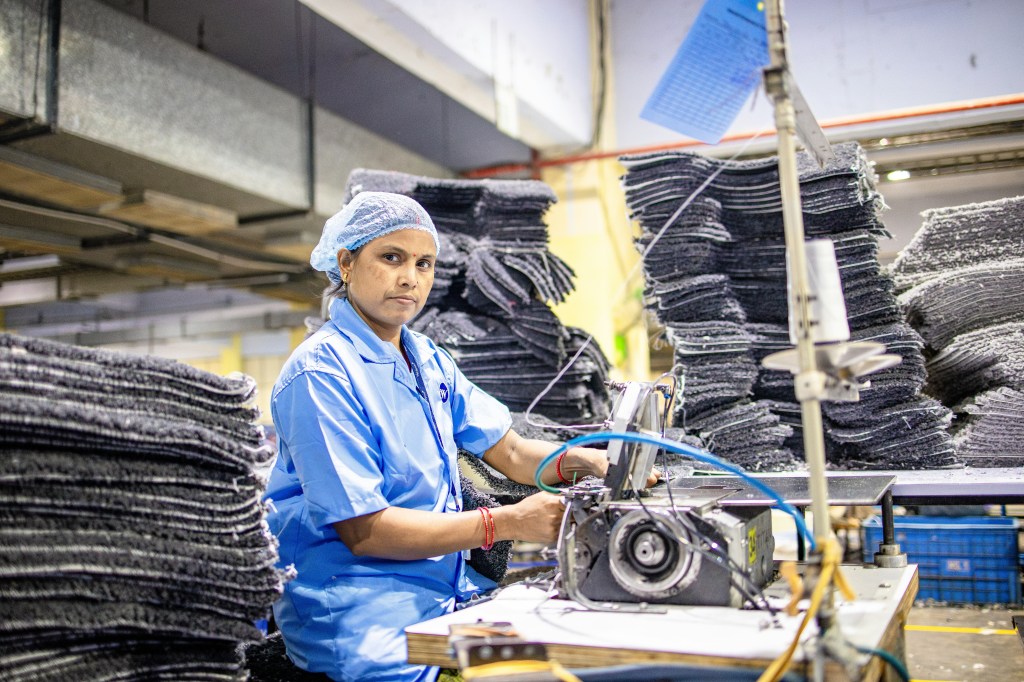
[Cover image] “Woman working in a factory using a sewing machine”, 2025 (https://unsplash.com/photos/woman-working-in-a-factory-using-a-sewing-machine-uEb_cV7RE0Q) by Equal stock (https://unsplash.com/@equalstock) licensed under Unsplash.com.


Leave a comment