
By Alix Poncet
Since the Paris Agreement of 2015, a central question has come to define international economic governance: who will finance the transition to a low-carbon and climate-resilient global economy? Article 2.1(c) of the Paris Agreement does not merely elevate environmental ambition; it reimagines the very purpose of finance by requiring capital flows to align with sustainable development pathways [1]. Meeting this objective demands having institutions able to deploy capital at scale, withstand short-term pressures and act with a long-term perspective anchored in legitimacy and public interest. Sovereign wealth funds and public pension funds, together managing well over USD 100 trillion worldwide, have thus emerged as pivotal actors in both global financial markets and the financing of national economies.
The urgency of the investment challenge is stark. The International Energy Agency estimates that annual global clean energy investment must rise from around USD 1.8 trillion in 2023 to approximately USD 4.5 trillion by the early 2030s to sustain a 1.5 °C trajectory [2]. Emerging and developing economies alone will require more than USD 1 trillion each year to build the infrastructure required for their ecological transitions [3]. Private finance will remain essential, yet market forces on their own are unlikely to close this gap. What has come into view instead is a widening divergence between the pace of the transition and the capacity of the global financial system to allocate capital at the scale and speed required, prompting the emergence of a new diplomacy of climate finance – one designed to bridge public capital, market mechanisms and environmental imperatives.
It is in this context that President Emmanuel Macron launched the One Planet Sovereign Wealth Funds (OPSWF) initiative in Paris on 12 December 2017, together with leading global funds such as the Public Investment Fund of Saudi Arabia, Mubadala of the United Arab Emirates, Norges Bank Investment Management of Norway, the Qatar Investment Authority, the Kuwait Investment Authority and the New Zealand Superannuation Fund [4]. The initiative advances a dual rationale: aligning sovereign capital with long term climate goals to protect value and macro-financial stability, while leveraging shareholder influence to drive corporate decarbonisation and transparency. Built upon three guiding principles of Alignment, Ownership and Integration, the OPSWF framework has since evolved into a recognised benchmark of responsible sovereign investment and a cornerstone of the emerging architecture of climate governance. It embodies a form of economic statecraft in which State-owned capital is strategically mobilised to accelerate the decarbonisation of the global economy, support long term economic development and safeguard intergenerational prosperity.
Sovereign Capital as a Catalyst for Low-Carbon Investment
From an economic perspective, the OPSWF initiative represents a direct response to well-known market failures in climate finance. Low-carbon infrastructure typically demands high capital expenditure, long investment horizons and exposure to uncertain policy environments, features that tend to discourage short-term private capital. Sovereign wealth funds, in contrast, are expressly designed to deploy patient capital and absorb volatility. They form part of a wider category of “principal investors” that includes public pension funds, family offices and endowments, which together manage USD 36 trillion and are expected to grow at a compound annual growth rate of 6% through 2030 [5]. Their structural resilience positions them as market anchors capable of crowding in private investment, especially in emerging economies where financing gaps are widest. The Paris Summit reaffirmed this catalytic capacity through the introduction of operational tools such as the Value Creation Framework and the Greening Real Estate Playbook, designed to reduce risk, enhance efficiency and strengthen resilience throughout the investment life cycle [4].
Institutionally, OPSWF operates as a collective risk-mitigation platform, consolidating expertise from sovereign wealth funds, global asset managers and private equity firms representing more than USD 48 trillion in assets [6]. This “community of practice” enhances credibility and signals power, demonstrating that climate alignment is not only compatible with fiduciary responsibility but increasingly a determinant of investment performance, as confirmed by the Joint Communiqué reporting that 70 % of sovereign funds consider the integration of climate factors to enhance long-term risk-adjusted returns [6]. The Boston Consulting Group observes a structural shift in the strategies of principal investors: their allocations to private markets have increased on average by 10% per year over the past decade, and they now control up to 70% of global private market assets [5]. As financial engineering loses potency, principal investors are prioritising operational value creation, co-investing and direct investments to influence outcomes more actively. In this sense, OPSWF represents not only a forum for knowledge sharing, but a powerful accelerator of strategic investment transformation.
Viewed through the lens of social science, OPSWF also responds to the evolving legitimacy expectations surrounding state-owned investors. Historically associated with limited transparency, sovereign wealth funds are now obliged to demonstrate societal contribution, intergenerational stewardship and accountability aligned with climate action. By embedding principles of Alignment, Ownership and Integration into governance practice, OPSWF advances this evolution and establishes soft standards with tangible normative influence [6]. According to the Communiqué, three-quarters of participating funds systematically integrate climate considerations into investment decisions, and nearly 70 % regard climate-aligned strategies as key to portfolio resilience. This aligns with a broader movement identified by BCG, in which principal investors adopt “double-bottom-line” mandates combining financial returns with national development priorities and climate ambitions, while taking a more visible public role in shaping markets [5]. The implications extend beyond climate finance: sovereign wealth funds are becoming critical partners in funding the industrial and strategic transformation of economies such as France, where ambitions for re-industrialisation, technological sovereignty and infrastructure decarbonisation exceed the fiscal capacity of the state.
Leveraging Sovereign Wealth Funds and Public Pension Funds to Finance the French Economy
Faced with a structural budgetary deficit and a shrinking share of domestic savings, France must call on new sources of long-term capital to finance its industrial and ecological transformation. The public narrative increasingly focuses on attracting foreign institutional investors. Two categories stand out: sovereign wealth funds (SWFs) and public pension funds (PPFs). Each presents distinct features but also complementary advantages for financing the French economy at scale.
France’s investment requirements are substantial. Under the France 2030 plan and associated industrial policy, the government has earmarked a €100 billion investment programme, equal to roughly one third of the annual State budget, to transform production models, infrastructure and training [7]. Further, analysis shows that over the next fifteen years the cumulative need for infrastructure investment in energy, transport and nuclear amounts to around €500 billion – including approximately €100 billion for electrical networks, €100 billion for rail transport, €220 billion for general transport infrastructure and €67 billion for six new EPR2 nuclear reactors (excluding further units) [7]. The French economy must therefore mobilise tens of billions of Euros annually from non-State sources. On the climate side, EU research indicates the European Union already invests only €498 billion annually in 2023 while the annual requirement to meet 2030 targets is roughly €842 billion – leaving a €344 billion annual shortfall. For France this gap translates into large unmet needs in retrofit, low-carbon infrastructure and reindustrialisation under global technological competition [7].
Public pension funds now manage a global asset pool of roughly USD 58.5 trillion as of 2024 [8]. In the OECD area alone pension assets have grown to 92 % of GDP at end-2024 [9]. These funds are increasingly allocating to long-duration, infrastructure and climate-aligned assets. For example, large pension funds in infrastructure reported allocations of 4.1 % of assets in 2018 and the numbers are growing. Given their size, long-term liabilities and need for real‐asset returns, PPFs offer a significant pool of capital suited to France’s needs: large, stable investments in hard infrastructure, green energy, mobility and digital scale-ups.
For France, tapping into PPFs means accessing capital with minimal sovereignty risk (compared to strategic-State investors) and aligning with markets rather than national agendas. The article by the Institut Montaigne highlights that France has lagged neighbours in attracting foreign pensions: their capital could become a major lever for long-term investment in French infrastructure and industry.
Sovereign wealth funds also represent large pools of patient capital. Though their motivations may include strategic State interests, in many cases they seek stable long-term returns and have growing mandates to invest in low carbon infrastructure, technology and renewables. For France, SWFs can bring large-scale investment into high-capex sectors like nuclear, large-scale storage or green hydrogen – sectors beyond the risk appetite of many commercial investors. For instance, President Macron announced private-sector-only investments in AI of €109 billion in early 2025, including commitments from foreign funds and partnerships. SWFs, with sovereign backing, can support such scale [7].
In sum, the combination of PPFs and SWFs could finance four strategic French priorities:
- Reindustrialisation and economic sovereignty: investing in advanced manufacturing, semiconductors, AI infrastructure and defence, where France needs patient capital and strategic backing.
- Ecological transition: deploying capital in large-scale infrastructure – energy grids, rail, nuclear, green hydrogen – that require several-tens of billions of Euros per year.
- Scale-up financing and technological competition: developing French “champions” in AI, digital platforms and clean technology requires long-term support beyond venture capital.
- Reducing public sector burden: with public finances under pressure, leveraging institutional investors shifts part of the cost of the transition off the State balance sheet while preserving the public mission.
Mobilising sovereign wealth funds and public pension funds to finance large-scale transition infrastructure will only succeed if capital is allocated to projects capable of demonstrating credible long-term returns. In other words, the economic viability of the ecological transition depends on treating decarbonisation not as a constraint but as a source of value creation.
Climate as a Vector of Value Creation
Climate alignment has clearly shifted from a compliance obligation to a profit engine. Market evidence shows that 70% of institutional investors, representing more than USD 3.6 trillion, now embed climate criteria into value-creation plans, and 77%, managing USD 3.9 trillion, use decarbonisation as an active lever of performance [10]. Corporate demand reinforces this: over 70% of Fortune Global 500 companies have formal emissions-reduction targets, and climate-labelled products generate an average 12.5% increase in first-year sales, while 23,000 firms have already achieved USD 13.5 billion in operational savings through energy efficiency and supply-chain optimisation [10].
The financial upside is increasingly quantifiable. Industrial case studies show that decarbonisation programmes can deliver EUR 26 million in EBITDA gains within three years and economic modelling suggests climate-aligned firms may exhibit up to 20% higher profitability than non-aligned peers [10]. This performance is driven through three mechanisms: cost reductions (lower energy use and regulatory exposure), opportunity capture (premium pricing and market share in low-carbon segments) and improved adaptive capacity (resilience to supply-chain and policy shocks).
As a result, carbon efficiency has become a determinant of revenue, investment attractiveness and long-term competitiveness. For sovereign wealth funds and public pension funds, the conclusion is strategic: accelerating portfolio decarbonisation is no longer primarily about avoiding downside risk – it is a pathway to durable value creation, innovation and macroeconomic resilience.
The Paris 2025 Summit: Strategic Direction
The 8th OPSWF CEO Summit, held in Paris on 21–22 October 2025, marked a step in the institutionalisation of sovereign climate finance diplomacy.
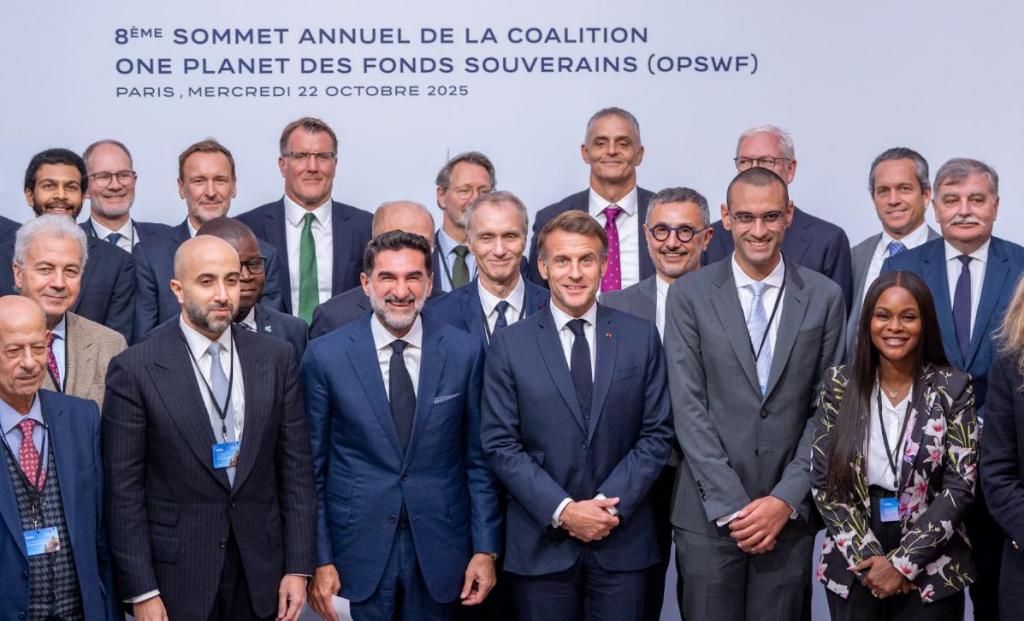
8th annual One Planet Sovereign Wealth Funds. Elysee Palace, 23th October 2025. [Rights Granted to Alix Poncet]
The event convened more than 80 institutions representing approximately USD 48 trillion in assets – around 40% of global equity market capitalisation – at the Quai d’Orsay and the Élysée Palace to advance a shared agenda linking climate action, financial performance and technological transition.
Structured around four pillars – climate-driven value creation, AI and sustainability, renewables in emerging markets, and natural capital – the Summit delivered operational tools such as the Value Creation Framework, demonstrating how decarbonisation can generate up to 20% EBITDA uplift, and the AI Sustainability Handbook, promoting data-driven transition strategies. It also launched the Green Capital Bridge, a co-investment platform targeting USD 100 billion to deploy 131 GW of renewable capacity in Africa by 2030, signalling the scale of sovereign capital mobilisation into global transition needs [11].
In his address to the assembled CEOs, President Emmanuel Macron stressed that economic competitiveness and climate transition are now structurally inseparable, and that OPSWF members play an increasingly significant role in shaping global capital flows toward strategic priorities. He acknowledged the progress achieved – improved cost-competitiveness of renewables, rising contribution of nuclear power, and industrial decarbonisation within Europe – while noting that hard-to-abate sectors such as real estate and heavy mobility require renewed investment focus [11].
President Macron identified two pressing challenges: the persistent dependence of many emerging economies on coal, and China’s dominant position within key clean-tech value chains, both accentuated by geopolitical tensions and diverging climate commitments among major economies. Importantly, when the President refers to the need to “de-risk” economies, he does not advocate for isolation or the abrupt severing of interdependencies. Rather, his message centres on improving the composition of economic relations: reducing excessive exposure to any single actor, diversifying partnerships, and promoting new forms of cooperation capable of enhancing resilience. In other words, de-risking is conceived as a way to balance dependencies, not to eliminate them, thereby reinforcing strategic autonomy while sustaining openness to global capital and innovation [11].
President Macron’s leadership in mobilising sovereign wealth funds for climate action and economic financing does not so much contradict France’s pursuit of economic and technological sovereignty as it reflects the strategic balance required in a globalised transition economy. By promoting international capital flows toward low-carbon infrastructure and reindustrialisation, France seeks to accelerate investment beyond what its public finances alone can sustain. At the same time, updated French investment-screening rules [12] ensure that foreign participation does not compromise control over critical technologies, defence-related capabilities or essential infrastructure. In this sense, Macron’s engagement with sovereign investors complements rather than undermines the sovereignty agenda described in the Draghi Report: foreign capital is welcome when it strengthens national and European strategic autonomy, and channelled away from domains where it might create new dependencies. Rather than a paradox, this dual strategy embodies a form of cooperative sovereignty – leveraging global partnerships to enhance competitiveness and resilience, while retaining decision-making power over the assets that define France’s and Europe’s long-term sovereignty.
Sovereign Capital as a Foundation for a Cooperative and Competitive Transition
This article has demonstrated that sovereign wealth funds and public pension funds now stand at the centre of a historic reorientation of global finance. Since the Paris Agreement, the question has evolved from whether capital should align with climate objectives to how it can do so in a way that delivers shared prosperity. The OPSWF initiative illustrates that when long-term sovereign investors coordinate their actions and adopt common standards, they can not only correct market failures but also accelerate innovation, competitiveness and resilience in the transition to a low-carbon global economy.
The opportunities created by this shift are considerable. Far from being constrained by climate ambition, sovereign investors are discovering new sources of value creation, enhanced macroeconomic stability and leadership in emerging sectors – from renewable infrastructure to artificial intelligence supporting decarbonisation. Importantly, the evolution of sovereign capital is taking place within a broader movement toward responsible stewardship: greater transparency, improved governance, and growing attention to environmental and societal outcomes. These trends show that sustainable investment is becoming a marker of financial excellence, not a deviation from fiduciary duty.
France has played a pioneering role in this transformation, shaping the OPSWF as a platform of constructive climate diplomacy and demonstrating that financial innovation can be aligned with the public interest. At a time when Europe faces heightened geopolitical competition and profound industrial challenges, mobilising sovereign wealth funds and public pension funds offers a way to reinforce economic sovereignty without retreating into isolation. Instead, it encourages strategic partnerships, co-investment models and the pooling of expertise to generate benefits at continental and global scale.
The way forward is clear: strengthening international cooperation must accompany the deployment of sovereign capital. Three priorities should guide this agenda. First, enhance governance frameworks that ensure climate alignment is measurable, credible and translated into real-economy outcomes. Second, expand collaborative de-risking mechanisms that unlock investment in high-impact regions, particularly emerging economies where global decarbonisation will be won or lost. Third, continue to build bridges between long-term investors, public institutions and technological innovators, supporting a transition that is both financially sound and socially inclusive.
Sovereign capital has thus become more than a reservoir of national wealth: it is emerging as a cornerstone of a stable, green, and cooperative global economy. By leveraging this role intelligently and collectively, sovereign investors can help ensure that the transition to a low-carbon world is not merely a defensive race against risk, but a proactive project of shared development, industrial renewal and intergenerational prosperity. The challenge is significant; yet with the right governance and partnerships, the opportunity is greater still – and firmly within reach.
Edited by Justine Dukmedjian.
References
[1] United Nations Framework Convention on Climate Change. (2015, December 12). Paris Agreement. https://unfccc.int/sites/default/files/english_paris_agreement.pdf
[2] International Energy Agency. (2023, October 24). The path to limiting global warming to 1.5 °C has narrowed, but clean energy growth is keeping it open. https://www.iea.org/news/the-path-to-limiting-global-warming-to-15-c-has-narrowed-but-clean-energy-growth-is-keeping-it-open
[3] London School of Economics and Political Science – Grantham Research Institute on Climate Change and the Environment, & Independent High-Level Expert Group on Climate Finance (IHLEG). (2022, November). Finance for climate action: Scaling up investment for emerging markets and developing countries. https://www.lse.ac.uk/granthaminstitute/wp-content/uploads/2022/11/IHLEG-Finance-for-Climate-Action-1.pdf
[4] One Planet Sovereign Wealth Funds. (n.d.). One Planet Sovereign Wealth Funds (OPSWF) Initiative. https://oneplanetswfs.org/
[5] Boston Consulting Group. (2024, December 9). Global principal investors report 2024: Sovereign wealth and public pension funds reshape private markets. https://www.bcg.com/press/9december2024-sovereign-wealth-public-pension-funds-reshape-private-markets
[6] One Planet Sovereign Wealth Funds Network. (2024, December). OPSWF framework companion document 2024. https://growthfund.gr/wp-content/uploads/2024/12/OPSWF_Network_Companion_doc_2024.pdf
[7] Institut Montaigne. (n.d.). Les fonds de pension et le financement du long terme en France. https://www.institutmontaigne.org/expressions/les-fonds-de-pension-et-le-financement-du-long-terme-en-france
[8] Thinking Ahead Institute & WTW. (2025, February). Global pension assets study – 2024. https://www.thinkingaheadinstitute.org/news/article/global-pensions-assets-climb-to-record-usd-58-5-trillion
[9] Organisation for Economic Co-operation and Development. (2025). Pension markets in focus – Preliminary 2024 data. https://www.oecd.org/content/dam/oecd/en/topics/policy-sub-issues/asset-backed-pensions/PMF%202025%20-%20Preliminary%202024.pdf
[10] One Planet Sovereign Wealth Funds, Mubadala, Carlyle Group, & Bain & Company. (2025). Climate-driven economic value creation. [Internal publication].
[11] Poncet, A. (2025, October 23). Statement collected at the 8th annual One Planet Sovereign Wealth Funds, Élysée Palace, Paris.
[12] Ministère de l’Économie, des Finances et de la Souveraineté industrielle et numérique. (n.d.). Investissements étrangers en France – règles de contrôle des investissements. https://www.tresor.economie.gouv.fr/services-aux-entreprises/investissements-etrangers-en-france
[Cover image] Ahmed Al Calily (Mubadala) and President Emmanuel Macron at the 8th annual One Planet Sovereign Wealth Funds. Elysee Palace, 23th October 2025. [Rights Granted to Alix Poncet]


Leave a comment