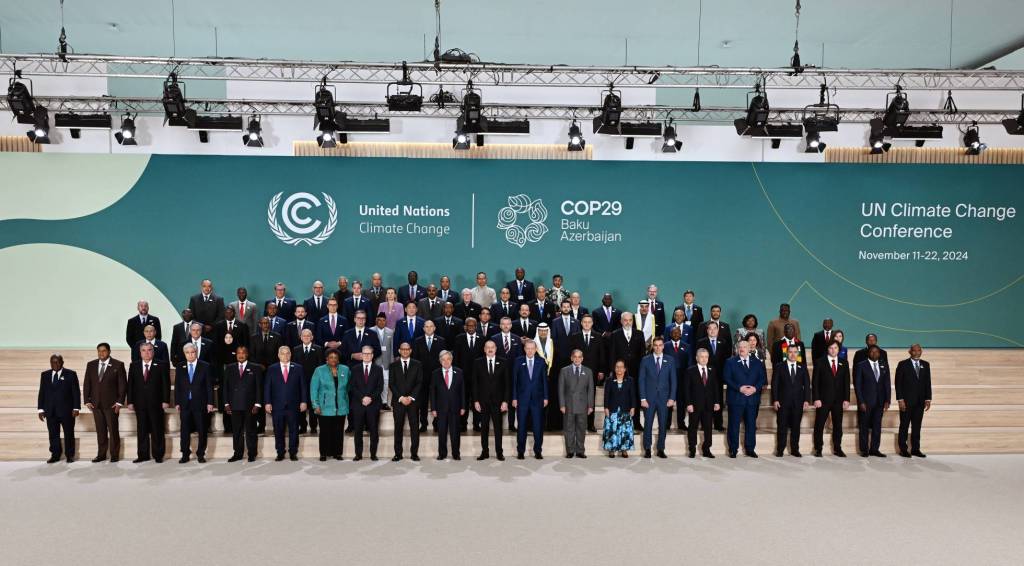
The 30th edition of the UN Conference Of the Parties, or “COP”, is set to take place in Brazil from 10 to 21 November.
Nearly all of the 200 countries that signed the treaty back in 1992 will send delegations to Belém, a highly symbolic place located in the Amazon rainforest, the largest of the remaining primary forests, threatened by agriculture, logging, mining and, evidently, climate change [1]. True to COP tradition, controversy surrounds its organisation. The recent clearing of some protected rainforest to accommodate a four-lane highway for the event caused alarm amongst activists [2].
Beyond logistical challenges, this conference also marks the tenth anniversary of COP21 held in Paris, where signatories agreed to try to limit global temperature rise to 1.5°C above “pre-industrial levels” of the late 1800s, and keep it “well below 2°C” [3].
Under the current agreement, all countries were supposed to submit before COP30 updated plans detailing how to reduce their greenhouse gas emissions, yet only a third have done so thus far [3].
The conference takes place against a backdrop of environmental and political setbacks in the global fight against climate change.
On the environmental front, CO₂ emissions and global temperatures reached new records in 2024 – and 2025 is on track for similarly bleak milestones. There is now a growing scientific consensus that it is already too late to remain within the 1.5°C target [4] [5].
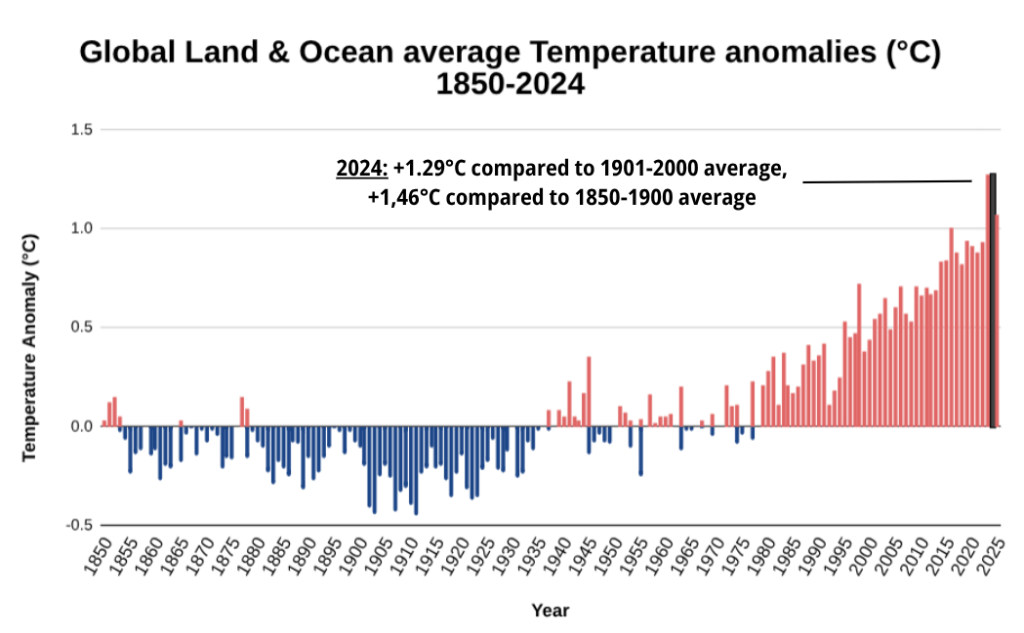
National Centers for Environmental Information. (2025). Climate at a glance: Global time series [Data set, 1850 baseline]. U.S. Department of Commerce, sourced from NOAA. EIPS visual
Politically, climate change has become increasingly overshadowed by rising debt burden, cost of living crisis, ageing populations and increased defence spending [6].
Across the Americas, the United States is once again threatening to withdraw from the agreement as it did in 2017, with President Trump calling climate science “the greatest con job” during his UN address in September [7]. Further south, Argentina, under President Milei, is following a similar path [8]. As for the host country of Brazil, President Lula has come under increased criticism for granting oil exploration permits, even though the International Energy Agency has clearly stated that no such projects should be approved in order to avoid missing the country’s 2050 emission targets [3].
Meanwhile in Europe, the Green Deal is under strain from countries calling for greater pragmatism on climate goals, allowing individual states more flexibility to decarbonise their economies, and to “radically lighten the regulatory load on people and businesses” [9].
Although last year’s COP29 in Baku, Azerbaijan, yielded considerable results in terms of climate financing from developed countries under the “New Collective Quantified Goal” (NCQG), these achievements fell well short of developing countries’ expectations – they will only receive $300 billion of the estimated $1.3 trillion needed annually for climate action.
The feeling of “too little too late” is palpable among low- and middle-income countries, whose growth is constrained by climate policies while bearing a majority of the cost of climate change-related damages [10].
This year’s meeting intends, amongst other things, to secure greater commitments from wealthy nations.
In addition, this COP aims to set up the Global Goal on Adaptation, which would provide countries with a “clear basis for planning, implementation and accountability” in climate policies [10].
Due to Brazil’s importance in preserving primary forests, COP30’s agenda will also focus on rewarding nations taking concrete climate actions to preserve them, by creating a $4 billion-per-year fund dubbed the “Tropical Forest Fund Facility” (TFFF) [11].
Lastly, countries are urged to further shift from pledges to implementation. According to the UN, current national climate pledges put the planet on track for 3.1°C warming this century. To avoid this catastrophic outcome, countries need to “fully strengthen and implement their pledges, ensuring they cut their emissions by 43% by 2030 compared to 2019 levels” [11] [12].
Regardless of the threats posed by climate inaction, maintaining a global framework uniting scientists, non-governmental organisations, state officials and the private sector remains essential, even according to COP long-time critic Greenpeace [13].
Past experiences have shown that faced with impending climate catastrophe, countries are able to agree on comprehensive and fast applicable deals. The landmark 1987 Montreal Protocol banning CFC gases from destroying the ozone layer is a commonly drawn comparison to the current climate crisis. Although the harmful effects of the gas were only discovered in 1974 and confirmed in 1984, it took world leaders only three years to agree on the treaty and two additional years to implement it [14].
More recently, the EU was able – through its decarbonisation efforts and green energy roll-out – to reduce its emissions by 8% between 2022 and 2023, while net emissions were down 37% from 1990 levels (even as GDP grew by 68% over the same period) [15]. Likewise, renewable energy prices have fallen dramatically over the past decade – in part thanks to China’s manufacturing subsidisation prowess. The International Renewable Energy Agency now estimates that up to 91% of green projects are cheaper than fossil fuel alternatives [16].
Doomerism cannot be an option in the current crisis. The dire situation should not lead to disillusionment but instead make climate change mitigation a global priority, with developing and wealthy nations contributing according to both their historic and current emission levels.
Edited by Jules Rouvreau.
References
[1] Earth.org. (2024, June 22). World Rainforest Day: The world’s great rainforests. Earth.org. https://earth.org/world-rainforest-day-worlds-great-rainforests/
[2] BBC News. (2024, June 18). Brazil’s Amazon highway for COP30 sparks alarm among activists. BBC News. https://www.bbc.com/news/articles/c9vy191rgn1o
[3] BBC News. (2024, September 10). COP30: Countries urged to submit plans to cut emissions. BBC News. https://www.bbc.com/news/articles/c04gqez4lkyo
[4] World Meteorological Organization (WMO). (2024, October 5). Carbon dioxide levels increase by record amount to new highs in 2024. WMO. https://wmo.int/news/media-centre/carbon-dioxide-levels-increase-record-amount-new-highs-2024
[5] Carbon Brief. (2025, October 15). State of the climate: 2025 on track to be second or third warmest year on record. Carbon Brief. https://www.carbonbrief.org/state-of-the-climate-2025-on-track-to-be-second-or-third-warmest-year-on-record/
[6] Organisation for Economic Co-operation and Development. (2025). Government expenditure by function (COFOG), Government at a Glance 2025 [Data indicator]. OECD. https://www.oecd.org/en/publications/government-at-a-glance-2025_0efd0bcd-en/full-report/government-expenditure-by-function-cofog_d2b167d4.html https://docs.google.com/spreadsheets/d/1uWB7s_kpdz1BGN1gBDrVhOMYSYMAmcYT/edit?usp=sharing&ouid=111825168631874186501&rtpof=true&sd=true
[7] The Guardian. (2025, October 13). Donald Trump’s withdrawal from the Paris agreement makes tackling the climate crisis even harder. The Guardian. https://www.theguardian.com/commentisfree/2025/oct/13/donald-trump-withdrawal-paris-agreement-tackling-climate-crisis-easier
[8] CBC News. (2025, November 5). COP30: Brazil sets stage for climate talks amid Amazon challenges. https://www.cbc.ca/news/science/cop30-climate-brazil-amazon-9.6969984
[9] The Guardian. (2025, June 26). EU to roll back environmental policies in major deregulation push. The Guardian. htps://www.theguardian.com/environment/2025/jun/26/eu-rollback-on-environmental-policy-deregulation-european-green-deal
[10] BBC News. (2025, October 21). COP30: Developing nations warn climate funding is too little, too late. BBC News. https://www.bbc.com/news/articles/cd0gx4przejo
[11] United Nations University (UNU-EHS). (2025, July 15). 5 expectations for COP30 in Belém. UNU. https://unu.edu/ehs/article/5-expectations-cop-30-belem#:~:text=COP%2030%20is%20expected%20to,address%20climate%20change%2Drelated%20losses
[12] Greenpeace International. (2024, May 27). COP30 in sight: 5 things you need to know about the next COPs. Greenpeace. https://www.greenpeace.org/international/story/79300/cop30-sight-5-things-need-know-cops/
[13] Greenpeace International. (2024, May 27). COP30 in sight: 5 things you need to know about the next COPs. Greenpeace. https://www.greenpeace.org/international/story/79300/cop30-sight-5-things-need-know-cops/
[14] European Climate Policy Portal (Climat.be). (n.d.). Protocole de Montréal. Federal Public Service Health, Food Chain Safety and Environment. https://climat.be/politique-climatique/internationale/protocole-de-montreal
[15] Climate Action – European Commission. (2024). Progress in EU climate action. European Commission. https://climate.ec.europa.eu/eu-action/climate-strategies-targets/progress-climate-action_en
[16] International Renewable Energy Agency. (2025, July 22). 91% of new renewable projects now cheaper than fossil-fuel alternatives [Press release]. https://www.irena.org/News/pressreleases/2025/Jul/91-Percent-of-New-Renewable-Projects-Now-Cheaper-Than-Fossil-Fuels-Alternatives
[Chart] National Centers for Environmental Information. (2025). Climate at a glance: Global time series (Global land & ocean temperature anomalies, 1850–Present) [Data set]. U.S. Department of Commerce. EIPS montage. https://www.ncei.noaa.gov/access/monitoring/climate-at-a-glance/global/time-series
[Cover image] Wikimedia Commons. (2024, November 12). Summit of leaders COP29 (12 November 2024) [Photograph]. Wikimedia Commons. https://commons.wikimedia.org/wiki/File:%D0%A1%D0%B0%D0%BC%D0%BC%D0%B8%D1%82_%D0%BB%D0%B8%D0%B4%D0%B5%D1%80%D0%BE%D0%B2_COP29_12_%D0%BD%D0%BE%D1%8F%D0%B1%D1%80%D1%8F_2024.jpg


Leave a comment