
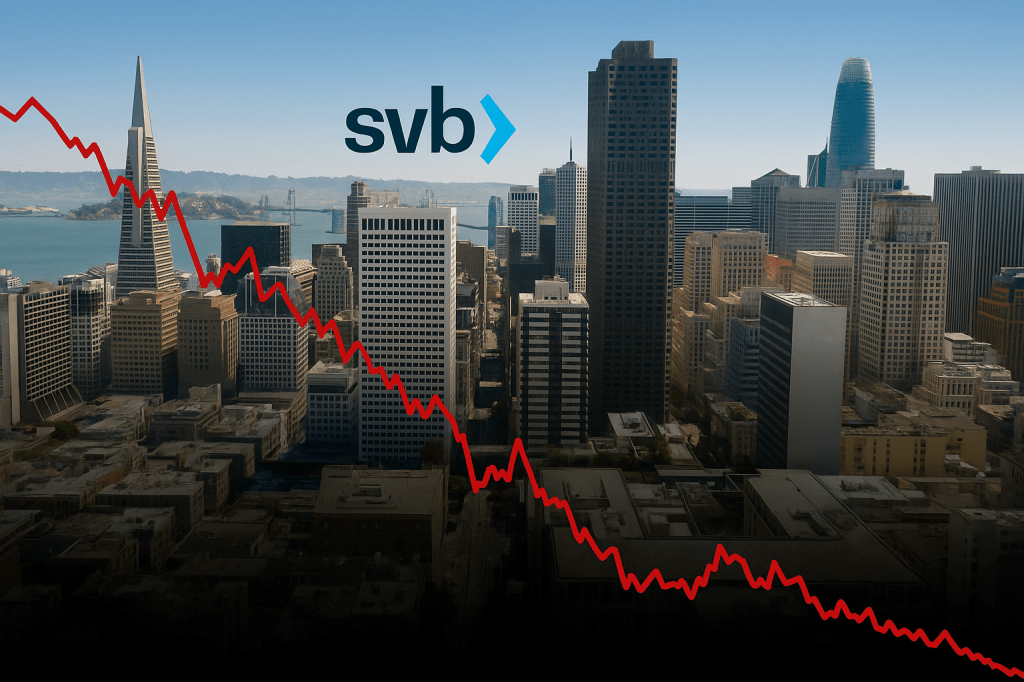
The sudden implosion of Silicon Valley Bank (SVB) in March 2023 was far more than an isolated financial incident; it was a seismic event that sent shockwaves through the global financial system, exposing deep-seated vulnerabilities at the intersection of politics, regulation, and corporate governance. This dramatic episode raises a crucial question: how did such a failure occur at the heart of one of the world’s most dynamic financial ecosystems, and what lessons should be learned to prevent history from repeating itself?
1. The Political Economy of Deregulation: A Recipe for Disaster
The narrative of SVB’s demise is inextricably linked to a broader political shift towards financial deregulation. Following the 2008 global financial crisis, the Dodd-Frank Act introduced stringent oversight for banks with over $50 billion in assets, aiming to prevent a recurrence of systemic risk. However, this regulatory framework has been constantly challenged. One of its prominent detractor was none other than SVB’s CEO, Greg Becker, who lobbied intensely to partly roll back the Act [1].
Between 2015 and 2018, SVB spent over $500,000 on federal lobbying, actively advocating for an increase in the threshold for “enhanced prudential standards” from $50 billion to $250 billion in assets [1]. Becker personally testified before Congress, arguing that such regulations stifled growth and were unnecessary for banks with SVB’s “low risk profile” [1]. This lobbying campaign, supported by political donations, ultimately bore fruit. In 2018, legislation was passed and signed by then-President Donald Trump, significantly weakening oversight for regional banks, including SVB, by raising the regulatory threshold to $250 billion [1].
This political victory for the banking sector had profound consequences. Despite warnings from financial watchdogs like Better Markets, who cautioned that weakening these standards could be “disastrous”, the new rules reduced the frequency of liquidity stress tests and eased capital requirements [1]. This created a regulatory blind spot, allowing SVB to grow rapidly to over $200 billion in assets without being subjected to the rigorous scrutiny designed to identify and mitigate the very risks that ultimately led to its collapse. The absence of a Chief Risk Officer in the months preceding the failure further underscored a critical lapse in governance, enabled by a permissive regulatory environment [1].
2. A Masterclass in Mismanagement: The Financial Drivers of Collapse
While the political and regulatory context set the stage, it was a series of fatal financial decisions that triggered SVB’s collapse. The bank’s balance sheet became a tinderbox of unhedged interest rate risk (not protected against losses), a vulnerability that was exposed by the Federal Reserve’s aggressive rate-hiking cycle. As detailed by the Financial Times, SVB’s downfall was rooted in a two-pronged failure of asset-liability management [4].
First, the bank amassed a massive $91.3 billion held-to-maturity (HTM) bond portfolio, heavily concentrated in long-duration, agency-guaranteed mortgage-backed securities [4]. With an average duration of 6.2 years, this portfolio was acutely sensitive to rising interest rates. As rates climbed, the market value of these bonds plummeted, resulting in a staggering $15 billion unrealised loss by the end of 2022 [4]. Crucially, SVB failed to protect itself against the risk of rising interest rates it chose not to “hedge”, that is, not to use financial instruments that could have balanced out potential losses as interest rates climbed. The Financial Times described this as a critical error, all the more so because the bank had deliberately lengthened the duration of its investments since 2018, making it especially vulnerable to rate shocks [4].
Second, SVB made the bold decision to deactivate the hedge on its available-for-sale (AFS) portfolio, a move primarily motivated by the pursuit of short-term profits. After initially putting hedging mechanisms in place to protect against rising interest rates, the bank controversially chose to dismantle these protections on nearly $11 billion of its AFS portfolio in 2022, recording an immediate gain of over $500 million [4].
However, this decision left most of the portfolio highly vulnerable to any further rate increases. By the end of the year, SVB’s hedging positions amounted to only $563 million, compared to $135 billion for comparable institutions such as Credit Suisse[4].
In other words, the bank bet heavily, without protection, on the end of rising interest rates, a bet that proved disastrously wrong. This situation was akin to a homeowner living in a hurricane-prone area of Florida canceling his flood and storm insurance to save on premiums and temporarily improve their cash flow – only to find themselves completely exposed when the next storm hits.
SVB’s strategy prioritised short-term financial gains at the expense of long-term stability, leaving the bank uninsured against the very market forces it had initially sought to protect itself from.
In addition to these asset-side failures was an equally precarious liability structure. SVB’s deposit base was highly concentrated in the tech and Venture Capital (VC) sectors and overwhelmingly uninsured. This vulnerability was deeply rooted in the dynamic shifts experienced by startups and entrepreneurs during the COVID-19 pandemic. While the crisis severely impacted many businesses, others, particularly internet-based ventures like e-commerce and remote work solutions, experienced significant growth as global demand surged during lockdowns [5]. This period saw a rapid influx of capital into certain tech sectors, creating a boom for agile and adaptable startups. As a specialised bank serving this ecosystem, SVB became a repository for these burgeoning funds. However, a critical flaw was that 90% of the bank’s $173 billion in deposits as of December 31, 2022, exceeded the Federal Deposit Insurance Corporation (FDIC)’s $250,000 insurance limit [2]. This meant that most of the money held at SVB was effectively unprotected, rendering the bank highly susceptible to sudden withdrawals.
This period of rapid expansion was followed by a challenging downturn as market conditions evolved. A Journal for Small Business Strategy article highlights that during the pandemic, the capital market became highly volatile, leading to increased caution and risk-aversion among investors, making funding more unstable [5]. As the economic landscape shifted and central banks began raising interest rates, the tech sector faced a less favourable environment. Startups, which often operate by ‘burning cash’ to fuel growth, began drawing down their significant deposits – many of which held at SVB – to finance ongoing operations amidst this tightening market and increased investor prudence. This created a severe liquidity crunch for SVB, exacerbated by its existing unrealised losses on its bond portfolio. The ensuing bank run was a direct consequence of this unstable, uninsured deposit base and the bank’s inability to liquidate its devalued assets without incurring catastrophic losses.
3. The Politics of Crisis Response: Contagion, Bailouts, and Moral Hazard
The collapse of SVB triggered a frenetic, 72-hour race in Washington to prevent a full-blown systemic crisis [2]. The Biden administration, haunted by the political fallout of the 2008 bailouts, faced a daunting challenge: how to stabilise the global banking system without being seen as rescuing reckless financiers. The response that emerged was a powerful demonstration of executive action, but one that has ignited a fierce debate about the nature of government intervention and the concept of moral hazard.
As detailed by The Washington Post, top officials, including Treasury Secretary Janet Yellen and National Economic Director Lael Brainard, quickly recognised the potential for contagion [2]. Fears mounted that SVB’s collapse could trigger a domino effect across the banking system, as confidence in financial markets eroded. Smaller regional banks faced the risk of deposit withdrawals from anxious clients fearing similar weaknesses, while larger institutions could be destabilised through interconnected markets and investor panic.
This concern proved well-founded: within days, Signature Bank collapsed under similar liquidity pressures, and Credit Suisse – one of Europe’s largest lenders – faced a crisis of confidence that culminated in its emergency takeover by UBS. The SVB failure thus revealed how quickly localised financial stress can ripple across borders, underscoring the fragility of global market interdependence and the speed at which panic can travel in a digital age.
The administration’s decisive action came on Sunday. In an extraordinary move, the Treasury, the Federal Reserve, and the FDIC jointly announced that all depositors at SVB including those with funds far exceeding the $250,000 insurance limit – totalling $156 billion – would be made whole [3]. This was achieved by invoking a “systemic risk exception”, a legal maneuver that allows regulators to bypass the normal rules of deposit insurance to prevent broader financial instability [3].
This decision, while successful in calming markets and preventing a wider panic, was politically contentious. The administration took pains to argue that this was not a “bailout”, emphasising that taxpayers would not bear the cost (the rescue would be funded by a special assessment on other banks) and that the bank’s shareholders and executives would be wiped out [2]. However, critics argue that by guaranteeing uninsured deposits, the government effectively bailed out the wealthy venture capitalists and tech companies that constituted SVB’s client base. This has led to debate, as highlighted in CrisesNotes, about the ever-expanding definition of “systemic risk”. If the potential failure of a single regional bank and its impact on the tech Industry is sufficient to trigger this kind of federal intervention, the legal standard for what constitutes a systemic threat has become dangerously loose and subject to political discretion [3].
The long-term consequence is a significant increase in moral hazard, as it signals to large, uninsured depositors that the government will likely intervene in future crises, weakening incentives for prudent risk management. The collapse of Silicon Valley Bank, though modest compared to Lehman Brothers in 2008, reflects the same recurring flaws: overreliance on cheap liquidity, poor risk oversight, and the assumption that public safety nets will absorb private failures.
After Lehman’s fall, the ensuing contagion exposed deep fragilities in Europe’s financial architecture, culminating in the 2010–2012 Eurozone debt crisis, where private risk was effectively transferred onto sovereign balance sheets. SVB’s downfall, emerging after a decade of ultra-low rates and excessive liquidity, follows a similar trajectory: when monetary conditions tightened, complacency turned to panic, and state intervention once again became the backstop.
This pattern highlights a persistent structural weakness in global finance: while crises differ in form, their underlying dynamics remain unchanged. Each intervention may restore short-term stability, but it simultaneously weakens market discipline and reinforces expectations of future bailouts. In doing so, it perpetuates a cycle in which moral hazard becomes the enduring, if often overlooked, legacy of every financial crisis.
Edited by Maxime Pierre.
References
[1] The Guardian. (2023, March 11). Silicon Valley Bank chief pressed Congress to weaken risk regulations. https://www.theguardian.com/business/2023/mar/11/silicon-valley-bank-weaken-risk-regulations-svb
[2] The Washington Post. (2023, March 14). The 72-hour scramble to save the United States from a banking crisis. https://www.washingtonpost.com/us-policy/2023/03/14/72-hour-scramble-save-united-states-banking-crisis/
[3] CrisesNotes. (n.d.). Every Complex Banking Issue All At Once: The Failure of Silicon Valley Bank in One Brief Summary and Five Quick Implications.
[4] FT Alphaville. (2023, March 13). How crazy was Silicon Valley Bank’s zero-hedge Strategy? https://www.ft.com/content/f9a3adce-1559-4f66-b172-cd45a9fa09d6
[5] Silva, E., Beirão, G., & Torres, A. (2023). How startups and entrepreneurs survived in times of pandemic crisis: Implications and challenges for managing uncertainty. Journal of Small Business Strategy, 33(1), 84–97. https://jsbs.scholasticahq.com/article/72084-how-startups-and-entrepreneurs-survived-in-times-of-pandemic-crisis-implications-and-challenges-for-managing-uncertainty
[Cover image] “San Francisco, USA”, n.d. (https://www.pexels.com/fr-fr/photo/mer-ville-monument-batiments-8319481/), EIPS montage. Picture by Mikhail Nilov (https://www.pexels.com/fr-fr/@mikhail-nilov/) licensed under Pexels.


Leave a comment