Gaza: when 5,000 years of history are shattered by the bombs
Explore Gaza’s 5,000-year heritage, now under threat from war. Discover the IMA exhibition preserving ancient artefacts, cultural memory, and the region’s rich civilisations amid destruction.
“More than ever today, especially since October 7 and the ensuing destruction, Gaza deserves to have its history told. For the archaeological artefacts presented in this unprecedented exhibition were rescued from destruction through exile. For the war that now rages wounds and sometimes erases, entire sections of the identity of this once-flourishing land, a true crossroads of civilisations between Asia, Arabia, Africa, and the Mediterranean“
Jack Lang, Institut du Monde Arabe’s President [1]
Gaza: A Crossroads of Civilisations for 5,000 Years
Located at the crossroads of Africa and the Near East, Gaza has occupied a strategic geographical position since antiquity. Stretching along the coastal corridor that links Egypt to the Levant, it commanded the vital route between the Sinai and the Fertile Crescent, serving as a key passage for traders, armies, and caravans connecting Arabia, Egypt, and the Mediterranean world. This unique position made Gaza both a coveted centre of power and a flourishing port as early as the second millennium BCE [2].
The Egyptians first established garrisons there, followed by the Philistines, who made it one of their principal cities in the 12th century BCE. Under the Assyrians, Babylonians, and Achaemenids, Gaza retained its dual role as a commercial and religious crossroads. With the arrival of Alexander the Great, the city was rebuilt according to the Hellenistic model, adorned with temples dedicated to Zeus and Aphrodite, and renamed to reflect its new Greek identity. However, during this period, it remained a prosperous administrative and cultural hub at the heart of imperial trade networks.
One of the most renowned monuments of antiquity was the Marneion, a monumental temple dedicated to Marnas, Gaza’s tutelary deity. Its destruction in the early fifth century by Christians marked the symbolic end of local paganism [2]. Bishop Porphyrius of Gaza then erected a basilica upon its ruins, embodying the city’s Christianisation and its enduring capacity for transformation. Under the Byzantines, Gaza evolved into a renowned intellectual and theological centre, while the discovery of a sixth-century synagogue – decorated with mosaics depicting the sun and the zodiac – attested the vitality of local Judaism.
The Arab conquest of the seventh century introduced Islam, further enriching this layered cultural landscape. Mosques were built, among them the Great al-Omari Mosque, constructed atop the remains of a Crusader church that itself had been founded on much older structures. During the twelfth century, the Crusaders turned Gaza into a fortified outpost, building a large Gothic church and a Templar castle. After the Muslim reconquest, the church was converted into a mosque, perpetuating the sacred continuity of the site. Nearby stands the Church of Saint Porphyrius, consecrated around 1150 on an earlier sanctuary [4], housing the tomb of the sainted bishop;
Under the Mamluks and later the Ottomans, Gaza maintained this composite religious landscape, where mosques, churches, and remnants of synagogues coexisted within a dense urban fabric inherited from successive civilisations. Through its temples and sanctuaries, the city reveals an unbroken history of transformation and continuity, each era leaving its imprint in stone. Gaza thus emerges as a palimpsest of spiritual heritage – a city where faiths, empires, and identities met, clashed, and ultimately converged across five millennia.
When Stones Turn to Dust: A Heritage Under Fire
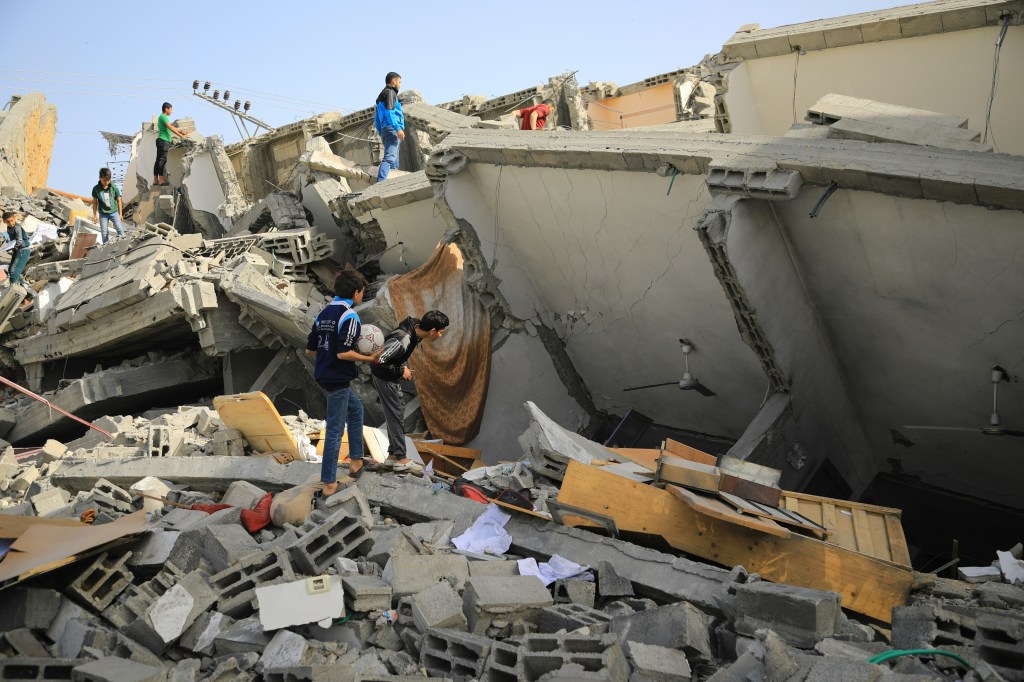
Today, that same crossroads of civilisations lies under siege. The ongoing war in Gaza devastates not only human lives but also the material memory of five thousand years of history. Temples, mosques, churches, archaeological sites, and museums – tangible witnesses to the city’s role as a meeting point of cultures – are being reduced to rubble. What is vanishing is not merely architecture, but the very testimony of coexistence, faith, and identity.
The Great al-Omari Mosque, Gaza’s oldest and most revered religious monument, epitomises this destruction. Built on the ruins of a Philistine temple and a Byzantine church [5], it had stood since the seventh century as a living record of Gaza’s layered sacred past. Its destruction in December 2023 marked the loss of one of the city’s most emblematic spiritual symbols [6]. The ancient port of Anthedon (Blakhiyah) – dating back to the eighth century BCE and listed on UNESCO’s tentative list of World Heritage sites – was likewise described by archaeologists as “completely or massively destroyed.” Once a thriving Hellenistic and Roman harbour, it now lies buried under bomb craters. The Pasha’s Palace (Qasr al-Basha), a Mamluk-Ottoman monument turned museum in 2010, was heavily damaged during airstrikes, along with the invaluable collection it housed, spanning from the Bronze Age to the Islamic period [7]. The Church of Saint Porphyrius, consecrated around 1150 and one of the world’s oldest still-functioning churches, was struck in October 2023 while sheltering displaced families [8].
Before the conflict, Gaza contained at least 316 culturally significant sites – monuments, historic buildings, and ancient settlements. By early 2025, 138 had suffered severe damage, 61 moderate, and 27 minor damages. UNESCO’s August 2025 report listed 110 damaged sites since October 2023 [9], including thirteen religious structures, seventy-seven historic buildings, nine monuments, three storage facilities, and seven archaeological zones. In the end, it is the majority of Gaza’s cultural heritage that has been destroyed.
The obliteration of Gaza’s cultural heritage is not collateral; it represents the deliberate erasure of collective memory. Temples, synagogues, mosques, and churches once embodied centuries of spiritual and intellectual exchange that defined the city. Their disappearance silences the dialogue of civilisations that Gaza once symbolised. These monuments were not only aesthetic or religious artifacts but irreplaceable archives of human continuity. When ancient layers are bombed or bulldosed, the archaeological context – and with it, historical knowledge – is irretrievably lost.
The consequences are both cultural and practical. Archaeological sites have become inaccessible, buried under rubble or rendered unsafe. Museums and storerooms have been looted or destroyed, exposing artifacts to theft and decay. The historic urban fabric – its Ottoman alleys, domed houses, and ancient neighborhoods – has been obliterated, making authentic reconstruction nearly impossible. In Gaza, the destruction of heritage mirrors the destruction of life itself: both embody the disintegration of continuity and belonging.
Saving What Remains: Preservation in Exile and Emergency Action
As the IMA exhibition shows, amid this devastation, a global effort has emerged to document and preserve what remains of Gaza’s millennia-old heritage. Archaeologists, curators, and international institutions are engaged in a race against time to protect fragments of a civilisation now at risk of vanishing.
This emblematic exhibition brings together archaeological objects excavated during Franco-Palestinian missions and saved from destruction before the current war. Statues, ceramics, jewellery, and mosaics now stand as refugees of memory, bearing witness to the Gaza that was. Their display in Paris transforms the museum into a sanctuary for a culture surviving in exile.
UNESCO’s office in Ramallah has launched emergency cultural assessments and supports artists and archivists through heritage preservation programs. Satellite and drone mapping projects record the damage at sites [3].
On the diplomatic front, the 1954 Hague Convention provides the international legal framework for protecting cultural property during armed conflict. The International Criminal Court has opened preliminary discussions on cultural erasure as a potential war crime. In July 2024, UNESCO placed the Monastery of Saint Hilarion on its List of World Heritage in Danger, a symbolic yet significant gesture of global recognition [10].
Exhibitions like that of the IMA thus transcend culture: they become acts of solidarity and transmission, connecting global audiences to a history that refuses to be buried.
UNESCO’s Role and the Duty of Memory
As the destruction of Gaza’s heritage accelerates, UNESCO’s founding mission – “to ensure, through education and culture, the respect for justice, law, and human dignity” – acquires renewed urgency [11]. The organisation must move beyond symbolic condemnation toward a form of emergency cultural diplomacy: securing archives, funding reconstruction, and protecting the expertise of local historians and archaeologists who continue their work amid devastation.
The IMA exhibition “Les Trésors de Gaza” thus stands as more than a cultural showcase; it is an act of defiance, a declaration that Gaza’s history cannot be erased. “Nothing is worse than abandonment and oblivion,” declared Jack Lang – a phrase that now resonates as a moral imperative.
The challenge before the international community is to transform empathy into action: to support Palestinian archaeologists, protect endangered archives, and commit to the transmission of memory. Saving Gaza’s heritage is not only about preserving stones; it is about safeguarding a living history, a shared human legacy that belongs to all civilisations. The duty of memory, once invoked, must now become the duty of protection.
[9] Euro-Mediterranean Human Rights Monitor. (2025, September 15). Israel carries out systematic erasure of Gaza’s historical landmarks and cultural heritage. Euro-Med Monitor. https://www.euromedmonitor.org/en/article/6855
The US-Israeli decapitation strategy against Iran has proven fruitless, as the Islamic Republic’s inbuilt institutional resilience ensures systemic survival amidst…



Leave a comment