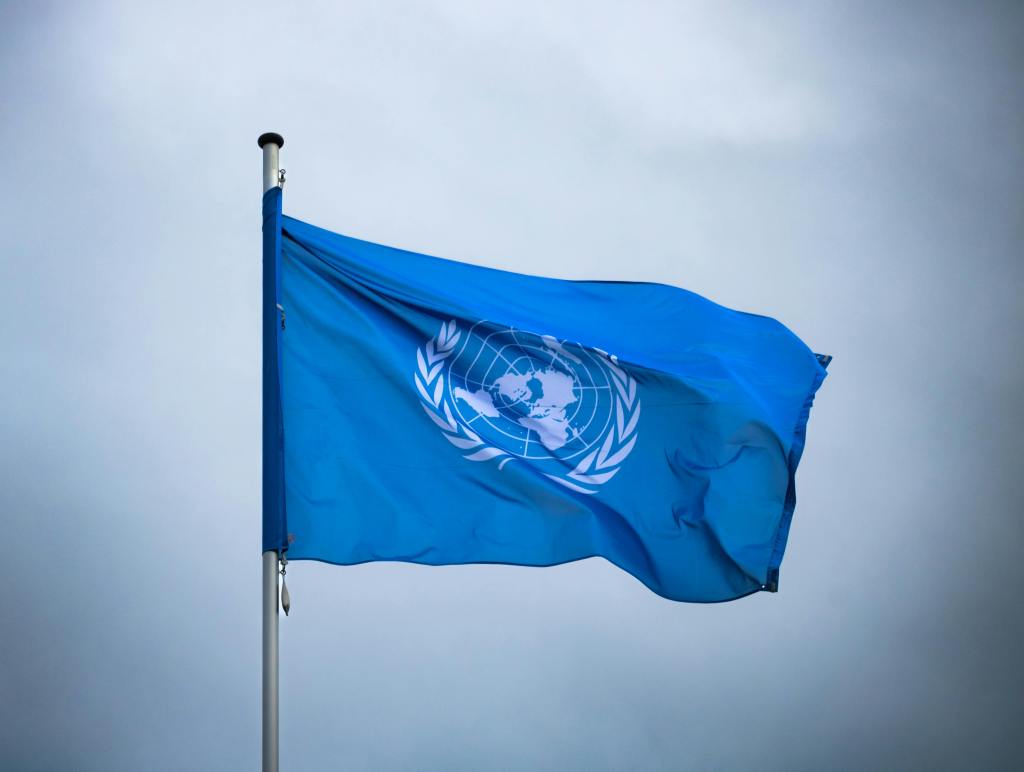
“It’s too bad that I had to do these things instead of the United Nations doing them.” Trump told the UN General Assembly. Some of those conflicts have, in fact, not ended, but Trump used the claim to ask the existential question: “What is the purpose of the United Nations?” [1].
The war that Israel is waging in Gaza once again highlights the paralysis of the UN: inefficient and incapable of enforcing its own Charter or protecting the innocent.
When the United Nations was founded in October 1945, it was born from the ashes of humanity’s most devastating conflict. Since the League of Nations had failed to prevent the Second World War, the new organisation was meant to ensure that such a catastrophe could never happen again. The UN’s founders spoke in the language of peace and hope, of diplomacy as a means of moral redemption. As its second secretary-general, Dag Hammarskjöld once reminded delegates that the UN was “not created to lead mankind to heaven, but to save humanity from hell.” [2].
Eighty years later, that promise feels hollow. In Gaza, the UN appears less as a guardian of world peace than as a powerless observer, watching from the sidelines as cities burn and civilians die. What was once the world’s moral compass is now accused of irrelevance [2], gridlocked by geopolitics and deprived of authority. But the crisis facing the UN today is not just about Gaza: it is the culmination of decades of structural decay, political cynicism, and the failure of great powers to uphold the very ideals they wrote into its Charter [2].
In the Gaza Strip, the war has exposed the paralysis at the heart of the United Nations. Every attempt to pass a binding Security Council resolution condemning Israel’s bombardment or calling for a ceasefire has been vetoed by the United States [1], the very state that helped design the UN system in 1945. Since every proposal that seeks to limit Israel’s actions is immediately met with an American veto, international law no longer has any coercive power.
The UN’s structure, meant to ensure peace through balance, has instead institutionalised imbalance. The five permanent members of the Security Council: the United States, the United Kingdom, France, Russia, and China, wield a veto that allows them to block any resolution contrary to their interests. This mechanism, once justified as a guarantee of stability, has become the symbol of paralysis. Gaza has simply made the dysfunction visible: even when humanitarian law is violated, the Council is mute [2][3].
Secretary-General António Guterres, to his credit, has spoken out with uncharacteristic candour. “We are seeing massive killing of civilians,” he said, “and dramatic obstacles to the distribution of humanitarian aid. The truth is that this is morally, politically, and legally intolerable.” [2]. Yet the world, as Financial Times noted, no longer seems to be listening. The UN’s press briefings are now “more mausoleum than press room.” Its moral authority, once embodied in Hammarskjöld’s voice, has evaporated [2].
Unfortunately, the crisis in Gaza is not the first to highlight the UN’s powerlessness. In April 2022, as Guterres met Ukrainian officials in Kyiv, two Russian missiles struck nearby [3]. The symbolism of this brazen gesture was chilling: even the UN Secretary-General was no longer shielded by the organisation’s prestige.
From Syria to Sudan, from Yemen to Myanmar, the UN has been reduced to a humanitarian bystander, issuing reports and condemnations [2] while others decide the course of war. The pattern is painfully familiar. During the Rwandan genocide, UN peacekeepers stood by as hundreds of thousands were slaughtered [7]. In Bosnia, they watched the fall of Srebrenica unfold under their mandate. In Iraq in 2003, the US invasion bypassed the Security Council entirely. In each case, the UN’s credibility suffered another blow [8].
Yet to write the UN off as useless would be unjust. Despite its political paralysis, it remains a humanitarian backbone in war zones. In Gaza, the UNRWA, the World Food Programme, and the Office for the Coordination of Humanitarian Affairs deliver aid, document violations, and provide some measure of accountability [4]. The UN may not prevent wars but it saves lives, coordinates peacekeeping operations, and rebuilds shattered societies. In places like Cambodia, Mozambique, and Timor-Leste, UN missions have helped organise free elections, demobilise militias, and lay the foundations of peace [6].
The UN’s strength, paradoxically, lies in the very areas where it is least visible.
At the heart of the UN’s dysfunction lies a simple truth: it cannot rise above the powers that control it. Its founding structure, the veto power, was both its birth certificate and its curse. Designed to prevent great-power conflict, it has instead institutionalised great-power privilege. When the United States vetoes resolutions to protect Israel, or Russia does so to shield itself over Ukraine, they remind everyone that the law bows to force [3].
This dynamic has deepened in recent years. According to the Financial Times, the UN today confronts “two crises at once—within and without”, a telling summary of both its internal decay and its loss of external authority. Internally, decades of bureaucratic expansion and mission creep have left the organisation bloated and incoherent: over 40,000 overlapping mandates, shrinking budgets, and declining morale [2]. Externally, renewed great-power rivalry such as the US-China confrontation, Russia’s aggression, and Western divisions, has frozen the Security Council in a state of paralysis not seen since the Cold War.
The United States, meanwhile, oscillates between protector and saboteur. It was the UN’s principal architect and remains its largest funder, yet successive administrations have undermined its authority. Donald Trump’s “America First” policy, coupled with budget cuts and open hostility toward multilateralism, eroded both the UN’s capacity and its morale [2]. Even allies of the institution admit the decline. “In many ways, the UN is the walking dead,” said Lord Mark Malloch Brown, a former deputy secretary-general [2].
Now that the irrelevance and impotence of the UN have been established, does it mean that it should be reformed ? Contradictorily, reform is both necessary and nearly impossible. Every Secretary-General since Kofi Annan has promised to “modernise” the UN but every reform effort has collided with the same political realities [2]. Real change requires consensus among 193 member states and, crucially, the assent of the five permanent members, the very states least inclined to dilute their power.
Nonetheless, António Guterres’s UN80 reform plan represents a new attempt to reverse decline. UN80 is an initiative aimed at transforming the way the UN operates: it involves identifying efficiency gains, reviewing how mandates are implemented, and exploring potential structural changes and program adjustments within the UN system [5].
The deeper question, however, is one of purpose. Should the UN focus on mediating conflicts, or on long-term development and climate action? Should it remain universal, or become more selective? For Sigrid Kaag, former Dutch deputy prime minister and UN official, “The UN doesn’t have to do it all. It can still set global norms, but it doesn’t have to be part of all the doing” [2]. This pragmatic vision echoes a growing sentiment among diplomats: perhaps the UN’s survival depends on learning to do less, but better.
Despite its failures, the UN remains the only global forum where every state has a voice – however unequal those voices may be. In an age of rising nationalism and fractured alliances, that alone carries symbolic weight. The UN provides the legal and moral framework through which international aid, peacekeeping, and human rights action are coordinated. The UN can’t be replaced.
The paradox is that the UN is both indispensable and impotent. Unable to stop wars, yet essential to preventing disorder; powerless to enforce morality, yet vital in preserving the very language through which humanity still aspires to it.
As Gaza’s ruins bear witness to the UN’s paralysis, the temptation is to declare the organisation dead. And yet, history offers perspective. The League of Nations collapsed because it lost both credibility and purpose; the UN, though wounded, retains both, at least in potential. Its survival depends not on grand speeches, but on whether its members rediscover the will to act collectively.
Edited by Jules Rouvreau.
References
[1] David Michael Lamb, 2025 September 23, “Trump asks what is the UN’s purpose? This is the answer“, CBC News https://www.cbc.ca/news/world/un-trump-charter-1.7641469
[2] Russel A. and Hauslohner A. 2025 September 23 ”Can the UN save itself from irrelevance ?”, Financial Times https://www.ft.com/content/ef26562c-4534-473e-abc9-bda24e1f58da
[3] Nooten C. 2022 June 27, “How the war in Ukraine highlights the UN’s impotence”, Le Monde https://www.lemonde.fr/en/international/article/2022/06/27/how-the-war-in-ukraine-is-highlighting-the-un-s-impotence_5988154_4.html
[4] UN’s official website, “The Question of Palestine” https://www.un.org/unispal/permanent-status-issues/
[5]UN’s official website, “UN80 initiative” https://www.un.org/un80-initiative/en
[6] : 2024 February 15 , “How did UN peacekeeping help in a year marked by war?“ https://www.un.org/en/delegate/how-did-un-peacekeeping-help-year-marked-war
[7] Russel A. 2025 March 28 “The Convoy — a survivor relives Rwanda’s genocide” Finacial Times, https://www.ft.com/content/82f2a2fd-1eb1-4299-a908-696ed2360bf6
[8] Kuper S. 2025 June 26, “How War became contagious” , Financial Times https://www.ft.com/content/9bf97844-54d2-4a50-8539-dcb3cb6dac18
[Cover image] by Niklas Jeromin, licensed under pexels.com. The United Natiaons at a Standstill: Power, Paralysis, and the Crisis of Legitimacy https://www.pexels.com/fr-fr/photo/ciel-terre-bleu-libre-15405989/


Leave a comment