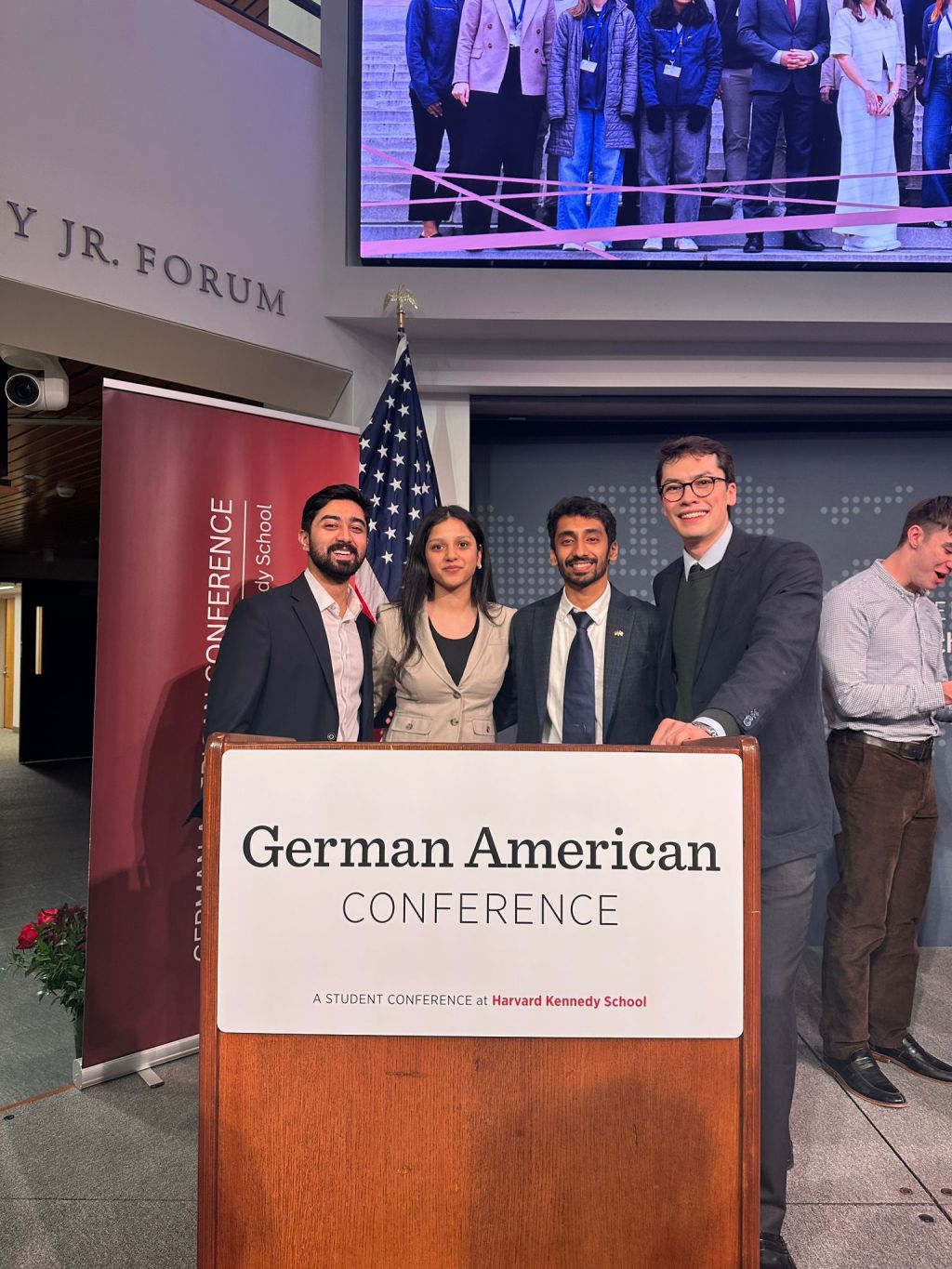
From 14–16 November 2025, the 17th edition of the German American Conference (GAC) took place at the Harvard Kennedy School in Cambridge, Massachusetts, under the theme “Transatlantic Relationship at a Crossroads” [1][2]. This student-run conference brings together leading figures from politics, business, academia, and culture to strengthen ties between Germany, Europe, and the United States. Over the years, it has grown into one of the most prominent student-led transatlantic summits [3][4].
The German American Conference at Harvard was founded in 2008, initially under a different name, as a student-organised forum connecting young professionals and decision-makers across the Atlantic [1]. Its evolution into a major platform for debate on global challenges is reflected in its consistently high-profile speaker line-ups and growing international audience [3].
With the 2025 conference spanning three days, the first day was dedicated to registration and the opening ceremony. We were welcomed by a warm address from the Co-Chairs—Harvard students Johannes Magdowski, Michael Gritzbach, and Karlotta Garinet—who also appear as Co-Chairs in the official 2025 conference materials [1]. The opening session featured current changemakers. The first keynote came from Brigadier General Gunnar Brügner, Defence Attaché at the Embassy of Germany to the United States, followed by a performance from a string quartet composed of Harvard students.
The next panel addressed the question “When Populism Becomes the System”, discussed by Prof. Daniel Ziblatt (Harvard University), Heidi Reichinnek (a leading figure in Germany’s left party Die Linke), Dr. Melanie Amann (deputy editor-in-chief at Der Spiegel), Prof. Laura Jakli (Harvard Business School), and Prof. Matthias Risse (Harvard Kennedy School). Several of these speakers are listed among the conference’s featured or former speakers, underscoring GAC’s role in convening prominent political and academic voices [1].
Another highlight was the appearance of Hazel Brugger, an unexpected but very positive addition to the programme. She had just been announced as a recipient of the 2025 Bambi award in Munich in the category Comedy for “Humour with Attitude” (Humor mit Haltung), in recognition of comedy that is both entertaining and socially engaging [6–8]. She then spoke at Harvard’s Memorial Church the following day. Brugger shared her insights into how comedy and satire are deeply political and what growing anxieties around freedom of speech mean—not only for her own work as a comedian but for everyone participating in public debate. Her talk was followed by a piano trio, again composed of Harvard students. The final session of the first day delved into the technicalities of competition through the perspective of Mike Canning, Global Chief Strategy Officer at Deloitte. Even after several hours of speeches and discussions, he succeeded in keeping the audience engaged, including many attendees still fighting jet lag.
The format of the next two days was intentionally flexible. According to the official programme, GAC 2025 featured dozens of panels, workshops, and side events running in parallel, as well as dedicated spaces for informal coffee chats with professors, business leaders, and policymakers [2][3]. The main topics revolved around competitiveness, both in military and economic terms, alongside discussions on innovation policy, security, and the role of technology in reshaping transatlantic relations [2][3].
Panels I attended included discussions with investment-banking Managing Directors, professors from the Harvard Kennedy School and Harvard Business School, German politicians, and entrepreneurs. As my previous research has focused on European innovation and military mobility, I concentrated on sessions covering these areas. It was encouraging to hear that my research and the opinions of many changemakers were aligned. Nevertheless, as is often the case with conferences, it remains uncertain how many of the suggestions voiced over the weekend will ultimately be implemented.
One of the main—and arguably most glamorous—opportunities to connect throughout the weekend was the evening gala. It was hosted across the upper floors of the Prudential Tower, in a venue known as View Boston, which offers panoramic views over the city’s skyline [5]. Overlooking Boston while interacting with some of the most proactive young professionals involved in the transatlantic relationship was a one-of-a-kind experience.
To broaden opportunities for participation, the German American Conference has, since 2015, featured an Innovation Lounge, designed as a platform where startups, think tanks, industry leaders, and students from both sides of the Atlantic can meet [1][6]. At GAC 2025, this format focused particularly on AI start-ups and included a pitching competition and an essay contest. The best-rated essays, selected by an independent jury, earned free conference admission and, for some winners, travel stipends—continuing the conference’s tradition of supporting young talent and lowering financial barriers to participation [1][6]. As a student at ESCP, it was particularly exciting to see fellow ESCP students being recognised. Febin Roy, a MiM student currently based in Berlin, won one of the top three spots in the essay competition.
Beyond competitions, GAC has long emphasised accessibility by offering scholarships supported by partners such as foundations, alumni clubs, and corporate sponsors, enabling students and early-career participants to take part regardless of financial background [3][4].
Overall, the conference was a clear success. In a period when the transatlantic partnership is strained by shifting geopolitical landscapes, technological rivalries, and trade realignments, such a forum is not just helpful but essential. It provides a space for dialogue and innovation and allows the future leaders of this relationship to interact and experience first-hand what it means to be a transatlantic leader [3][4].
For anyone interested in attending in the future, the conference is conducted in English, is organised by students across the Harvard community, and has repeatedly been described as one of the largest student-led conferences on European–American or transatlantic relations globally [3][4]. There was no formal application process for the 2025 edition; instead, participants could register directly, with scholarships and competitive opportunities such as essay contests and pitch competitions providing additional support [1][4].
The only aspect that felt somewhat overlooked was the composition of the participants. Most attendees were Germans studying in the United States or Germans who had travelled specifically for the conference. A more balanced mix of nationalities—especially more American participants—could have made the discourse even richer. Looking ahead, as a participant in the transatlantic conference, this raises a broader question: could a similar format be developed to bridge other divides, for example between East and West? If GAC shows anything, it is that a student-driven format can create a serious and impactful space for international dialogue.
Edited by Jules Rouvreau.
References
[1] German American Conference at Harvard. “History.” Available at: https://germanamericanconference.org/history
[2] Hubert Burda Media. “Hazel Brugger wins BAMBI award for humour with attitude.” Available at: https://www.burda.com/en/news/hazel-brugger-wins-bambi-award-for-humour-attitude/
[3] Minda de Gunzburg Center for European Studies, Harvard University. “Day 1 | German American Conference 2025.” Event description, 2025. Retrieved 1 December 2025, from https://ces.fas.harvard.edu/events/2025/11/day-1-german-american-conference-2025-2 Centre d’études européennes Minda
[4] Harvard Clubs of Germany – Rhein-Main. “German American Conference.” Association of Harvard University Alumni in Germany. Retrieved 1 December 2025, from https://rhein-main.harvard-club.de/de/german-american-conference-1 Harvard Club
[5] 617 Images. “View Boston opens this summer at Boston’s Prudential Center!” Blog post, 2023. Retrieved 1 December 2025, from https://www.617images.com/blog/2023/5/23/view-boston-opens-this-summer-at-bostons-prudential-center
[6] Mittelstandcafé. “German American Conference at Harvard rückt näher.” Article on Innovation Lounge, 2015. Retrieved 1 December 2025, from https://www.mittelstandcafe.de/german-american-conference-at-harvard-rueckt-naeher-1273440.html Mittelstand Cafe
[Cover image] by Maxim Baumgaertel, German American Conference, 2025.


Leave a comment