By Félix Dubé
In September 2025, US Secretary of Commerce Howard Lutnick told NewsNation that the Trump administration had begun pressuring Taiwan to “quickly transfer 50% of its microchip production to the US if it wanted guaranteed protection against a possible Chinese invasion”. This request may seem unreasonable, as not only would it be a monumental task, but if Taiwan complied with the US request, it would be even more counterproductive to its protection. Indeed, even though Mr. Lutnick specified that the US would offer “some kind of security guarantee” in order to “not eliminate its Silicon shield”; complying with this request would make Taiwan much less essential to the US. Of course, Taiwan did not agree to this request, but the US got part of what it wanted: the installation on US soil of the world’s largest and most advanced semiconductor chip manufacturer, TSMC (Taiwan Semiconductor Manufacturing Company) [1]. This decision was made in part to appease the US government, but also to be completely exempt from US taxes.
As a result, the world of chips is being reorganised. US industrial policy and tariffs have attracted some of the most advanced manufacturing to the United States, thereby reducing US interest in Taiwan. Accompanying this, Washington’s rhetoric has become more unilateralist. During his campaign, Trump pressed Taiwan to “take on greater responsibility for its own defence”. And even as US support seems to be gradually eroding, the People’s Liberation Army (PLA) is normalising pressure around the island, notably by increasing the pace of daily exercises, such as surprise encirclement, crossing the median line, cyber campaigns, and propaganda portraying Taiwan’s elected leaders as “separatists.” These exercises can be summarised as large-scale military operations, notably with the presence of aircraft carriers, such as the Shandong that was seen very close from Taiwan’s contiguous zone (which extends 24 nautical miles from its coast) [2]. Finally, several senior US and Taiwanese officials, such as US Secretary of Defence Pete Hegseth, even claim, based on information received by US intelligence services, that Taiwan could be invaded as early as 2027 [3].
For these reasons, the question of whether a conflict between Taiwan and China is possible no longer arises. But rather, what form would it take? And, in the event of a Chinese invasion, does Asia’s first democracy have the means to resist the wrath of the Red Nation?
Taiwan’s Defensive Potential
If we start by looking at the figures, a war and, above all, a victory for Taiwan seems highly unlikely. According to data collected by GlobalFirepower, China ranks as the world’s second military power, while Taiwan ranks 22nd. China has 2,035,000 active military personnel compared to Taiwan’s 215,000; its annual defence budget is $266.85 billion compared to Taiwan’s $19.74 billion. Whether in terms of weaponry, manpower, air power, or naval power, China’s military power far exceeds that of Taiwan. If war were decided by brute force alone, we could stop there [4].
EIPS promotion
Indeed, given China’s colossal numerical advantage, attempting to compete with China ship for ship or aircraft for aircraft would be extremely costly and ineffective for Taiwan.
Therefore, defence experts widely agree that Taiwan should adopt an asymmetric approach, known as the “porcupine strategy,” to deter and, if necessary, defend against a Chinese invasion. A porcupine defence takes advantage of Taiwan’s favourable defensive geography, notably by deploying a large number of dispersed and mobile coastal missiles, air defences, fast patrol boats, naval mines and minelayers, as well as small surveillance drones. This strategy would disrupt amphibious landings and target forces attempting to land on its beaches.
As one retired general observed: “Our geography is unfavourable to China—we have one main highway that moves north to south. This would make the transport of heavy equipment difficult. Taiwan possesses in every aspect a very favourable geography for an asymmetric defence, including mountainous terrain and thick forest in the east, extensive rice paddies, and urbanised coastal areas in the west, all of which complicate invasion by creating natural obstacles and could be used as a means of protection in the event of a prolonged war [5].
This approach of avoiding direct confrontation is more viable and cost-effective, aiming to make any invasion difficult and costly, and above all to prevent a lightning invasion that would prevent external allied forces from intervening.
Beyond its geography or its army, it is an entire societal strategy. On July 18, Taiwan concluded its 41st annual Han Kuang military exercises, the largest and most ambitious since their launch in 1984. Lasting 10 days, the 2025 edition mobilised more than 22,000 reservists for intensive live-fire operations around the clock. For the first time, the exercises were not scripted, simulating a large-scale Chinese invasion extending deep into civilian urban areas, with tanks, missiles, rocket launchers, and troops manoeuvring in city streets. The exercises simulated coercive tactics without open warfare, emergency operations, simulating the transition from peace to war and the deployment of forces in a context of increased threat. And even large-scale combat, including joint anti-landing operations, coastal and in-depth defence, and prolonged war scenarios [6].
The establishment of national defence is even taking a non-military turn: with the election of the third president of the DPP (Democratic Progressive Party), Lai Ching-te, his goal is to reinstate military courts for retired officers involved in espionage cases. He led the expulsion of Chinese spouses advocating reunification, warned Taiwanese entertainers promoting reunification, and extended compulsory military service for men from four months to one year [7].
This comprehensive societal approach has blurred the boundaries between the military and civilian spheres, the Han Kuang 2025 exercises marked that Taiwan’s strategic community has shown a high degree of realism regarding a Chinese invasion and the strategy to adopt in response. The scale of it, its duration, the shift from pre-planned to unpredictable scenarios, and deployment of new weapons during the exercises, all of these factors demonstrated the growing preparedness of both the Taiwanese military and the civilian population.
Moreover, as a result of these exercises Lai’s government has demonstrated its political commitment to a strong defence. This could increase the DPP’s popularity internally and abroad to allies, especially to the US. Taiwan’s increased defence budget and plans to allocate additional resources to the massive purchase of US weapons are in line with Trump’s policy of encouraging allies to bear a greater share of defence costs. This will help ensure more favourable US policies toward Taiwan in terms of legislation and arms purchases. US support will inevitably send a signal to allies.
Finally, last week the Taïwan Defence Ministry announced that 23 million inhabitants will receive a booklet this week on how to survive natural disasters and emergencies, as well as an invasion by China. In it, it includes guidelines on what supplies to stockpile in households and put in go-bags, it also includes instructions on what to do when encountering enemy soldiers, and that “any claims that the government has surrendered or that the nation has been defeated is false” [8]. Chi Chien-han, 43, a community leader, told AFP: “I think it’s quite helpful, it reminds us to stay alert rather than acting like nothing matters” [9].
External Factors
Several external factors could influence this war, firstly the main factor in this war is the restrictions that would weigh on China’s power. Indeed, the overall figures put forward by Beijing mask the strict limits imposed on its usable power. Crossing the Taiwan strait in the opposite direction would concentrate ships, aircraft, and logistics in predictable corridors where Taiwan’s “porcupine” tools would be most effective against a much larger but less mobile adversary. Similarly, US planning would accompany a Chinese invasion with the establishment of a blockade and calibrated strikes on maritime logistics.
Finally, in this context, even with Trump’s more pointed and unilateral remarks, the US remains the pivotal external actor. Indeed, Taiwan’s disproportionate role in the most advanced semiconductors gives the US a constant interest; even if Taipei invests in the US, 80 to 90% of TSMC’s production remains in Taiwan. Similarly, allowing China to further entrench its influence in the South China Sea, an area through which nearly a third of global trade passes, would be a terrible mistake on the part of the US. As a result, American interests in the area are far too significant for the US not to intervene in the event of an invasion.
Furthermore, China cannot afford to ignore another important external variable: Japan. This is especially true following comments made by Prime Minister Sanae Takaichi, who stated that an emergency situation in Taiwan could “threaten the survival” of the country. This statement paves the way legally for collective self-defence alongside US forces. Given the geography and closer proximity of US and Japanese partners across the Pacific, Japan’s position increases the risk of escalation for Beijing if it becomes too involved in the strait, and strengthens deterrence. However, this statement remains criticised, particularly because it does not remain in the spirit of the G20 and that Japan should play a stabilising and cooperative role rather than adding fuel to the fire [10].
Finally, the currently ambiguous position of several Asian countries such as South Korea and the Philippines remains important and should not be overlooked in this conflict.
Nuancing
Before rushing to an all-out war, it’s worth reconsidering the threat of China and to admit that maybe the game isn’t worth the candle for the Red Nation. Indeed, an outright amphibious onslaught against Taiwan would probably be the most complex and dangerous military operations in history, far more than the 1944 D-Day landings. It would probably risk a court nuclear-tinged escalation with the United States, and create the same atmosphere as a second Cold War going way further than just tariffs. This would jeopardise Xi Jinping’s political standing amid a shrinking, one-child-policy generation, would hammer China’s own economy through shipping disruption and international sanctions from the West [11].
China’s primary interest would therefore be to use pressure tactics that do not cross the threshold of open conflict, such as rolling blockades like the one that followed Nancy Pelosi’s visit in 2022, coercive trade measures, and large-scale cyberattacks, which would create social and political instability in Taiwan. Perhaps even China’s military exercises are a kind of sword of Damocles, a frightening threat that never materialises. Similarly, rumours of an invasion in “2027” should also be taken with caution. Beijing itself has avoided setting deadlines, and its leaders are above all cautious. From Zhongnanhai’s perspective, a wait-and-see strategy could work, banking on the worsening polarisation of the West, the maintenance of political division in Taiwan, and the gradual rise of cultural arguments. A recent poll by the Taiwan Public Opinion Foundation found that 49% of respondents considered the United States to be more reliable than China, but 43% believed the opposite. In this scenario, reunification could eventually be achieved without a single shot being fired, but simply through psychology and pressure [12].
Edited by Jules Rouvreau.
References
[1]Ashley Belanger (2025, September 29) Taiwan pressured to move 50% of chip production to US or lose protection
https://arstechnica.com/tech-policy/2025/09/taiwan-pressured-to-move-50-of-chip-production-to-us-or-lose-protection/ (ars Technica)
[2] Rishab Rathi (2025, April 17)Island Defence: Assessing Taiwan’s Military Capabilities
[3] Philip H. Gordon and Ryan Hass (2025, September 22) Nobody Lost Taiwan
https://www.foreignaffairs.com/taiwan/nobody-lost-taiwan
[4] Comparison of China and Taiwan Military Strengths (2025)
https://www.globalfirepower.com/countries-comparison-detail.php?country1=china&country2=taiwan#google_vignette (Global FirePower)
[5] Kelly A. Grieco and Hunter Slingbaum (2025, September 11) Taiwan’s Squandered Defensive Potential
https://www.stimson.org/2025/taiwans-squandered-defensive-potential/ (Stimson)
[6]Ghulam Ali (2025, July 23) How Taiwan is bracing for war: A whole-of-society strategy
https://www.thinkchina.sg/politics/how-taiwan-bracing-war-whole-society-strategy(Think China)
[7]Ghulam Ali (2025, July 23) How Taiwan is bracing for war: A whole-of-society strategy https://www.thinkchina.sg/politics/how-taiwan-bracing-war-whole-society-strategy(Think China)
[8] Wayne Chang (2025, November 18) Taiwan rolls out handbook on how to prepare for natural disasters–andaChineseinvasion https://edition.cnn.com/2025/11/18/asia/taiwan-handbook-china-invasion-disasters-intl-hnk (CNN World)
[9] Staff Writer with AFP (2025, November 21) Taiwan Issues ‘Crisis’ Guide on Preparing for Disasters, Chinese Attack
https://thedefensepost.com/2025/11/21/taiwan-crisis-guide-chinese-attack/ (AFP)
[10] Dr.Yaohui Wang and Jiateng Yang (2025, November 23) Japan’s meddling in Taiwan Issue goes against the spirit of the G20
https://sundayworld.co.za/news/japans-meddling-in-taiwan-issue-goes-against-the-spirit-of-the-g20/ (Sunday World)
[11] Dan Grazier Lead Author, James Siebens Author and MacKenna Rawlins Author (2025, September 3) Rethinking the Threat: Why China is Unlikely to Invade Taiwan
https://www.stimson.org/2025/rethinking-the-threat-why-china-is-unlikely-to-invade-taiwan/ (Stimson)
[12] Kerry Brown (2025, July 29) How China Could Take Taiwan, Without Firing a Shot
https://time.com/7304355/china-invasion-taiwan-2027/ (Time)
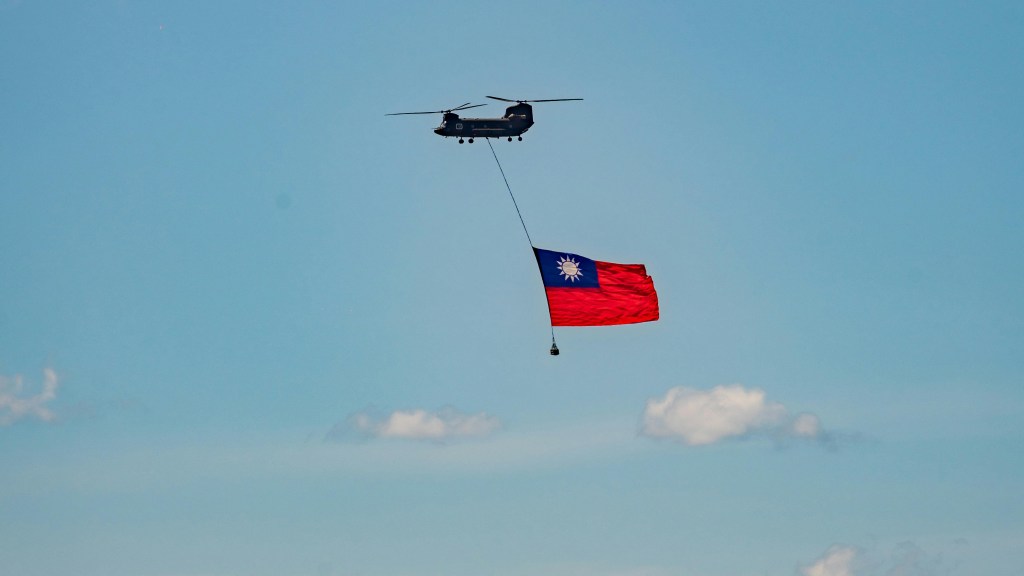
[Cover image]: Helicopter Flying Over Taiwan Skyline Displaying Flag (https://www.pexels.com/photo/helicopter-flying-over-taiwan-skyline-displaying-flag-34244550)Picture by Wei86 Travel (https://www.pexels.com/@wei86-travel-31932701/). Licensed under Pexels (https://www.pexels.com/license/)


Leave a comment