
Artificial Intelligence (AI) has grown exponentially since 2018 [1]. It has fueled a global race for dominance and calls for regulation [3]. While policies, such as the EU AI Act, tend to focus on ethics and data protection, AI’s environmental costs remain underexamined [3]. There are two answers when asking about AI’s compatibility with the environment: 1) its capacity to play a decisive role in mitigating climate change; 2) the impact of AI on the environment and climate change [1].
The environmental impact of AI is difficult to measure accurately [1]. Due to a major lack of transparency from companies and from the models themselves, conceived as “blackboxes”, measurable data is largely inaccessible [1]. Therefore, most of the evidence available is based on a snippet of reality.
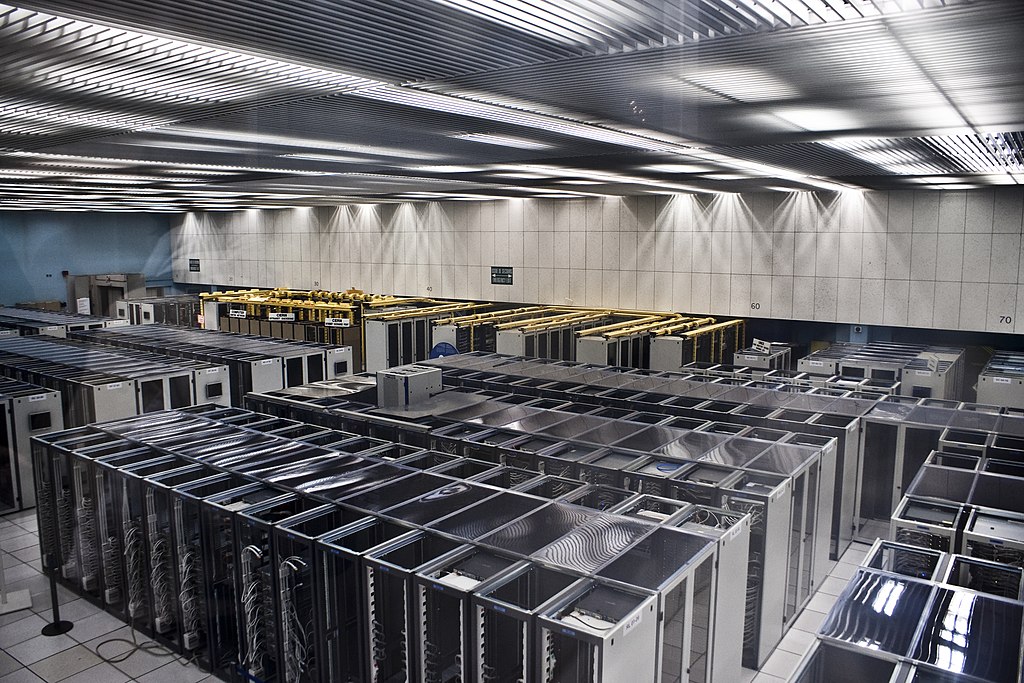
The infrastructure needed to build and operate AI systems poses a problem due to its energy and water-intensive data centers and the need for rare minerals for the hardware [1].
In 2024, 1.5% of global electricity consumption was used by data centers around the world and is expected to rise as AI adoption accelerates [1]. The majority of this power still comes from non-renewable sources, due to the high demand for data centers, which complicates global decarbonisation plans [2]. Construction and operation practices are frequently unsustainable [2]. The acceleration of demand for energy risks straining the grid, prompting operators to rely on diesel-based generators to absorb fluctuations and protect the grid, thus undermining decarbonisation efforts [2].
Training a single large model like OpenAI’s GPT-3 required about 1287MWh of electricity, roughly equivalent to the annual consumption of 120 average homes in the US [2]. Considering the short shelf life of Gen-AI models, often replaced within weeks or months by more parameter-heavy successors, the vast amount of electricity used to train previous models yields no long-term utility [2]. This highlights an inefficiency in AI innovation, one of energy intensive progress without lasting output.
To give an example, asking an AI model 15 questions and then generating 10 images and 3 attempts for a five-second video requires enough electricity to ride 100 miles on an e-bike or to run the microwave for over three and a half hours [6].
Beyond energy, AI’s operation consumes vast amounts of water, primarily for the cooling of data centers [6]. According to research, data centers are estimated to consume 2L of water for every 1 kW per hour of energy used in the data center [2]. In regions where water is becoming scarce, this poses a threat on water priorities. The example of Taiwan is very telling; in 2021, the government issued water rationalisations prioritising the semiconductor industry over agriculture, as these parts are essential in the building of supercomputers [7]. The reallocation of water through rations, from agriculture to semiconductor manufacturing illustrates how AI’s growth not only reshapes environmental policies but national priorities as well.
The minerals necessary for the production of semiconductors and supercomputers, namely lithium, boron, silicon and graphite, are mined unsustainably [3]. The mining and processing of these minerals has significant impacts on the environment and contributes to biodiversity loss, land and water degradation, and human health [1]. As demand rises for AI infrastructure and its use, so do the direct impacts on the environment, and shifts away from the expansion of renewable energy [1]. This competition for minerals underscores the need for global governance of mineral resources.
It is known that AI can strongly contribute to tackling some of the largest environmental challenges faced globally. It has been used to chart methane emissions and other Green House Gases as well as map the dredging of sand [3]. AI’s ability to model complex data sets has already played a crucial role in developing solutions to measure deforestation. Green tech, today, has largely implemented the use of AI which drives the ability to provide concrete solutions, such as optimising the placements of renewables, and streamline the distribution of energy [9]. AI is also being used in agriculture, enabling precision farming through insights gathered on soil conditions, irrigation needs, and crop health which allows the industry to make better use of its resources while reducing its environmental impact [9]. Looking ahead, emerging technologies like quantum computing could amplify this potential even further [4].
Quantum computing has been increasingly researched as a way to alleviate and overcome AI’s shortcomings. Quantum computers excel at processing complex data and solving problems going beyond the reach of traditional computers (supercomputers included) [4]. In the case of climate change, which requires the analysis of vast amounts of datasets, quantum computing could significantly improve the ability to mitigate climate change’s effects [4]. The energy consumption is also drastically reduced – supercomputers require MegaWatts whereas quantum computers consume kilowatts [8]. Experiments using quantum computing with AI have yielded some promise, yet it has been found that there is a need for much powerful quantum computers to effectively apply quantum computing to AI [5].
Edited by Jules Rouvreau.
References
[1] Reitmeier, L. and Lutz, S. (2025) What direct risks does AI pose to the climate and environment? London: Grantham Research Institute, LSE. Available at: https://www.lse.ac.uk/granthaminstitute/explainers/what-direct-risks-does-ai-pose-to-the-climate-and-environment/ (Accessed: November 16 2025).
[2] Zewe, Adam. “Explained: Generative AI’s environmental impact.” MIT News, January 17, 2025. Available at: https://news.mit.edu/2025/explained-generative-ai-environmental-impact-0117. (Accessed: November 18 2025).
[3] United Nations Environment Programme (UNEP) (2024) ‘AI has an environmental problem. Here’s what the world can do about that.’ UNEP News & Stories. Available at: https://www.unep.org/news-and-stories/story/ai-has-environmental-problem-heres-what-world-can-do-about (Accessed: November 12 2025).
[4] VivaTech (2025) Understanding climate change through quantum AI. Available at: https://vivatechnology.com/news/understanding-climate-change-through-quantum-ai (Accessed: 19 November 2025).
[5] Kleinman, Zoe (2025). “Will quantum be bigger than AI?” BBC News. Available at: https://www.bbc.com/news/articles/c04gvx7egw5o. (Accessed: November 19 2025).
[6] O’Donnell, J. and Crownhart, C. (2025) ‘AI energy usage, climate footprint & Big Tech’, MIT Technology Review, 20 May. Available at: https://www.technologyreview.com/2025/05/20/1116327/ai-energy-usage-climate-footprint-big-tech/ (Accessed: November 15 2025).
[7] U.S. Department of Homeland Security – Advancing Emerging Technologies (2023) Taiwan Supply Chain. Available at: https://experience.arcgis.com/experience/a1ec0d1276064ae387c863f2a14b11e1/page/Taiwan-Supply-Chain(Accessed: November 16 2025).
[8] Pashaei, P. (2025) ‘Can quantum computers address the AI energy problem?’, Quantum Computing Report, 28 March. Available at: https://quantumcomputingreport.com/can-quantum-computers-address-the-ai-energy-problem/#:~:text=A%20classical%20supercomputer%20consumes%20a,by%20a%20domestic%20electric%20oven. (Accessed: November 14 2025).
[9] Bou, E. (2024) ‘Green AI: The yin-yang of a breakthrough’, Forbes, 16 December. Available at: https://www.forbes.com/sites/elenabou/2024/12/16/green-ai-the-yin-yang-of-a-breakthrough/ (Accessed: November 19 2025).


Leave a comment