By Cyprien Guillot de Suduiraut
This article is a short report on the “Dismantling Drug Trafficking Networks: Analytical Approaches and European Coordination” panel held at the Milipol Paris trade exhibition in November 2025 [1]. I would like to thank ESCPrit Défense for offering the opportunity to attend this leading event on homeland security [2].
Four panellists delivered remarks on the current threats posed by drug trafficking networks in France.
OFAST [3] Deputy Head Christian de Rocquigny opened the discussion by underscoring the undeniable gravity of the situation. Between 2023 and 2024, seizures of cocaine, ecstasy, and synthetic drugs in France rose by 130%, 123%, and 133%, respectively [4]. Subsequent data presented to the audience indicated that this upward trend continued into 2025, with cocaine and amphetamine confiscations rising by a further 20%. This expansion has coincided with sustained declines in both wholesale and retail prices over recent years.
The panellist bluntly criticised recurring liberal calls within segments of the French political sphere to decriminalise drug use [5]. To this end, he recalled the tragic case of a five-year-old child from Brittany who died in early 2025 after ingesting portions of cocaine belonging to his parents, which had been concealed in the family bathroom [6]. According to him, the impact of hard drugs extends well beyond users themselves, as they tend to affect families and close relatives too, thereby rendering any prospect of legalisation ethically indefensible.
Mr. de Rocquigny also drew attention to the surge in violence driven by the growth of trafficking networks. Once largely confined to confrontations among criminal groups, such violence has increasingly spread into the broader social sphere. This alarming shift was recently illustrated by the assassination of the younger brother of Amine Kessaci, a prominent environmental and anti-drug activist based in Marseille [7]. It is widely suspected—including by Kessaci himself—that the killing was nothing else than an act of intimidation intended to silence a prominent public opponent of drug dealers. Should ongoing investigations confirm this hypothesis, it would constitute a serious challenge to the rule of law in France [8].
The specialist finally stressed the fact that rising drug crime levels were indiscriminately generating money laundering and corruption—in addition to sowing death—all over the territory of metropolitan France. In this regard, European drug trafficking is incrementally becoming very similar to its Latin American counterpart, with terrorist overtones. Examples proving this evolution include the series of coordinated attacks on French prisons in April 2025 or the deadly May 2024 attack on a penitentiary convoy to liberate Mohamed Amra—an alleged drug lord with supposed ties to organised crime gangs in Marseille—which resulted in the death of two prison officers [9] [10].
Mr. de Rocquigny pointed out that traffickers generally use more advanced technological means than other types of terrorists (e.g. jihadists). Their modus operandi implies quietly running businesses with large sums of money at stake and avoiding direct clash with police forces—something Islamists, conversely, cannot conceive when planning their actions. Therefore, drug dealers invest in better solutions to dodge any possibilities of being arrested. This is paradoxical, since according to the speaker, the most advanced tools of French authorities are being focused on hunting down ‘classic’ terrorists rather than drug traffickers.
Captain Anna Berthelot of the Criminal Research Institute of the French National Gendarmerie (IRCGN) then took the floor. She outlined the Institute’s analytical work on seized narcotics, aimed at determining both their provenance and purity levels. Whereas cocaine previously averaged 30–40% purity, recent laboratory findings indicate a steady arithmetic increase over the past months, a trend researchers anticipate will persist in the near future.
EIPS promotion

Regarding source attribution, Captain Berthelot highlighted significant advances achieved by the IRCGN in cooperation with its partners. She noted that existing databases have reached a level of maturity sufficient to pinpoint patterns and suggested that determining a product’s origin solely through laboratory analysis may soon be feasible. Such capabilities would enable authorities to reconstruct international trafficking routes with greater accuracy, thereby enhancing the effectiveness of counternarcotics strategies [11]. Moreover, she underscored the critical importance of cooperation, not only at the European level but also with law enforcement agencies in the Americas.
Europol officer Jean-Christophe Belle subsequently described the diversification of narcotics entry points into Europe. While long-established major ports such as Hamburg have experienced a decline in inbound flows, smaller and previously secondary ports are witnessing a corresponding increase.
Mr. Belle further argued that Europe has increasingly become a production hub for synthetic drugs. Criminal cartels and trafficking organisations are now more deeply embedded in several European countries, contributing to surges in violence and corruption, notably in Sweden, Belgium, and the Netherlands.
He also stressed the urgency of strengthening cooperation between European and non-European law-enforcement bodies to enable the worldwide seizure of criminal assets. This enforcement mechanism is relatively well established within the European Union but remains far more difficult to implement on a global scale [12].
Lastly, the panellist addressed the growing use of artificial intelligence in intelligence-gathering activities. While he described AI as a powerful instrument for streamlining data processing, he asserted that it is not yet considered sufficiently reliable to conduct advanced analytical assessments, which remain the responsibility of human analysts.
Béatrice Brugère, Deputy Prosecutor at the Judicial Court of Paris, followed on the topic of artificial intelligence. She lamented the magistracy’s backwardness in terms of integration of AI, despite the substantial backlog of cases—each involving hundreds of procedural steps—awaiting adjudication. In her view, the French justice system remains insufficiently trained in this domain, even though technological proficiency will be essential to addressing future drug-related challenges. This shortcoming, she argued, reinforces France’s attractiveness to major criminal organisations by creating a particularly favourable balance between potential gains and the risk of repression.
She further contended that the primary advantage of such organisations lies in their legal agility, in contrast with a judicial framework that is inherently slow to adapt. Benefiting from a persistent lead over the courts, they readily exploit regulatory and procedural gaps. Against this backdrop, she welcomed the planned establishment, in early 2026, of a new prosecutor’s office for national organised crime (Parquet national anti-criminalité organisée; PNACO) in compliance with legislation adopted by the French parliament on June 13th, 2025 [13]. This new institution, along with other legislative provisions, will greatly assist the authorities in analysing criminal organisations’ inner workings. It constitutes a first step in the development of anticipation skills within the French judiciary—one that could eventually make the state regain control of the situation in the long run.
On a less positive note, the speaker criticised the lack of funding to train or recruit new judicial officers, although assisting positions are going to be crucial to fill in the coming months and years to support judges in their fight against criminals.
Mrs. Brugère finally addressed the sensitive issue of security within French prisons, particularly the challenge of preventing high-ranking incarcerated criminals from continuing to direct illicit activities from their cells through encrypted social media platforms. In this context, she welcomed several recent measures initiated by Justice Minister Gérald Darmanin, including the establishment of ‘high-security units’ within prisons (a controversial initiative eventually upheld as lawful by the French Conseil d’État [14]) as well as his proposed ‘zero phone’ policy aimed at ensuring that no illicit communication devices capable of contacting the outside world enter French detention facilities [15].
These decisions made by the Keeper of the Seals are directly inspired from Italian policies, which Mrs. Brugère presented as a benchmark. She referred in particular to Italy’s well-known Article 41-bis prison regime (also known as carcere duro, denoting a ‘hard’ or ‘strict’ custodial framework) which allows for the complete isolation of certain detainees, namely individuals convicted of mafia-related offences. The prosecutor described this provision as an “exceptionally precise piece of legislation” successfully reconciling democratic principles with robust security safeguards, two concepts that are often, in her view, mistakenly portrayed as incompatible in public discourse [16].
This is how the Italian state achieved the adaptation of its prisons to mafia-related threats and got rid of most of traditional Camorra clans—even though the Camorra itself remains active to this day since its decentralised structure enabled internal renewal following the dismantlement of specific groups.
Mrs. Brugère concluded her intervention by emphasising that such positive outcomes, as demonstrated by the Italian case, can be obtained without having to resort to more radical models, such as the Salvadoran approach promoted by dictators in the making like Nayib Bukele.
Edited by Jules Rouvreau.
References
[1] Milipol Paris. (n.d.). Milipol Paris: International event for homeland security. https://www.milipol.com/en
[2] ESCPrit Défense. (n.d.). ESCPrit Défense [LinkedIn page]. LinkedIn. https://www.linkedin.com/company/escprit-defense/
[3] Office anti-stupéfiants. (n.d.). Office anti-stupéfiants (OFAST).
[4] Ministère de l’Intérieur. (2025). Dossier de presse : Campagne nationale de lutte contre le narcotrafic. https://www.interieur.gouv.fr/sites/minint/files/medias/documents/2025-02/06-05-25-dossier-de-presse-campagne-contre-narcotrafic-accessible.pdf
[5] Assemblée nationale. (2025). Rapport d’information n° 974 : Recommandation n° 45 (p. 313). https://www.assemblee-nationale.fr/dyn/17/rapports/cion_lois/l17b0974_rapport-information.pdf
[6] France Bleu. (2025, April 2). Saint-Brieuc : l’enfant qui avait avalé de la cocaïne est mort à l’hôpital. https://www.francebleu.fr/infos/faits-divers-justice/saint-brieuc-l-enfant-qui-avait-avale-de-la-cocaine-est-mort-a-l-hopital-8234316
[7] Kessaci, A. (2025, November 19). No, I will not stay silent. I will say and repeat that my brother Mehdi died for nothing. I will speak out about the violence of drug trafficking. Le Monde. https://www.lemonde.fr/en/opinion/article/2025/11/19/activist-amine-kessaci-no-i-will-not-stay-silent-i-will-say-and-repeat-that-my-brother-mehdi-died-for-nothing-i-will-speak-out-about-the-violence-of-drug-trafficking_6747608_23.html
[8] Albertini, A., & Rof, G. (2025, November 14). Brother of Marseille anti-drugs figure murdered on street. Le Monde. https://www.lemonde.fr/en/france/article/2025/11/14/brother-of-marseille-anti-drugs-figure-murdered-on-street_6747461_7.html
[9] Biseau, G., Leroux, L., & Saintourens, T. (2025, April 16). French prison attacks: Investigators explore all leads, from drug traffickers to the far left. Le Monde. https://www.lemonde.fr/en/france/article/2025/04/16/french-prison-attacks-investigators-explore-all-leads-from-drug-traffickers-to-the-far-left_6740286_7.html
[10] Lamche, A. (2024, May 14). Mohamed Amra – the escaped French prisoner known as “The Fly”. BBC News. https://www.bbc.com/news/world-69012563
[11] Europol. (2025, January 17). Europol holds largest-ever operation to increase seizures of criminal assets worldwide. https://www.europol.europa.eu/media-press/newsroom/news/europol-holds-largest-ever-operation-to-increase-seizures-of-criminal-assets-worldwide
[12] Assemblée nationale. (2025). Projet de loi adopté relatif à la lutte contre le narcotrafic. https://www.assemblee-nationale.fr/dyn/17/textes/l17t0102_texte-adopte-seance.pdf
[13] Conseil d’État. (n.d.). Prisons : Les quartiers de lutte contre la criminalité organisée sont légaux. https://www.conseil-etat.fr/actualites/prisons-les-quartiers-de-lutte-contre-la-criminalite-organisee-sont-legaux
[14] Ministère de la Justice. (n.d.). Gérald Darmanin annonce un plan pour lutter contre les objets illicites en détention. https://www.justice.gouv.fr/actualites/actualite/gerald-darmanin-annonce-plan-lutter-contre-objets-illicites-detention
[15] European Court of Human Rights. (2007). Judgment concerning the Italian “41-bis” prison regime.
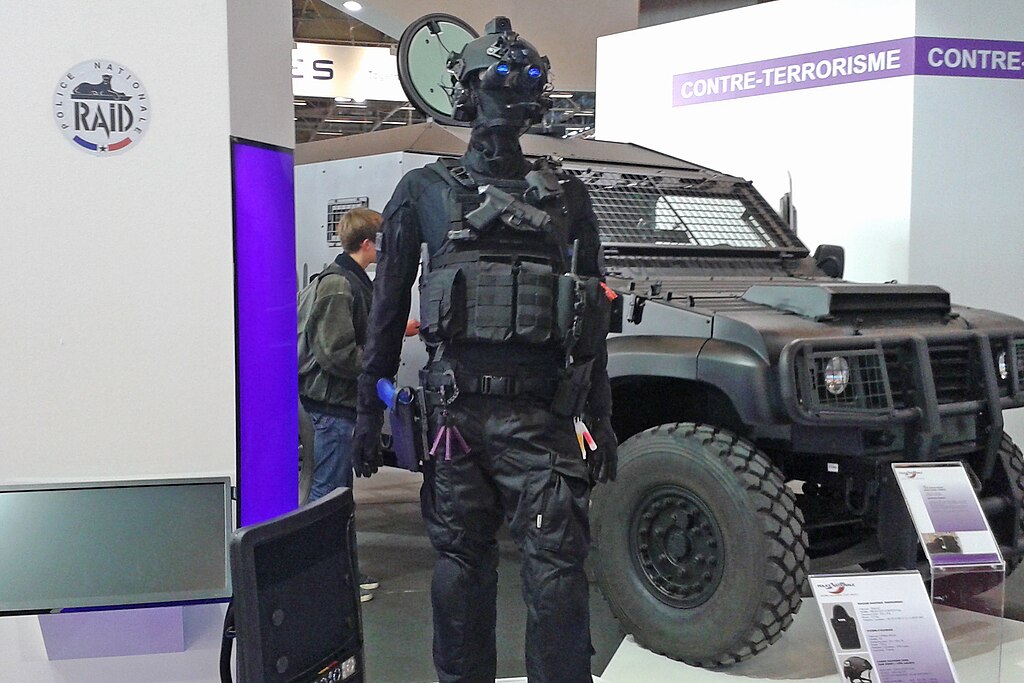
[image] Domenjod. (2015, November 18). RAID equipment on display during the Milipol exhibition — Paris, November 2015 [Photograph]. Wikimedia Commons. https://commons.wikimedia.org/wiki/File:RAID1_Domenjod_18112015.jpg


Leave a comment