

Introduction
COP30 took place at the mouth of the Amazon River in late 2025, making it the 9th COP since the historic Paris Agreement in 2015, and the memorable 1.5°C goal on global warming. Since then, according to the UN Environment Programme’s Emissions Gap Report, the world is likely to exceed that target with current emissions levels. (The UN body expects 2.3°C to 2.5°C increase in average global temperatures by the end of this century if Nationally Determined Contributions are upheld) [1].
During the conference, while many world leaders pledged continued efforts to reduce emissions, there was little agreement on how much and how deeply the states need to commit, raising questions on how successful the conference actually was in terms of realpolitik to reduce emissions. The American uncertainty surrounding engagement in multilateral climate processes under the Trump administration gave China the opportunity to speak to the assembly [2].
China’s Central Message at COP30
Vice Premier Ding Xuexiang took the stage and pledged to work with all parties and abide by the principle of common but differentiated responsibilities. The special representative of President Xi reaffirmed China’s climate commitments in the midst of a split Western consensus. Already on President Trump’s first day in office in 2025 did he re-withdraw from the Paris Agreement, weakening coherence and confidence in Western commitments [3] [4].
In contrast to the West, China is exemplifying how to marry economic development with green development—a riddle most Western nations are still trying to solve. It has successfully positioned itself as pro-cooperation actor with emphasis on global governance on climate change. That has portrayed climate action positively rather than as a burden, thus becoming a leading actor.
The same line of thought is reported by Reuters, stating that “…China is stepping into the limelight as a leader in the fight against global warming” [5]. They are simultaneously appearing as a uniting force by strengthening multilateralism and moving away from the unipolar world of US-centered leadership. Finally, rather than merely promoting sustainable ideals at COP, developed countries should focus on delivering concrete outcomes on climate finance, particularly addressing the gap in financing capacity between developed and developing countries. In this context, China’s stance signals a willingness to assume responsibilities traditionally associated with developed economies. While the EU, UK and Japan have pledged to finance sustainable development, little funding has been provided, citing “domestic fiscal pressures” [6].
Green Transition Metrics
China is ambitious in its energy transition, having invested over $818 bn into green sectors in 2024. Accounting for a significant forty percent of total global investment, which is more than double any other country. Even in 2023, China’s total investment exceeded that of the US, EU, and UK combined. This helps explain why China can credibly meet its financing commitments as stated at Belém. While the largest investment has gone to EVs, investments have also been substantial in renewables such as on-and offshore wind, solar and biofuels. As stated by Bloomberg, these technologies are “…proven, commercially scalable, and have established business models…” [7].
Such factors underpin significant investment in key industries and help explain China’s success in advancing green technologies without sacrificing economic growth. It is helpful that launching on the domestic Chinese market allows for early-stage adoption, growth and finally international launch at maturity. This is how China can effortlessly set the prices low and gain widespread adoption for green technologies, including solar panels, EVs and their batteries [8]. The graph below shows the figures by which China is overtaking solar panel and wind turbine industries on a global scale, acting as a mere visual representation of the significance China is determined to have during our lifetime.
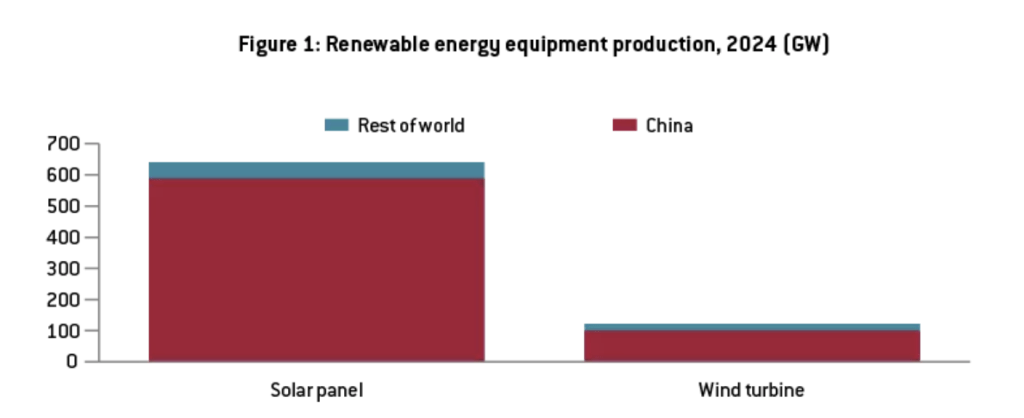
Figure 2. Renewable energy equipment production, 2024 (GW). Reproduced from Bruegel, China Can Decarbonise the World (Even If It Won’t Fix Its Overcapacity Problem).
Recently, Carbon Brief, a not-for-profit journalistic organisation reporting on climate change and sustainable development has noted that China’s CO2 emissions have been falling since March 2024. This is largely due to the industry development model as mentioned above [9]. It is crucial that China meets its climate commitment goals, since China is responsible for around 30% of global emissions [10]. Around ninety percent of these emissions are linked to energy production and consumption, a domain in which China is dominant [11]. Still, CO2 emissions in China have been stable and falling over the past 18 months, as shown by the figure below.
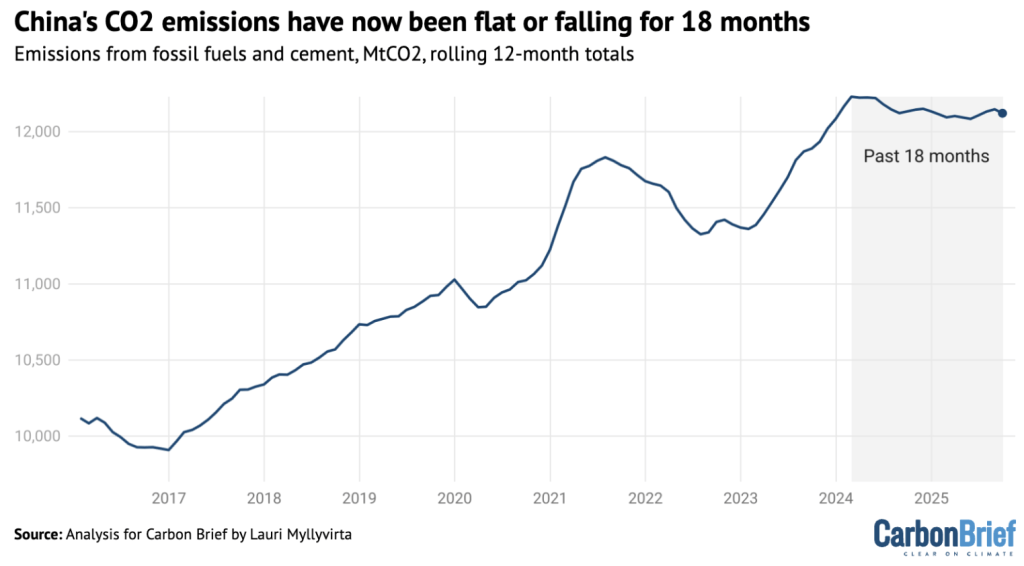
Figure 3. China’s CO2 emissions have been flat or falling for 18 months. Emissions from fossil fuels and cement (MtCO₂), rolling 12-month totals. Source: Carbon Brief.
The Western Dilemma
While China is gaining more and more traction and relevance on the stage of sustainability, the Western world is becoming increasingly fragmented. President Trump has effectively withdrawn from the Paris Agreement, absent from Belém, and thus becoming the counterbalance to the multilateral movement against climate change. The US administration aims to decrease other states’ climate commitments too [12]. Just in October of last year, as multiple countries from around the world came together to adopt an international deal to reduce emissions in the shipping industry, did the US administration use economic coercion and the threat of renewed tariffs to successfully halt the agreement [13].
In the UK, the net zero goal of 2050 has been “watered down or scrapped”, according to the Guardian. In the private sphere, BP and Shell have both decreased their climate engagements in order to refocus on fossil fuel activities, whilst HSBC has pushed their own climate goals back by 20 years. Vanguard and Blackrock also turned their back on commitments in green investment. Lobbying in the transport industries across the UK, EU and the US has also proven to decrease commitment across the board. This goes to show the stagnation in Western efforts to reduce emissions. Western nations are thus slowing the pace of the transitions they themselves set in motion, creating uncertainty and fragmentation. This deceleration opens space for China and other emerging economies to position themselves as leaders in innovation and large-scale industrial growth in green sectors [14].
Conclusion
There is clear leeway for emerging economies to gain traction in green industries and take responsibility for the emissions that have built wealth and a high quality of life in the Western world. China is moving to the forefront ever more and seeking to occupy the leadership that the US has vacated. They are simultaneously taking responsibility for their emissions like the West struggles to.
We have yet to see how Chinese commitments will manifest and only the future will show how China might affect global emissions and sustainable development. If China is able to sustain economic growth while reducing its carbon footprint through green investment and development, they will not only show the world that it is possible, they will make the biggest impact on combatting climate change that the world has ever seen. Whether this leadership translates into sustained global emissions reductions will ultimately depend on how China balances industrial expansion with long-term decarbonisation goals. Done successfully, it could result in China credibly moving forward in geopolitics, tech, and international trade.
Edited by Felix Dubé.
References
Figure 1. Stuckert, Ricardo. 06.11.2025 – Recepção Oficial dos Chefes de Delegação da Cúpula do Clima. Wikimedia Commons, 6 Nov. 2025,
Figure 2. Bruegel. China Can Decarbonise the World (Even If It Won’t Fix Its Overcapacity Problem). Bruegel, 2024, https://www.bruegel.org/analysis/china-can-decarbonise-world-even-wont-fix-its-overcapacity-problem
Figure 3. Myllvirta, Lauri. China’s CO2 Emissions Have Now Been Flat or Falling for 18 Months. Carbon Brief, 2024, https://www.carbonbrief.org/analysis-chinas-co2-emissions-have-now-been-flat-or-falling-for-18-months/
[1] “The World Is Likely to Exceed a Key Global Warming Target Soon. Now What?” UNEP, 2025, www.unep.org/news-and-stories/story/world-likely-exceed-key-global-warming-target-soon-now-what. Accessed 29 Jan. 2026.
[2] Staff, Carbon Brief (2025, November 5) COP30: What does the ‘Baku to Belém Roadmap’ mean for climate finance?
https://www.carbonbrief.org/cop30-what-does-the-baku-to-belem-roadmap-mean-for-climate-finance/ (Carbon Brief)
[3] Catalina Turcu (2025, December 11) Why global environmental negotiations keep failing and what we can do about it
https://theconversation.com/why-global-environmental-negotiations-keep-failing-and-what-we-can-do-about-it-269749 (The Conversation)
[4] Eleni Lazarou and Gabija Leclerc (2025, February 5) US withdrawal from the Paris Climate Agreement and from the WHO
https://www.europarl.europa.eu/thinktank/en/document/EPRS_ATA%282025%29767230 (European Parliament Think Tank)
[5] Valerie Volcovici, and Lisandra Paraguassu (2025, November 15) China finds bigger role as US sidesteps Brazil climate summit https://www.reuters.com/sustainability/cop/china-finds-bigger-role-us-sidesteps-brazil-climate-summit-2025-11-15/ (Reuters)
[6] Staff, Carbon Brief (2025, November 23) COP30: Key outcomes agreed at the UN climate talks in Belém
https://www.carbonbrief.org/cop30-key-outcomes-agreed-at-the-un-climate-talks-in-belem/ (Carbon Brief)
[7] BloombergNEF (2025, January 30) Global Investment in the Energy Transition Exceeded $2 Trillion for the First Time in 2024, According to BloombergNEF Report
https://about.bnef.com/insights/finance/global-investment-in-the-energy-transition-exceeded-2-trillion-for-the-first-time-in-2024-according-to-bloombergnef-report/ (BloombergNEF)
[8] Anika Patel (2025, February 20) Explainer: How China’s renewable pricing reforms will affect its climate goals
https://www.carbonbrief.org/explainer-how-chinas-renewable-pricing-reforms-will-affect-its-climate-goals/ (Carbon Brief)
[9] Lauri Myllyvirta (2025, November 11) Analysis: China’s CO2 emissions have now been flat or falling for 18 months
https://www.carbonbrief.org/analysis-chinas-co2-emissions-have-now-been-flat-or-falling-for-18-months/ (Carbon Brief)
[10] Chen, Xihui Haviour, et al. “Assessing the Environmental Impacts of Renewable Energy Sources: A Case Study on Air Pollution and Carbon Emissions in China.” Journal of Environmental Management, vol. 345, no. 118525, 1 Nov. 2023, p. 118525. Science Direct, www.sciencedirect.com/science/article/pii/S0301479723013130, https://doi.org/10.1016/j.jenvman.2023.118525. Accessed 27 Jan. 2026.
[11] “Executive Summary – an Energy Sector Roadmap to Carbon Neutrality in China – Analysis – IEA.” IEA, 2021, www.iea.org/reports/an-energy-sector-roadmap-to-carbon-neutrality-in-china/executive-summary Accessed 27 Jan. 2026.
[12] Grown, Caren, et al (2025, November 10) What Will COP30 Mean for Climate Action? www.brookings.edu/articles/what-will-cop30-mean-for-climate-action/ (Brookings)
[13]Stallard, Esme. “Landmark Global Shipping Deal Abandoned under US Threats.” BBC, 17 Oct. 2025, www.bbc.com/news/articles/c3vnl0yxg53o. Accessed 29 Jan. 2026.
[14] Butler, Sarah, et al (2025, December 20) Was 2025 the Year That Business Retreated from Net Zero? https://www.theguardian.com/environment/2025/dec/20/was-2025-the-year-that-business-retreated-from-net-zero (The Guardian)


Leave a comment