Days on Earth nowadays resemble a bit to Orwell’s imagination. Not a world of omnipresent tyranny — maybe just yet — but one in which unthinkable disruptions arrive with uncomfortable regularity.
April 28th 2025 in Spain illustrates this, as the Iberian country faced an unprecedented nationwide power blackout. In some parts the convivial Spanish streets were filled with music, footballs, chessboards and face-to-face discussions — not very Orwellian now. Meanwhile also, trains didn’t work, nor did mobile networks or phone calls, or digital payments. With credit card systems down, longly unappreciated euro bills became substantial [1].
Because cash is coming back — so have said Al Jazeera [2] and BBC [3]. Whether it’s the 100USD Franklin bill, the British royal pound or the colorful EU banknotes, all are coming back, for contingencies like the mentioned one and others reasons too. In the UK, cash payments have risen for a third year in a row [3]. “We’re seeing more people use the ATMs and getting cash out”, said Mark Nalder, director of Payment Strategy for Nationwide [3].
In the Old Continent, warmer countries are historically more cash oriented [4], sometimes for tax avoidance reasons [5]. In Northern countries however, the buzz of mobile phones announcing the payment was through has quickly extinguished physical notes and coins [4]. In Sweden for instance, digital payments account for 90% of purchases and only 1% of GDP [5]. Compare that to Japan, where paper and metal Yen constitute 22% of GDP [5].
Uncle Sam is a strong cash user too, having twice as many ATMs per person as Europe does [5]. PWC’s 2025 Holiday Outlook shows a 7% increase in cash use from previous year, 48% of US consumers expecting to use it among top 3 payment methods this year [2]. Gift cards [2] and Peace prizes are on the rise too.
And don’t get ourselves wrong, cash usage is not increasing compared to a decade ago when 79% of Euro zone payments were in cash [5]. Today, bank notes account for less than 50% and no-cash signs are still surging [5]. With the pandemic, spending habits changed [7], cashless life-style doubling from 7 million to almost 14 million between 2019 and 2020 [8]. The ECB (European Central Bank) even stopped issuing 500 euros bills [5]. But now, after an e-wallet rulership through and after Covid, people have surprisingly started taking more cash — as stated by PWC [6].
The first of the reasons is safety and easiness. Last year, Sweden had 130,000 victims of online fraud — summing a total of 270 million dollars swindled in the past half-decade [2]. If such tech-efficient furniture assembly country suffers this amount of scams, imagine other countries. In the Euro zone for example, 58% of consumers say being concerned about privacy when performing digital payments [9]. For those who think this way, cash seems to offer simplicity in an environment where every card triggers fees and data tracking [6]. It can also be frustrating for older people to employ bank cards and apps [5]. And some poorer people may not even be able to open bank accounts at all [5]. Taking all this into account, the EU top court ruled in 2021 that paper money should be accepted [5].
Safety and security now feel more than ever really important, and, as our every-day digital payments rely on Visa and Mastercard, it is natural to wonder how reliable are these American firms facing such uncertain political leaders [5]. Perhaps that explains EU member states recently in December reaffirming their desire to ban businesses from refusing notes and coins [5].
The second reason is budgeting. Studies show how the act of parting with money activates the anterior insula brain region, the same processing actual emotional pain [10]. This accentuates when pulling cash out from the wallet, but swiping a card takes the pain out of purchasing [10]. Tiktokers like Euphemia Moore — better known as She’s On a Budget — have understood this and started to employ techniques like cash stuffing: separating the money into different envelopes of cash to control spending (groceries, petrol, restaurants…). Beyond the TikTok trend, many consumers are turning to cash to make spending more tangible. Even households earning more than 125,000 dollars are using cash in categories in order to stay in budget [6].
Downsides are missing on interest rates and money losing value. But some really need to feel cash in their pockets to avoid spending excessively. BNPL (Buy Now Pay Later) dominated headlines for sometime, orders would grow by even 9% through methods like this one [6]. On the upside, some businesses offer discounts for cash payments. But the greatest purpose of using cash remains of course controlling one’s expenditure.
The ultimate argument is black swans. Nassim Taleb articulated this theory as an event considered implausible until it happens. Spain’s unprecedented blackout shines as an example. Countries like Finland are working on disruption-proof ATMs, dispensing cash even with systems down [11]. Others like Austria are installing ATM machines in rural areas where ATM networks from commercial banks have disappeared [11]. And Swedish Authorities have urged people to keep enough cash for a week’s groceries and living [2]. Following all this, the ECB published last September a paper advising National governments to introduce guidance suggesting citizens to stockpile sufficient cash to survive 72 hours of disrupted services (sufficient for food, water and medicine) [11]. All of this comes in a time where cyber attacks are more and more recurrent, and a nation needs to be ready for War, pandemics or natural disasters. If following the ECB’s advice, demand for banknotes will only keep increasing, and even in times of blackout — we’ll be seeing them more.
Cash won’t win, but won’t die either. It will not defeat the digital order, but in a world of blackouts, frauds and frictionless spending, consumers have been reminded of the quiet resilience of paper. It’s used less and less — and thus will probably continue — but the renewed clink of coins should make us realise that in today’s unpredictable bit of Orwellian world — cash is coming back.
Edited by Oriane Beveraggi.
References
[1] BBC News. (2025). Blackout in Spain and Portugal ‘first of its kind’, report finds. BBC. https://www.bbc.com/news/articles/cg7d4vjdlrmo
[2] [Channel name]. (2025). Cash makes a comeback in Sweden as digital payments face backlash [Video]. YouTube. https://www.youtube.com/watch?v=wH4rjWFSRH0
[3] BBC News. (2025). Cash payments ‘making a comeback as people budget’. BBC. https://www.bbc.com/news/articles/cew50nnz902o
[4] Euronews. (2025, December 24). The future of cash: How much money do Europeans carry today. Euronews. https://www.euronews.com/business/2025/12/24/the-future-of-cash-how-much-money-do-europeans-carry-today
[5] The Economist. (2026, January 8). Why Europe is rediscovering the virtues of cash. The Economist. https://www.economist.com/europe/2026/01/08/why-europe-is-rediscovering-the-virtues-of-cash
[6] PwC. (n.d.). Future of payments. PwC. https://www.pwc.com/us/en/industries/consumer-markets/library/future-of-payments.html
[7] The Guardian. (2025, January 7). Cash makes surprise comeback amid 46% annual rise in ATM withdrawals. The Guardian. https://www.theguardian.com/money/2025/jan/07/cash-makes-surprise-comeback-amid-46-annual-rise-in-atm-withdrawals
[8] The Guardian. (2021, June 16). Cashless society draws closer with only one in six payments now in cash. The Guardian. https://www.theguardian.com/business/2021/jun/16/cashless-society-draws-closer-with-only-one-in-six-payments-now-in-cash
[9] European Central Bank. (2025). [Article from the Economic Bulletin / SPACE survey]. ECB. https://www.ecb.europa.eu/press/economic-bulletin/articles/2025/html/ecb.ebart202506_02~1a773e2ca3.en.html
[10] Neuroscience Marketing. (n.d.). The pain of paying. Neuroscience Marketing. https://www.neurosciencemarketing.com/blog/articles/pain-of-paying.htm
[11] Financial Times. (n.d.). [Title of the article]. Financial Times. https://www.ft.com/content/9eb622d3-7343-44d5-a75e-e04bfb22117f
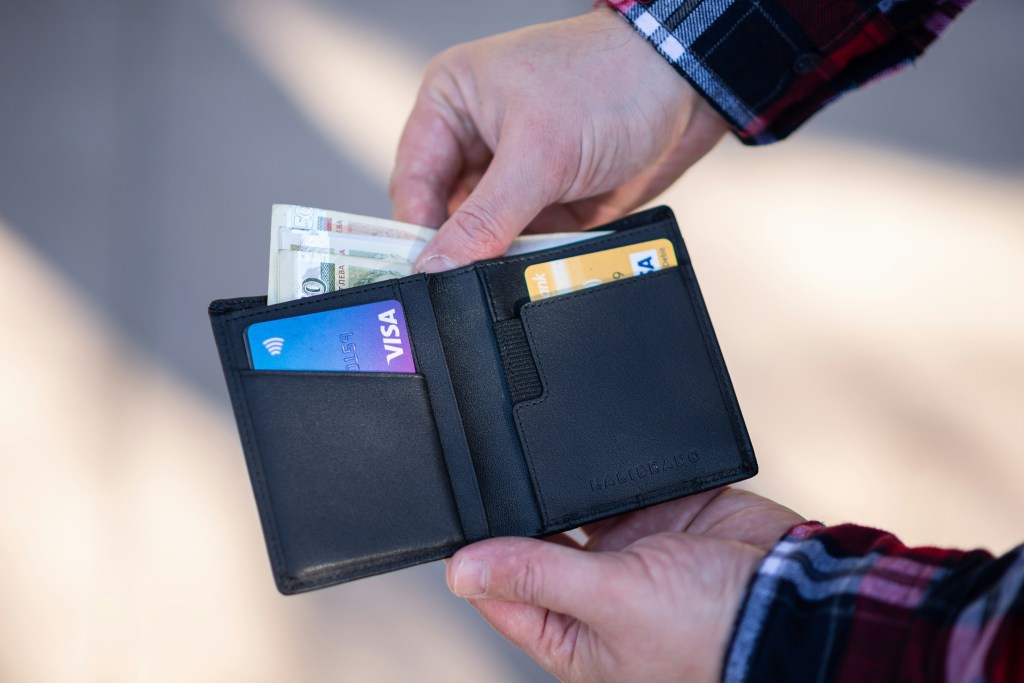
[Cover Image] Emile Kalibradov. (2021). Wallet in hand [Photograph]. Unsplash. https://unsplash.com/photos/2s9N9qHsSCI


Leave a comment