The WEF (World Economic Forum) has recently named the most dangerous threats that have become serious problems for humanity [1]. In the podium appear respectively geoeconomic confrontation as first, then state-based armed conflict, and lastly extreme climate changes [1]. However, the concerns have grown when the situation quickly escalated after the implementation of Trump’s tariffs, and the US military intervention in Venezuela [1]. These tensions have inevitably led to an increase in military spending, as clearly reported by sources such as Statista; indeed, by the end of 2024, the global military spending had reached approximately 2.7 trillion U.S. dollars.
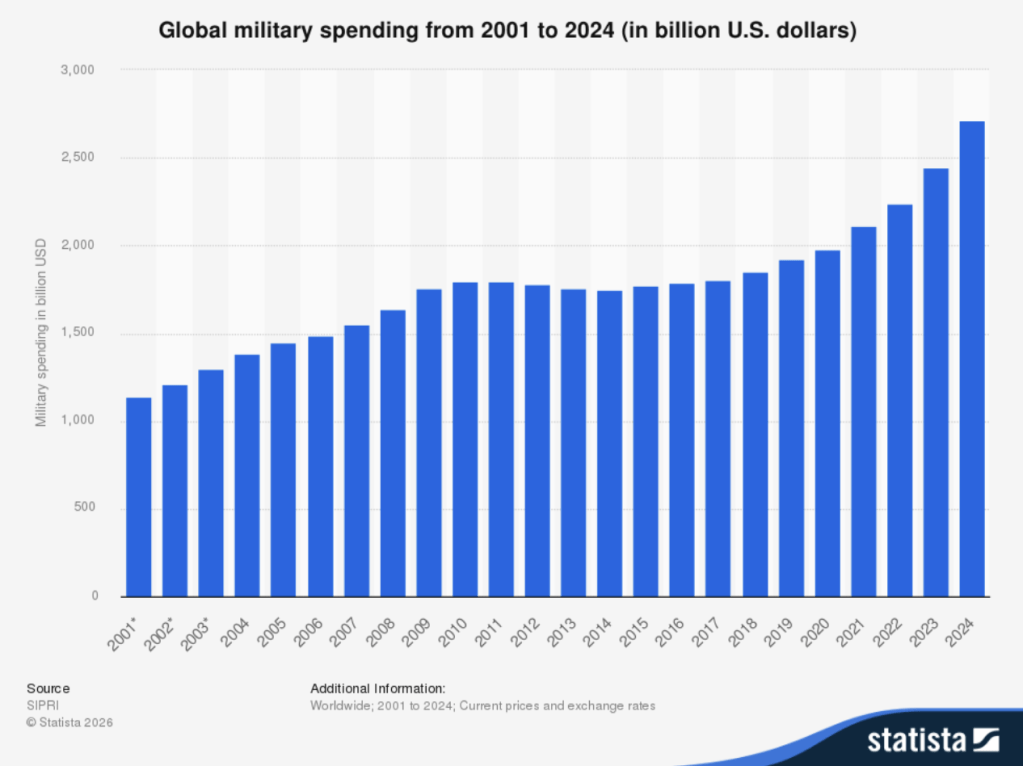
SIPRI, Global military spending from 2001 to 2024 (in billion U.S. dollars) Statista.
UK case – the changes in the army composition
“As the threat to our nation grows, we must ensure our armed forces can draw on the numbers and skills required to meet it,” the Army’s Lieutenant General Paul Griffiths said [4]. One of the issues the British army, and not only, is encountering right now is low monetary resources. This lack of funds by the government undermines the army’s capabilities, and its personnel composition, “We can’t do everything we would want to do as quickly as we would want to do it within the budget that is set” the Chief of the Defence Staff reported to the members of the British Parliament [2].
In addition, linked to this issue, there is the problem of the lack of military personnel, and the numbers show the severity of this situation. UK ‘s military forces are formed by 147,300 personnel, (this number includes both trained and untrained soldiers) [3]. The regular army has just around 73,000 full-time trained soldiers; among the lowest levels in modern British history [3][4]. One of the objectives set in the Strategic Defence Review is to maintain at least 76,000 full-time trained soldiers, and to commit a minimum of 2% of UK’s GDP to defence spending, in line with NATO requirements, while expressing an ambition to increase investment towards 2.5% of GDP in the longer term, and 3% in the next Parliament [7].
The “Dad’s” army
The Ministry of Defence (MoD) has recently announced that from now on, all former service members will be eligible to be called up for duty 18 years after they depart, up to the age of 65. The estimated number of veterans should amount to 95,000 ex-soldiers who would flow into Britain’s army, however no headcount for now was directly published by the Ministry of Defence [5] [6]. This decision may seem paradoxical, in fact, imagining to mobilise soldiers in their late 50s and 60s on the frontline is not ideal, however officers affirmed that this will not happen. The plan of the Ministry of Defence is completely different [5]. Veterans will work in more skill-demanding roles. Depending on their rank, the range of activities they will have to complete includes cyber defence, intelligence, medical intervention, communications, and strategic planning [5].
As stated before, this measure has been considered by the MoD to catch up with the other European armies. In fact, compared to Germany that can call upon 60,000 reserves, Poland that relies on 350,000 reserves, and Finland that boasts a formidable 870,000, the UK’s reserve, without the integration of the veterans, would amount only to 32,000 soldiers [5].
Why these sudden changes? – The threats
The changes the MoD wants to implement are strictly related to different shifts in the world order. The changes that are threatening the UK are diverse. The first problem is related to a growing multipolarity and competition between countries. The US, China, and Russia are fundamental players, and their behaviours influence the whole world balances. China is increasingly developing its economic, technological, and military capabilities, trying to establish dominance in the Indo-Pacific, and to erase US influence. Additionally, Chinese technology and also its proliferation to other countries is already an important challenge for the UK, in fact now the Defence will have to face Chinese technology and adapt quickly to be ready to respond in the right way. Linked to this, the relationship between the US and China is a key factor in a more multipolar world like ours in which global power is more widely distributed across countries [3]. The problem, however, is that this competition is not just between States: terrorist organisations, crime groups, proxy actors, and powerful private players all aim to mould the geopolitical context to their likings. On the other hand, the UK must now face a new Russia [3]. Indeed, the overall modernisation and expansion of Russian military equipment will pose a considerable threat in key areas such as cyberspace, space, undersea warfare, information operations, and chemical and biological weapons [3]. Other two fundamental States that play an important role are: Iran, which is contributing to the destabilisation of the Middle East region sponsoring proxies and partners such as, Hezbollah, the Houthis, Hamas and Iranian‑aligned Iraqi militias, and the DPRK which will continue the pursuit of modernisation of nuclear weapons [3].
Apart from the threat represented by these countries, the race for always new and more powerful technologies has become a real danger [3]. Given this, one of UK’s objectives is to focus on the modernisation of its technologies, this, for instance, includes implementing: artificial intelligence (AI), enhanced precision weapons which struck targets with greater accuracy from even greater ranges, directed energy weapons, such as the UK’s DragonFire, Hypersonic missiles, which travel at extremely high speeds and possess enhanced manoeuvrability, significantly challenge existing missile defence systems, and engineering biology which creates the potential to enhance the capacity of the military through advances in healthcare, medicine, and wellbeing [3].
New vision, a new era
The possibilities of improvement are endless, but action is what is needed.
“We do need to put more into our defences because otherwise it won’t be long before something more significant happens and we will think it should’ve been more of a priority”
Citizens’ Panel member, Rollestone Camp
Defence is not yet prepared for high-intensity conflicts against a similar military power as the UK, indeed stockpiles are not sufficient, the systems are outdated, and innovation is unfortunately slowed down by bureaucracy and the lack of funds. In addition to this, there is also the issue mentioned above linked to the low number of the fully trained operational soldiers employed in the army, and the reserves, a problem that the MoD is trying to solve through the integration of the 95 000 veterans [3].
Even though “transformation” has started, a deeper change is still required, we must understand that a new world order is appearing and the Ministry of Defence, government, industry, and society must adapt to it [3].
Lastly, the purpose of strengthening defence capabilities should not be to normalise war, but to prevent it. The devastating potential of a modern conflict is evident, and already underlined in the following warning:
“I know not with what weapons World War III will be fought, but World War IV will be fought with sticks and stones”
Albert Einstein
Edited by Oriane Beveraggi.
References
[1]Stewart, Heather. “Economic conflicts are world’s greatest risk, WEF survey suggests.” The Guardian, 14 January 2026, https://www.theguardian.com/business/2026/jan/14/economic-conflicts-are-worlds-greatest-risk-wef-survey-suggests Accessed 24 January 2026.
[2] Sheppard, David. “UK lowers threshold to bring older reservists back into service in event of war.” Financial Times, 15 January 2026, https://www.ft.com/content/d174a7e9-a3f5-435b-9434-34d6738effe4 Accessed 24 January 2026.
[3]“Strategic Defence Review 2025 – Making Britain Safer: secure at home, strong abroad.” GOV.UK, 2 June 2025, https://assets.publishing.service.gov.uk/media/683d89f181deb72cce2680a5/The_Strategic_Defence_Review_2025_-_Making_Britain_Safer_-_secure_at_home__strong_abroad.pdf Accessed 24 January 2026.
[4]NICOL, MARK. “Veterans aged up to 65 to be recalled to serve as Russia threat grows.” Daily Mail, 15 January 2026, https://www.dailymail.co.uk/news/article-15467887/Dads-Army-Veterans-recalled-serve-Russia-threat-grows.html. Accessed 24 January 2026.
[5] “UK to Recall Veterans Up to Age 65 to Bolster Forces Amid Russia Threat.” British Brief, 15 Jan. 2026, https://britbrief.co.uk/politics/defence/uk-to-recall-veterans-up-to-65-for-strategic-reserve.html. Accessed 24 January 2025.
[6] “Veterans can be recalled for service until they are 65 under new measures.” Sky News, 15 January 2026, https://news.sky.com/story/veterans-can-be-recalled-for-service-until-they-are-65-under-new-measures-13494705? Accessed 24 February 2026.
[7] Brooke, Louisa. “Strategic Defence Review 2025: The British Army.” UK Parliament, 12 December 2025, https://researchbriefings.files.parliament.uk/documents/CBP-10435/CBP-10435.pdf. Accessed 24 February 2026.


Leave a comment