

By the Editorial Board
After weeks of visible US military reinforcement across the Gulf, President Donald Trump, in coordination with Israel, launched the first wave of strikes against Iranian government infrastructure, plunging the region into open war.
Operation “Epic Fury” was launched with the stated aim of decapitating Iran’s ruling clerical leadership. On the first day of the war, Iran’s Supreme Leader Ayatollah Ali Khamenei, who ruled Iran with an iron fist for nearly four decades, was killed in a strike on his Tehran compound alongside several senior Iranian officials.
Yet the operation’s ultimate political objective remains ambiguous. Some officials have openly framed the campaign as a pathway to regime change, envisioning the emergence of a new leadership more acceptable to the international community. Others appear to suggest a more limited transition — one in which elements of Iran’s political elite remain in place while a different figure assumes power, echoing the Venezuelan scenario in which Nicolás Maduro was removed and replaced by his vice president, Delcy Rodríguez.
Both possibilities carry considerable uncertainty. A genuine regime collapse could trigger widespread unrest and violent repression by Iran’s security apparatus, which has killed thousands during January’s protest. A managed leadership transition, meanwhile, raises its own question: whether the US–Israeli coalition could realistically identify and install a viable political alternative within Iran’s deeply entrenched power structure.
The absence of a clearly articulated political endgame has added uncertainty to a conflict already expanding militarily.
The US military operation against Iran, launched by President Donald Trump from his Mar-a-Lago resort on Saturday, has been defined less by strategic clarity than by a cascade of shifting and often contradictory objectives. Defense Secretary Pete Hegseth attempted to clarify the goals on Monday, describing “Operation Epic Fury” as “laser focused” on destroying “Iranian offensive missiles, Iranian missile production, their navy and other security infrastructure, and ensuring they will never have nuclear weapons.” Yet in the same breath, Hegseth acknowledged that “this is not a so-called regime-change war, but the regime sure did change,” a remark that captured the administration’s confusion about its own objectives [1].
Trump himself has offered multiple, often conflicting rationales since launching what he called a “massive and ongoing operation.” His initial framing encompassed the elimination of Iran’s nuclear and long-range missile capabilities, the destruction of its navy, the neutralisation of its regional proxies, and ultimately regime change [2].
The administration’s inability to define clear war objectives comes as the human cost escalates. Hundreds of Iranians have been killed, six American soldiers are dead — and Trump himself has cautioned that further casualties are likely. The Red Cross now estimates that 200,000 people across the region require humanitarian assistance. Yet, the administration still struggles to explain the fundamental purpose of a war Trump once pledged he would never wage [3]. Secretary of State Marco Rubio explained on Monday the preemptive nature of the strikes, highlighting that “we knew that there was going to be an Israeli action. We knew that that would precipitate an attack against American forces, and we knew that if we didn’t preemptively go after them before they launched those attacks, we would suffer higher casualties”.
Israel’s assault on Iran marks the most direct and violent phase yet in a rivalry that has simmered for decades. Publicly, Israeli officials frame the campaign in narrow, defensive terms. Strategically, however, the objectives appear far more expansive: a bid to decisively tilt the regional balance of power.
Prime Minister Benjamin Netanyahu has been explicit about the campaign’s immediate goals. “We embarked on this mission to remove these two concrete threats against our existence: the nuclear threat, and the ballistic missile threat,” he said, insisting Israel was “very, very close” to achieving those goals [4].
Yet beyond neutralising specific capabilities, Israeli officials and analysts point to a broader ambition – disabling Iran’s capacity to function as a regional peer competitor. After years of attempting to contain Tehran through covert action and deterrence, Israel now appears intent on degrading its rival to the point of strategic irrelevance, consolidating its own position as the Middle East’s dominant military power [5].
Timing has also been political. The strike has shifted international attention away from intensifying criticism of Israel’s conduct in Gaza, potentially reshaping diplomatic dynamics in Europe and Washington. It also disrupts diplomatic engagement between Tehran and the Trump administration, which Israeli leaders feared could produce a nuclear agreement that would ease pressure on Iran and buy it time [6].
Despite notable tactical gains, the campaign’s strategic ceiling remains uncertain. Israel’s ability to permanently dismantle Iran’s most hardened nuclear facilities is widely believed to depend on direct US military involvement. Without it, the damage may be significant but not decisive. For Israel, this is the most ambitious attempt yet to eliminate what it sees as an existential threat.
Iran’s response to the widening confrontation with the United States and Israel marks a break from decades of calculated restraint. What was once a doctrine of controlled provocation has given way to open escalation, driven less by strategic patience than by the imperative of regime survival.
For years, Ayatollah Ali Khamenei adhered to what analysts termed a “no war, no peace” strategy, projecting defiance while avoiding direct confrontation. Tehran expanded its influence through proxy networks in Lebanon, Gaza, Syria and Yemen, carefully keeping major hostilities away from its own territory. The approach allowed Iran to harass its adversaries, extend its reach and limit direct retaliation.
That equilibrium unraveled after Hamas’s October 7, 2023 attack, when Israel sharply raised its tolerance for risk and began striking Iranian assets more directly. “Iran only has bad options now,” said Ellie Geranmayeh of the European Council on Foreign Relations. “Khamenei stuck to this idea of ‘no war, no peace’ for too long. It’s been untenable for years.” [7]
With its proxy infrastructure degraded and its own territory under attack, Tehran now faces a confrontation it long sought to avoid. Iranian officials increasingly frame the conflict as existential. What was once calibrated brinkmanship has become a struggle the leadership portrays as a fight for the regime’s survival.
The shift is visible in Tehran’s expanding target set. During the June 2025 hostilities, Iran largely confined its retaliation to Israel and a carefully signalled strike on a US base in Qatar. After the March 2026 attacks that killed Khamenei and several senior military commanders, however, Iran escalated sharply, striking Gulf energy facilities and civilian infrastructure, moves that crossed previous red lines [8].
Iran’s leadership appears intent on proving that it can still impose significant costs, even under severe pressure. Ali Larijani, a senior security official, declared that “Iran, unlike the United States, has prepared itself for a long war.” By widening the battlefield and targeting energy infrastructure critical to the global economy, Tehran is betting that sustained disruption will erode the resolve of its adversaries [9].
The strategy reflects a regime that no longer sees stability as advantageous. Instead, it appears to calculate that controlled chaos — once a tool of influence — is now its last leverage in an increasingly precarious fight to endure.
As in past and ongoing conflicts in the middle east, civilians are the first victims. On the first day of the war on Saturday, a girl’s primary school was reportedly hit by joint US and Israeli missiles in southern Iran, with the death toll rising to well over a hundred. In a statement released on social media, UNESCO described the strike as a grave “violation of humanitarian law” [10]. After Hezbollah entered the conflict on Monday, launching rockets at Israel, retaliatory salvos were fired at the Lebanese group, many in central Beirut, killing 52 and injuring another 154. Additionally, the Lebanese ministry of social affairs registered nearly 30,000 people displaced from the south of the country as tensions mount [11].
Iran too, in its strikes across the Middle East, has targeted urban centres. On Sunday morning, an Iranian ballistic missile hit central Israel, killing at least 9 residents and injuring dozens. Similar strikes have also hit central Tel Aviv [12].
When missiles and drones are not directly targeted, the debris causes devastating physical and material damage. Bahrain, the United Arab Emirate, Saudi Arabia, Jordan, Kuwait, Oman, Qatar have all suffered direct hits, most targeted towards US military assets in the region, with others hitting civilian infrastructure. Images of the five-star luxury hotel Fairmont in Dubai getting directly hit by an Iranian kamikaze drone on Sunday have made headlines worldwide [13].
On the economic front, the situation is highly volatile and risks worsening. Oil prices already soared from $65 on February 25 to $85 today [14]. As of Tuesday 3, traffic in the strait of Hormuz — one of the major choke points in oil supply by sea — is down nearly 80%. This will unequally affect crude oil exports as 70% of those are going to Asia. Qatar’s state-owned gas company halted all production of LNG on Monday, after multiple strikes on its facilities, sending gas prices up by as much as 50% after the announcement. On top of 2 tankers being directly hit in the strait by Iranian missiles, regional production facilities and refineries are targeted, with Saudi authorities temporarily shutting down the world’s largest refinery [15].
The ramifications of the war and the disruption to oil-producing countries remain hard to gauge. OPEC+ — the group of oil producing countries including Russia — have pledged to moderately increase supply to reduce pressure on prices, but that extra bump of 206,000 barrels per day will do little if hostilities endure, analysts warn [16].
However, the surge in prices remains relatively mild compared with previous conflicts. Firstly because economies are much less fossil fuel-intensive. Secondly, the industry has built substantial resilience. When Russia invaded Ukraine in 2022, the cost of a barrel shot up to $128 in a few days. One analyst noted that “the oil industry in the past five years has seen as many problems as in the 25 years before that”, due to covid and Russia’s war. This has helped importers to diversify their networks and have emergency measures in place to counter any supply chain disruptions.
Financial markets are also responding to the worsening war after a muted reaction on Monday, as the FT notes: “in Europe, the benchmark Stoxx Europe 600 was down 3.2 per cent, as banks led its steepest daily drop since the aftermath of President Donald Trump’s trade war last April. Germany’s Dax fell 3.7 per cent, adding to a 2.4 per cent drop on Monday. Futures tracking the S&P 500 and Nasdaq 100 indicated that the Wall Street benchmarks would drop 1.7 per cent and 2.2 per cent respectively” [17].
The war complicates an already tense relationship between Gulf countries and Iran. Most have already condemned Iran’s indiscriminate attacks on their infrastructure, and the great disruption caused to their main export: fossil fuels. The Gulf Cooperation Council (GCC) stated during a video call on Sunday that they would take “all necessary measures to defend [their] security and stability and protect [their] territories, citizens and residents, including the option of responding to the aggression” [18].
The hostilities came against the backdrop of negotiations led by America’s Gulf partners. Only days prior to the war, Omani foreign minister Badr Albusaidi, mediating the talks between Iran and the US regarding its enrichment programme, observed “significant progress”. He flew hastily to Washington on Friday to make the case to US officials, including vice president J.D Vance, that talks were heading in the right direction amid rising tensions. This did little to avert the war.
Regional countries caught in the crossfire of the widening conflict now face a difficult situation: either to remain neutral and pursue efforts to bring warring parties to the negotiating table, or choose a side as their very livelihood is under threat from Iranian attacks [19].
Finally, the Gulf state’s airspaces have almost entirely shut as a barrage of drones and missiles are fired by Iran. Thousands of flights have already been cancelled and tens of thousands of foreigners remain stranded. This poses a long-term question on Gulf state airport hubs, which have become a pillar of international travel. The move from fossil fuels-based economies to more diversified ones, including in the tourism industry, is being jeopardised the longer the war goes on.
The spillover effect from this war will have global implications: on the economic front, it could trigger turmoil in financial markets, already fragile after AI bubble fears. Economies that are largely dependent on fossil fuels to function, will be hit by oil supply disruptions, particularly importers of crude oil in Europe and Asia. But the greatest threat might yet be on the security front. The war could plunge Iran in a civil war if a power vacuum appears, as over 20% of the population is believed to still support the current regime — that represents nearly 20 million people. But the instability can also spread in multiple forms eastwards and westwards. In Pakistan — home to the world’s second-largest Shia population after Iran — dozens were reportedly killed as protesters attempted to storm the US embassy in Islamabad. This domestic instability is compounded by an already perilous conflict with neighbouring Afghanistan [20].
For the first time on Monday, Iran struck a British RAF base in Cyprus — a NATO ally and EU territory — with multiple kamikaze drones, underscoring Tehran’s ability to reach distant targets. The Iranian regime retains the capacity to attack adversaries through both cyber operations and long-range strikes. Yet the wider instability created by the conflict could also trigger large-scale population displacement, reviving memories of the Syrian and Libyan uprisings and the political repercussions they had across Europe over the past decade.
Edited by Maxime Pierre & Oriane Beveraggi.
References
[1] Financial Times. (2026). Donald Trump struggles to explain why he launched another Middle Eastern war. https://www.ft.com/content/fd31c6ad-39f0-4fae-851c-fadf44f006eb
[2] Financial Times. (2026). U.S. objectives in Iran conflict remain unclear amid escalating war. https://www.ft.com/content/2542b82d-7b4f-46f1-9588-898548e9c6ee
[3] British Red Cross. (2026). Middle East crisis: Humanitarian needs rising across the region. https://www.redcross.org.uk/stories/disasters-and-emergencies/world/middle-east-crisis-2026
[4] Financial Times. (2026). Netanyahu says Israel close to achieving objectives against Iran. https://www.ft.com/content/72d898ac-c18b-4884-ab94-0c21742d18e3
[5] Financial Times. (2026). Israel seeks to weaken Iran’s regional power. https://www.ft.com/content/858b354e-c9ce-4ea0-b4cf-f0989d1ea18c
[6] Financial Times. (2026). Israeli strikes reshape diplomatic dynamics in the Middle East. https://www.ft.com/content/58d47aed-82b9-4181-9e65-15834827a95d
[7] Financial Times. (2026). Iran faces mounting strategic pressure as conflict escalates. https://www.ft.com/content/d81360da-f580-4b09-8f6c-18b84cff9c17
[8] Financial Times. (2026). Iran executes Khamenei’s plan to spread regional war. https://www.ft.com/content/02eb660a-3c80-4d6b-9e58-e7411278b0f1
[9] Financial Times. (2026). Iran executes Khamenei’s plan to spread regional war. https://www.ft.com/content/02eb660a-3c80-4d6b-9e58-e7411278b0f1
[10] United Nations News. (2026). UNESCO condemns strike on school in southern Iran. https://news.un.org/en/story/2026/03/1167063
[11] The New York Times. (2026). Israel and Hezbollah exchange strikes as conflict widens. https://www.nytimes.com/2026/03/02/world/middleeast/israel-lebanon-strikes-hezbollah-iran.html
[12] Al Jazeera. (2026). US-Israel attacks on Iran: Death toll and injuries live tracker. https://www.aljazeera.com/news/2026/3/1/us-israel-attacks-on-iran-death-toll-and-injuries-live-tracker
[13] Business Insider. (2026). Photos show damage to Dubai’s Fairmont hotel after Iranian drone strike. https://www.businessinsider.com/photos-damage-luxury-tourism-dubai-fairmont-palm-iran-airstrike-2026-3
[14] Trading Economics. (2026). Crude oil price. http://tradingeconomics.com/commodity/crude-oil
[15] France 24. (2026). As Iran targets oil infrastructure, Middle East war threatens global economy. https://www.france24.com/en/middle-east/20260302-as-iran-targets-oil-infrastructure-middle-east-war-threatens-global-economy
[16] Financial Times. (2026). OPEC+ pledges modest output increase amid war-driven oil shock. https://www.ft.com/content/160cfda1-fe72-4efe-93b0-042be5dd2014
[17] Financial Times. (2026). Global markets fall as Middle East war escalates. https://www.ft.com/content/48a11039-eca6-4af4-89bd-c79b4203aee8
[18] Le Monde. (2026). From the UAE to Qatar, Gulf countries condemn Iranian aggression. https://www.lemonde.fr/en/international/article/2026/03/02/from-the-uae-to-qatar-gulf-countries-condemn-iranian-aggression_6751020_4.html
[19] Al Jazeera. (2026). Oman’s foreign minister meets U.S. officials amid rising tensions. https://www.aljazeera.com/news/2026/2/27/omans-foreign-minister-meets-with-uss-vance-as-middle-east-tensions-rise
[20] Al Jazeera. (2026). Fury on Pakistan streets: 20 dead after U.S.–Israel strike kills Khamenei. https://www.aljazeera.com/news/2026/3/2/fury-on-pakistan-streets-20-dead-after-us-israel-strike-kills-khamenei
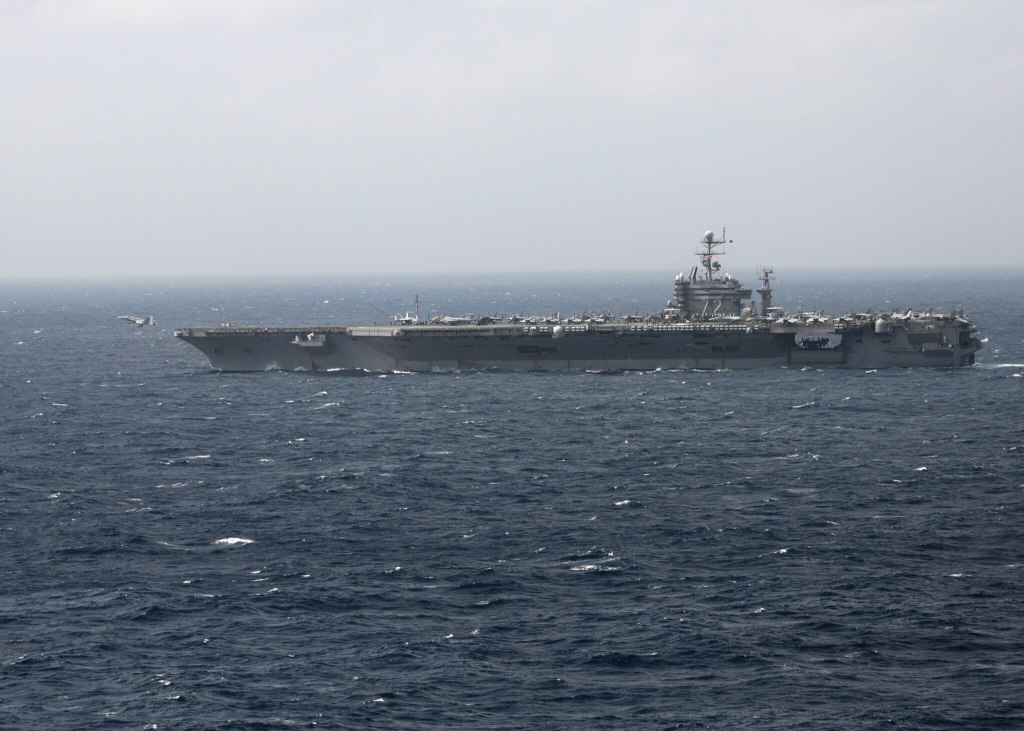
[Cover image]: U.S. Navy. (2010, October 14). An F/A-18 Hornet launches from the aircraft carrier USS Abraham Lincoln (CVN-72) [Photograph]. Wikimedia Commons. https://commons.wikimedia.org/wiki/File:US_Navy_101014-N-5016P-500_An_F-A-18_Hornet_launches_from_the_aircraft_carrier_USS_Abraham_Lincoln_(CVN_72).jpg


.jpg)
Leave a comment