
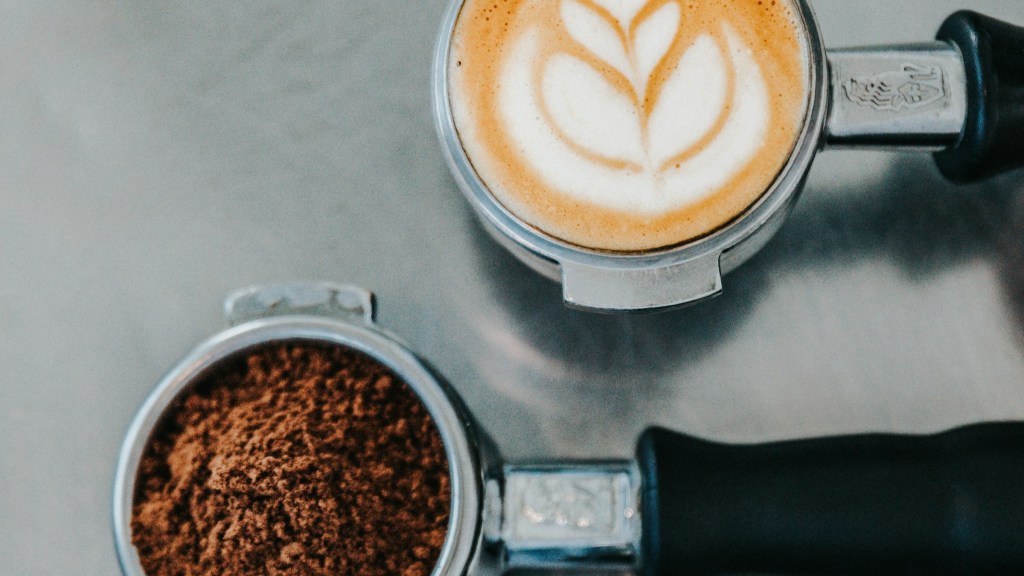
About 3 billion cups of coffee are consumed in the world every single day [1]. You probably drink one every morning to vigorously start your day. Also after lunchtime, to boost your brain to get the work done. But, have you ever thought about the effort behind these tiny little black beans? Like Jack’s beans, are they just magic and directly fly from Brazilian plantations? And will there always be endless fields of coffee bushes in Mount Kenya? Get comfortable, sip your espresso, and dive into coffee geopolitics.
Start in Paris, in the Montorgueil quartier, where one can find Substance Café. It’s the city’s first reservation-only coffee-tasting bar. Inside, Joachim welcomes the clients with a big smile, one enormous coffee roasting machine, 60kg Ethiopian coffee jute sacks on the floor, an elegant design and the smell of freshly-brewed specialty coffee. Joachim, the owner, roaster and barista, tells us about consumer shifts while he prepares a Panamanian filtered coffee, “objectively and subjectively the best in the world” — he says giggling. He goes to Panama’s farms himself: “to meet the people, to understand how the beans are this extraordinary and to see the terroirs where everything starts” — he tells EIPS.
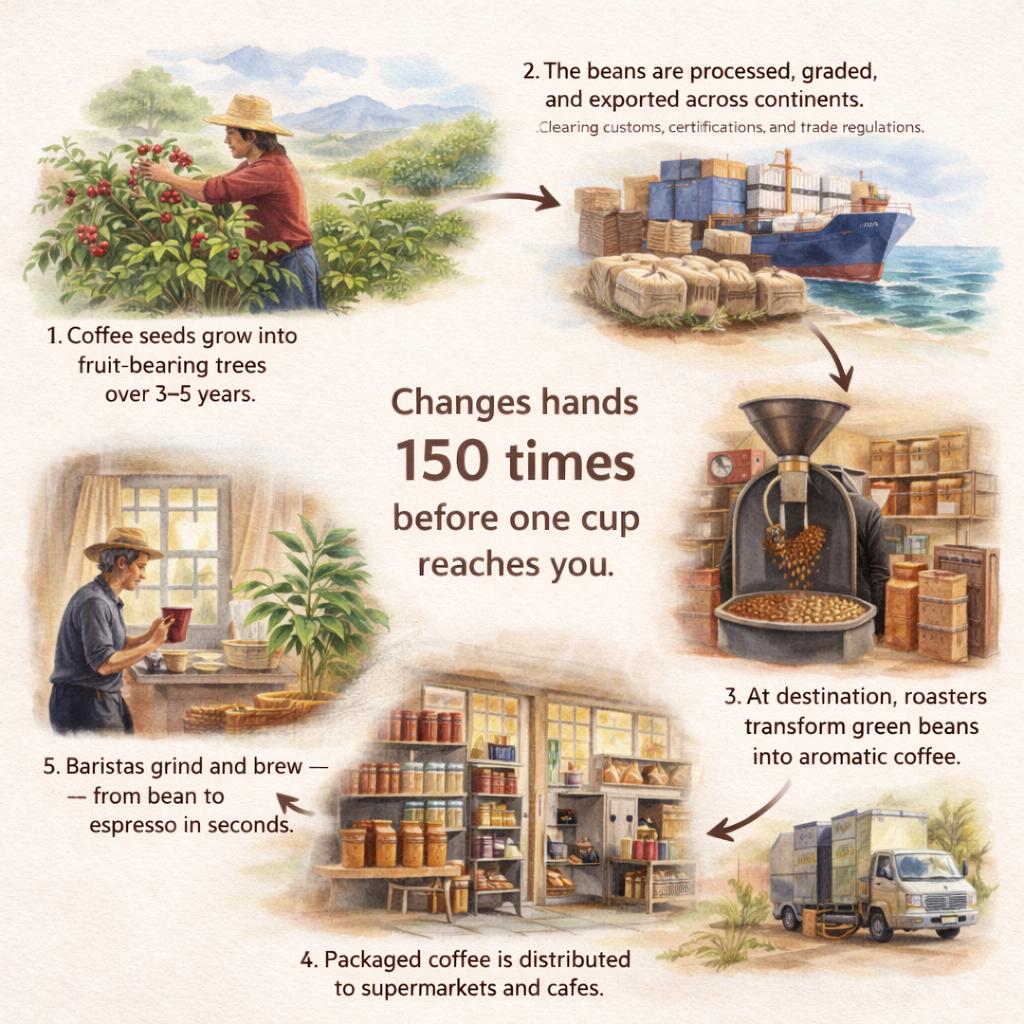
Coffee production begins with coffee seeds growing and bearing fruit, this takes 3 to 5 years. Once coffee cherries are harvested and separated, we get the un-roasted green coffee beans. After traveling long distances and clearing regulatory and bureaucratic processes, the beans will arrive at a roaster. Roasted and packaged, it’s sent to supermarkets or coffee shops. Baristas will grind the beans and serve it as an espresso or your other personal favorite. It takes about 6 months from coffee bean to cup and research say that coffee can change hands as many as 150 times before it reaches its final consumer [2].
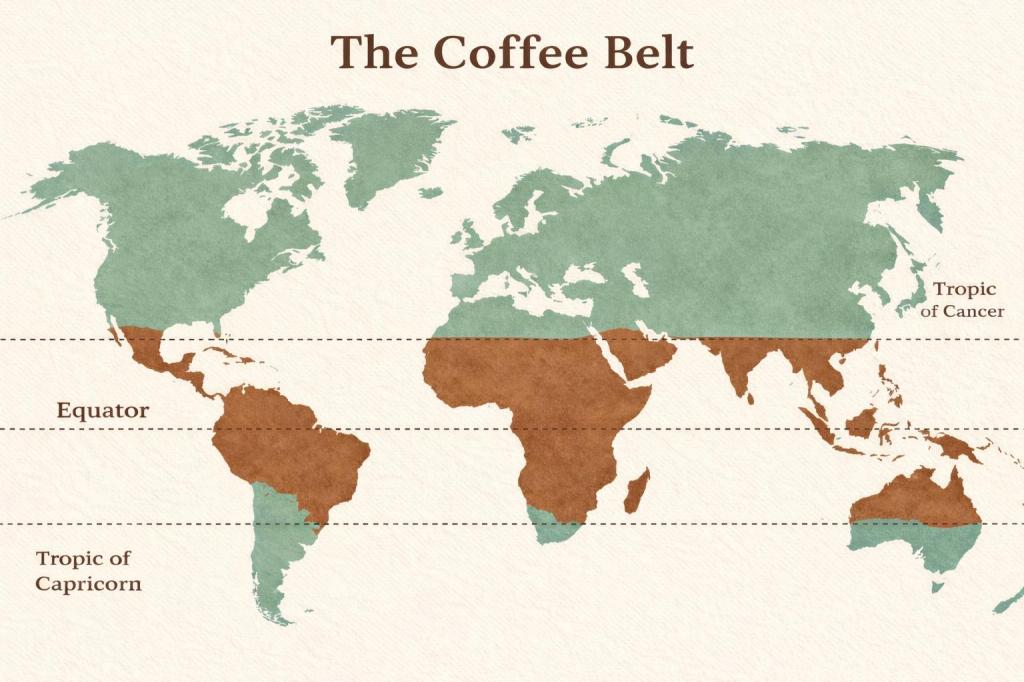
Two main commercial varieties stand out. Arabica beans are tastier and more valuable. They account for around 60% of worldwide coffee production [3]. Robusta is bitter and more often used for instant coffee [3]. These beans are quite picky and need ideal conditions to flourish: rich soil, mild temperatures, regular seasonal rainfall, and some shade[4]. This is why coffee plantations are found in a narrow climatic zone along the Equator, between the Tropics of Cancer and Capricorn.
Joachim’s favorite Panamanian terroirs are for example an ideal place, found in the coffee belt or coffee growing zone. The main producers are developing countries in South America, East Africa and South-East Asia. Brazil is the main grower (37% of global production), then Vietnam (17%), followed by Colombia (8%), Indonesia and Ethiopia (6%), Uganda and India (4%), Honduras (3%), and Mexico and Peru (2%) [5].
Each region produces coffee with a unique flavor, result of a complex combination of factors, including the plant variety, the soil, sunlight, and even the precise altitude of the farm or plantation [4]. But always with caffeine’s stimulating effect that humans seek.
The caffeine effect was first discovered in Ethiopia in the 15th century, it’s said that roasting the cherries turned it into an energising elixir. It then spread to the Middle East’s guesthouses and Mosque’s doors. The Ottoman Empire introduced coffee into Europe and from India it spread to Asia. In London, coffeehouses appeared in the 1650s and in Paris they’d host figures like Diderot and Voltaire in the 1700’s. As the “Lumières” needed their daily dose of caffeine, and European empires started exploiting colonies, coffee beans arrived more and more [6].
Shipping merchandise from American or African colonies was never an easy job. This is where coffee differs from cacao or sugar. “The green coffee beans last long time, as long as they’re not roasted. Even in 16th century sailing ships” — José Miguel Masiques says. The ESCP International Politics Society had the privilege to exchange with the CEO of Masiques, he told us about the insights and secrets of the world’s famous bean.
José Miguel Masiques is the 4th generation CEO of the green coffee logistics operator and warehouse keeper at the Port of Barcelona. Established there since 1890, Masiques plays a big role for the Iberian country and also for the continent. Barcelona’s Port welcomes around 80% of Spanish coffee beans, and it’s now Europe’s second biggest coffee importer. Right behind Antwerp and having overtaken European ports like Marseille or Trieste [7].
Coffee, like crude oil, gold or corn, is a commodity, its purchase is often done through a trader. A commodity trader buys at source and sells at destination. Among its functions: the trader will fix prices (following London and New York’s stock markets), finance the operation, and is physically responsible for carrying the coffee beans from farmer to roaster.
Masiques collaborates with traders, offering them a service through their terminal in the Catalonian Port specialised in the green coffee reception, storage, handling and delivery. Their function goes from acting as a stevedore, to a customs agent, or having a legal and consulting role, and logistics and distribution.
At Masiques, they’re experts in handling the green coffee beans. Taste must be unaltered and the beans scent guarded; the roaster must receive the same quality that left the coffee farm back in Brazil or Kenya. Not simple at all when managing 175,000 coffee tonnes a year [8] and the Port brings-in the morning “café” for practically an entire nation.
Western coffee demand is generally stable over the years, in recent decades coffee consumption has been steadily growing by around 2% a year [2], no drastic augmentation. However, “coffee demand in Asia is significantly increasing” — José Miguel Masiques tells EIPS. Historically tea drinking countries, younger generations are now finding an appetite for morning caffeine. The economic development of East-Asian countries, the Westernisation of lifestyles, and social media influence, have enabled consumers to drink more frappuccinos or soja lattes. “Demand is rapidly surging and green coffee beans’ supply is not following the same rhythm”, says the CEO while explaining that an annual increase of 0.1% in China is indeed a lot of newcomers and a whole lot more of needed coffee beans. As studies by the Columbia Center on Sustainable Investment show, we will need around 25% more coffee by 2030 to keep up with the constant growing demand [1].
And pushing the green bean’s demand even higher is the fact that consumers in Asia aren’t usually black espresso drinkers, but more of instant or soluble coffee. This makes sense, as it somehow remains more similar to the traditional tea drinking method: heat up water, mix with instant coffee, and it’s a smoother, more gentle taste. The problem here is — José Miguel Masiques explains — “for a kilo of ground coffee you need more or less the same amount of green coffee, but for a kilo of instant coffee you need between 2.5 and 3 kg of green coffee beans”.
In short, more people, mainly in Asia, are drinking coffee, and particularly drinking instant coffee, which requires a larger quantity of green coffee beans — coffee’s demand therefore increasing.
And to keep spilling the beans — green coffee’s offer is also decreasing now [1]. The main reason is climate change. As explained before, coffee needs some particular conditions to grow. Now with climate change, temperatures are rising and the coffee growing zone is not as fruitful as in the past [3]. The global coffee landscape is reshaping, with projections indicating that up to 50 percent of current coffee-growing areas may become unsuitable by 2050 [9].
Mount Kenya has plenty of arabica bushes, smoother and sweeter, its production happens to be more threatened — climate change could wipe out around 45% of arabica’s global production [10]. In Kenya, 98% of arabica beans thrive at temperatures between 18 and 21°C, now the National Meteorological Department shows how in 60 years temperatures have risen by 1.1°C, reaching even daytime highs of 25°C [3]. Such picky species cannot naturally bear such temperature change.
To adapt to the warming, the Kenyan Coffee Research Institute advises planting trees to shade coffee bushes. Another tip for farmers is to move uphill, where temperatures are cooler and now ideal for arabica [3]. Despite being a smart solution, there’s less space higher up [3]. And more alarmingly, this pushes coffee into areas long used for growing tea in Mount Kenya. And tea accounts for about $1.2bn a year for the African country — not to be harmed then [3].
United Nation’s Trade and Development division’s (UNCTAD) figures already show a slight impact, with arabica’s green coffee beans export having decreased by almost 5% between 2020 and 2024 [7]. The decline is counter-balanced by an increase in Robusta. This last one, which possesses a less refined flavor, is tougher than Arabica [1]. It can grow at higher temperatures and is more resistant to pests and diseases [1].
Climate change is bringing a wave of droughts, unpredictable rains and new climate patterns like El Niño [1]. Pests and diseases are another consequence of rising temperatures [3]. The Economist interviewed farmers from Nandi (Kenya) who woke up to find their entire harvest turned black from a fungus that festers in high humidity and warm temperatures [3]. “We don’t get money to put back into that crop” the Nandi residents said.
In East Africa, birthplace of coffee, the green bean is one of the region’s most important export [3]. This highly traded commodity is crucial to multiple economies and millions of lives [1]. In the world, 125 million people depend on coffee production [10]. The situation is even more fragile for the 25 million small landholders, 5.5 million of whom live under $3.2 a day [5].
Take Kenya for example, where coffee constitutes an income for 6 million people (10% of the country’s population), 65% being grown by smallholder farmers on just 0.16 hectares [3]. For their Ethiopian neighbors, coffee is a quarter of the country’s merchandise export earnings [2]. In Burundi there’s even a more important dependency, with two thirds of the exports being green coffee beans [2]. And it’s not only in Africa, Papua New Guinea’s coffee beans also are one of the biggest foreign incomes for the Pacific Ocean nation [10]. The coffee production brings prosperity to these countries [10].
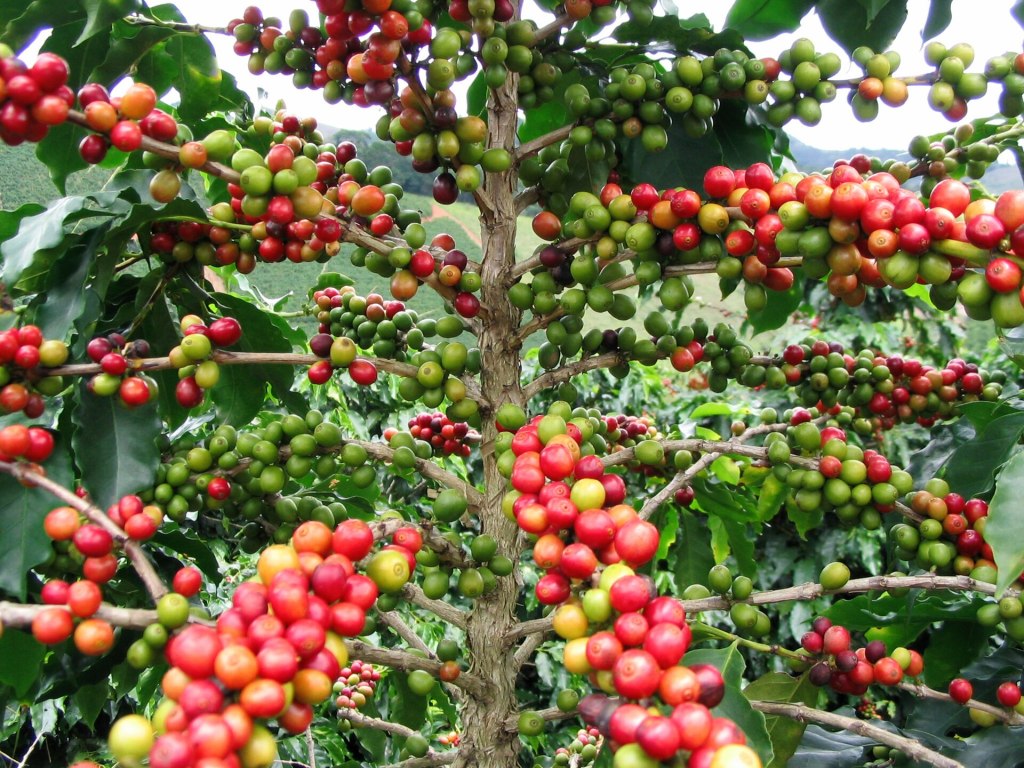
(Frutos del cafeto madurando, Taka, 2007)
Now, many coffee farming families, representing the bottom of the pyramid, are already facing low productivity levels due to pests and diseases and the effects of climate change [2]. Moreover, they’re vulnerable to a global coffee market controlled by a handful of actors whose interests do not necessarily align with theirs, leading to imbalances in the distribution of value in the coffee chain [2]. Take Ethiopian specialty coffee for example, the grower’s income accounts to around 3% of the final value, whereas transport and processing keep 20% of it, roasters almost 15% and the final retailer 48% of the final coffee-mug value [10, page 26]. In Addis Ababa, July 2025, FAO’s (UN’s Food and Agriculture Organisation) Director-General at the UN’s food systems summit stated: “Let us act boldly. Let us invest wisely. And let us put smallholder coffee farmers at the centre of agrifood systems transformation.” [9].
The global coffee market connects 25 million coffee producing families to 500 million daily coffee consumers [2]. Despite their poor conditions, their difficulties to keep up production with new climate challenges and the un-equal income they obtain, small coffee farming families remain the core of the world’s coffee production. In the words of FAO’s Director: “each cup of coffee tells a global story – of culture and trade, but also of livelihoods under pressure and resilience in the face of crisis.” [9].
With arabica beans risking extinction and the coffee belt’s production threatened by warmer temperatures, solutions need now to be assessed. As named before, a functional fix is to plant trees to shade coffee bushes [3]. Another is, as done in Mount Kenya, to move uphill to find cooler and better adapted temperatures [3]. Robusta — as its latin etymology implies — is more resistant or more “robust”. A way-out would be to increase its production and substitute arabica, but so it happens that robusta cappuccinos taste way too bitter.
The World Coffee Research, a non profit association, was founded in 2012 to tackle the threat of long term coffee supplies. They’ve initiated an international study to give coffee growers new varieties and strategies to cope with climate change. With 23 countries taking part, they’re focusing on finding new varieties and combining existing ones in order to make a climate proof coffee bean. Imagine, for example a new arabica-robusta breed, keeping a sweet taste while becoming more resilient. Coffee R&D is not easy, the bushes take after all some years to grow. But developing a new coffee variety would be a lifeline for growers and for daily coffeeholics. [10].
The ultimate solution that lately has arisen is shifting global production. As the geographical coffee belt straddling the equator has tightened due to changes in temperature, and once ideal Ethiopian farms or Panamanian terroirs have now become a bit too hot, switching latitudes could be an answer. Moving from the equator to higher regions like, let’s say Europe, may be feasible as those places, before incapable of growing the beans, have now become warmer and maybe coffee bush suitable. In fact, the Old Continent has already started experimenting. In Sicily, historically land of pistachios and olive oil, Palermo’s University has increased the coffee production from 30kg in 2021 to 100kg in 2024. In Spain, the Catalonian region has also yield a few kilos of beans, not much still, but unthinkable a few years ago. It remains closer to fiction for now, but maybe Europe — or some other northern latitude — could become the next big coffee producer [4,11].
The coffee bean industry is complex, and dependent on so many stakeholders. The initial farmers producing the green coffee beans are very substantial. Logistics operators like Masiques, bringing the coffee into Europe and other consumer countries, also have a key stake. And finally, thanks to roasters and baristas like Substance Café we get our essential morning beverage. 3 to 5 years for the plant to grow, 6 months from bean to cup and as many as 150 different hands on a bean to reach the final mug. 150 people! [2]. Each cup of coffee does certainly have quite a global background and many stories to tell.
If we’re able to enjoy our caffeine sip in many different ways — soluble coffee, Starbucks frappuccino or pumpkin latte, oatmeal flat white, classic Italian espresso or even Bond’s Martini style — is all thanks to them.
Nevertheless, demand is increasing and coffee supply affected by climate change, and innovations and new harvesting techniques are appearing. Thankfully enough, seems like caffeine supplies won’t disappear tomorrow, but in today’s world, always hand-in-hand with climate change, everything is uncertain. Remember the remote terroir where the coffee bean comes from, and every one of the people behind the creation, while tomorrow drinking one of the world’s 3bn daily cups of coffee [1].
Edtied by Felix Dubé.
References
[1] Financial Times (2023, August 16) Have we reached peak coffee?
https://ig.ft.com/coffee/ (Financial Times)
[2] United Nations Conference on Trade and Development (2018) Commodities at a glance: Special issue on coffee in East Africa (PDF)
https://unctad.org/system/files/official-document/ditccom2018d1_en.pdf (UNCTAD)
[3] The Economist (2022, March 17) Why global warming threatens east African coffee
https://www.economist.com/middle-east-and-africa/2022/03/17/why-global-warming-threatens-east-african-coffee (The Economist)
[4] Specialty Coffee Association of America (n.d.) Coffee regions of the world
https://www.aboutcoffee.org/origins/coffee-regions-of-the-world/ (Specialty Coffee Association of America)
[5] U.S. Department of Agriculture, Foreign Agricultural Service (2024–2025) Production – coffee
https://www.fas.usda.gov/data/production/0711100 (USDA FAS)
[6] Morris, Jonathan (2024, March 5) How humanity got hooked on coffee (Ted-Ed, YouTube)
https://www.youtube.com/watch?v=xQ156y4TtJs (Ted-Ed)
[7] Expansion.com (2026, January 23) Masiques: la puerta de entrada del café
https://www.expansion.com/empresas/transporte/2026/01/23/69735fa8e5fdeaf4508b4571.html (Expansión)
[8] El Mercantil (2025, December 18) Masiques proyecta en Barcelona la terminal de café más moderna del sur de Europa
https://elmercantil.com/2025/12/18/masiques-proyecta-en-barcelona-la-terminal-de-cafe-mas-moderna-del-sur-de-europa/ (El Mercantil)
[9] Food and Agriculture Organization of the United Nations (2025, July 27) FAO Director-General: Transforming the global coffee value chain is more than just an economic necessity
https://www.fao.org/newsroom/detail/fao-director-general–transforming-the-global-coffee-value-chain-is-more-than-just-an-economic-necessity/en? (FAO)
[10] Financial Times (2022, October 26) Can scientists develop a coffee bean more resistant to climate change? (Video)
https://www.youtube.com/watch?v=aVgnMdsr3wA (Financial Times)
[11] The Economist (2025, July 24) Could Europe be the next big coffee producer?
https://www.economist.com/europe/2025/07/24/could-europe-be-the-next-big-coffee-producer (The Economist)
[Cover image]: Photographie à plat de café au lait, de café moulu et de grains de café
(https://unsplash.com/fr/photos/photographie-a-plat-de-cafe-au-lait-de-cafe-moulu-et-de-grains-de-cafe-Y3AqmbmtLQI) Picture by Nathan Dumlao (https://unsplash.com/fr/@nate_dumlao). Licensed under Unsplash (https://unsplash.com/fr/licence)
[Image 3]: Taka. (2007). FruitColors [Photograph]. Wikimedia Commons. https://commons.wikimedia.org/wiki/File:FruitColors.jpg


Leave a comment