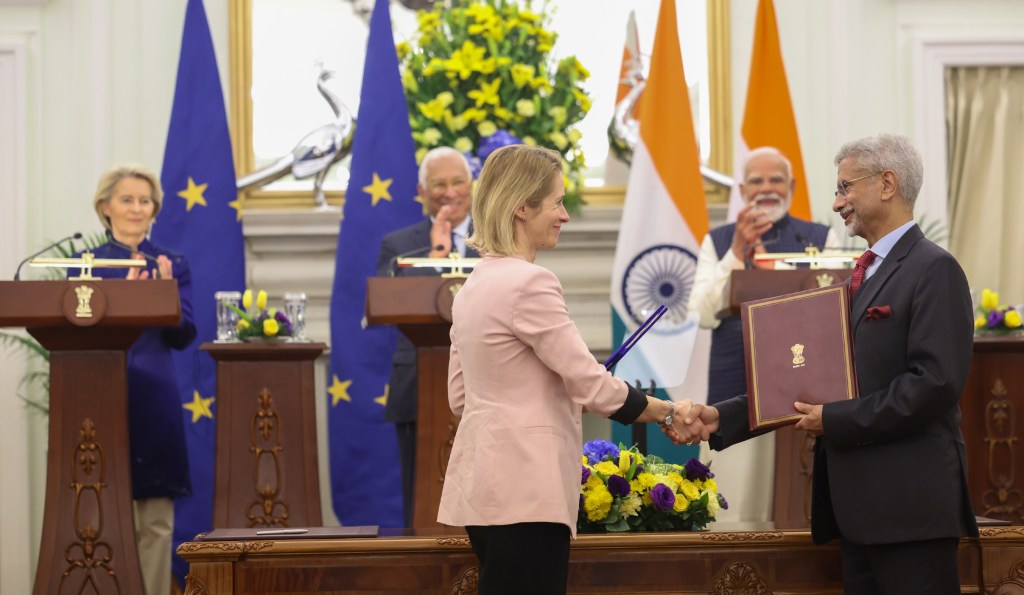
On January 27, 2026, the global economic order underwent a seismic shift. After nearly two decades of negotiations, the European Union (EU) and India finally joined forces to sign a historic free trade agreement (FTA) of unprecedented scale [7][11]. In the words of Ursula von der Leyen (President, EU), it was dubbed the “Mother of All Deals” [1]. Valued at around €1.88 trillion, this trade deal will create a market for 2 billion people and account for approximately 25% of global GDP [1][2][12]. The ripple effect was so strong that it was felt in the halls of the U.S. Capitol. The aftermath triggered a “domino effect” that forced Washington to revise its “America First” tariff policy, renegotiate its own pact, and sign another historic trade agreement with India valued at around $500 billion [4][6].
At the outset, these may be perceived as only some of the historic trade deals ever signed. However, beneath the surface lies something uniquely powerful, hinting at a shift in the global order. It signals the birth of a new era of Realpolitik, where modern autonomy and geopolitical hedging take precedence over the traditional, slow-moving multilateralism of the past [5].
Why Does This Hint at a Shift, and Why Is This Necessary?
For decades, nations were expected to revolve around one of two power centres. Initially, it was the U.S./USSR dynamic. After the dissolution of the Soviet Union, the primary centre became the U.S.–China. However, the historic agreements of 2026 signal the emergence of a multipolar architecture driven not by ideology but by strategic multi-alignment [5][9].
This represents a pivot toward strategic autonomy, where decisions are not dependent on the volatility of U.S. trade policies or on China’s supply chain dominance [2]. Instead, it reflects the ability to exercise options strategically to benefit national economic progress.
The bottom line is that power is no longer about who you “belong” to, but how many different centres of power you can be indispensable to simultaneously. India is the first major power to demonstrate that one can be a “friend of the West” and a “leader of the Global South” without sacrificing either role [5][8].
Significance of India: The Neutral Hub
(Karastelev, Gold and silver round frame magnifying glass, 2021)
By successfully navigating these landmark deals simultaneously, India has transitioned from a participant in global rule-making to a primary shaper of outcomes, effectively positioning itself as a neutral economic hub that provides stability in an era of “controlled disorder” [5][7].
In the words of President von der Leyen, “when India succeeds, the world is more stable, more prosperous, and more secure—and we all benefit” [12].
With the successful signing of these deals, India has positioned itself as the ultimate neutral hub for the world market. Major powers are now competing to gain access to its 1.4 billion consumers, giving New Delhi the “swing vote” in global trade [3][7].
This success points to another important angle. The West is no longer the centre of the West. In 2026, the most important Western trade action is taking place in New Delhi and Brussels due to Washington’s unpredictability, indicating a strong shift from fragile multilateralism to robust strategic autonomy and multi-alignment [4][5].
How is the Future Shaping Out?
In the years to come, the world order appears to be moving beyond rigid blocs toward a form of multipolar pragmatism. One thing that’s gradually becoming clear as broad daylight: The greatest strategic strength will not lie in choosing sides but in becoming the ground upon which multiple powers converge [5][10].
Edited by Oriane Beveraggi.
References
- Al Jazeera. (2026, January 27). Mother of all deals: How India–EU trade deal creates $2.7 trillion market.
https://www.aljazeera.com/economy/2026/1/27/mother-of-all-deals-how-india-eu-trade-deal-creates-27-trillion-market - Allianz Global Investors. (2026). EU–India trade deal.
https://www.allianzgi.com/en/insights/eu-india-trade-deal - AP News. (2026). India–EU trade agreement coverage.
https://apnews.com/article/india-eu-modi-trade-wine-auto-74b8744b2ef562d2e820b238e6ce8d38 - CNBC. (2026, February 3). Trump U.S.–India trade deal compared with Europe–India deal.
https://www.cnbc.com/2026/02/03/trump-us-india-trade-deal-europe-india-deal-compared.html - European Council on Foreign Relations (ECFR). (2026). A new world in trade: How Europeans can make the most of the India deal.
https://ecfr.eu/article/a-new-world-in-trade-how-europeans-can-make-the-most-of-the-india-deal/ - Livemint. (2026). U.S.–India aim for $500 billion trade.
https://www.livemint.com/news/us-news/us-india-aim-for-500-billion-trade-as-trump-admin-pushes-maximum-pressure-on-russia-says-jacob-helberg-modi-ukraine-11771982245277.html - Reuters. (2026, January 27). India and EU finalise landmark trade deal.
https://www.reuters.com/world/india/india-eu-finalise-landmark-trade-deal-pm-modi-says-2026-01-27/ - SDG News. (2026). Historic EU–India trade deal signals new global trade order.
https://sdgnews.com/historic-eu-india-trade-deal-signals-new-global-trade-order - South Asia Monitor. (2026). EU and India: Paradigm shift conceptual vision.
https://southasiamonitor.org/eu-watch/eu-and-india-paradigm-shift-conceptual-vision - Statista. (2026). Real value added to India–EU GDP in different international trade scenarios.
https://www.statista.com/chart/35782/real-value-added-to-india-eu-gdp-in-different-international-trade-scenarios/ - The Guardian. (2026, January 27). EU and India sign free trade agreement.
https://www.theguardian.com/business/2026/jan/27/eu-and-india-sign-free-trade-agreement - YouTube. (2026). Video source.
https://youtu.be/vF8k_Z_6prA - Cover Image: The India–EU Security and Defence partnership [Map]. Wikimedia Commons. https://commons.wikimedia.org/wiki/File:The_India%E2%80%93EU_Security_and_Defence_partnership.jpg
- Image: Karastelev, D. (2021, April 1). Gold and silver round frame magnifying glass [Photograph]. Unsplash. https://unsplash.com/fr/photos/loupe-cadre-rond-dore-et-argent-j06gLuKK0GM


Leave a comment