The Nile, the world’s second-longest river, stretches over 6,700 kilometres and flows through numerous African countries, including Egypt and Ethiopia [1]. Born from the confluence of the White Nile and the Blue Nile, this natural bounty — which has enabled the rise of many cities — has long been coveted by multiple actors. As a result, the river has always stood at the heart of power struggles over the control of its waters.
For centuries, Egypt has maintained a hegemonic position mainly thanks to the Nile, turning it into the backbone of its economic life. Consequently, its economic model — historically based on agriculture — and its water security are deeply dependent on the river: 95% of the country’s freshwater supply originates from it with 86% of this water coming from Ethiopian Highlands [1] [2]. “Water is Egypt’s only existential threat… we will not hesitate to defend Egypt’s water rights” emphasised Foreign Minister Badr Abdelatty in June 2025, affirming that water security is a matter of survival [3].
In order to preserve its leadership in the region, Egypt often cites historical agreements to assert its rights over the Nile. On May 15, 1902, a treaty in Addis Ababa required Ethiopia not to build on the Blue Nile, Lake Tana, or Sobat River without London and Sudan’s consent. The first real waters-sharing treaty was signed in 1929 between Egypt and Sudan (represented by the UK), obliging Sudan not to alter the Nile’s flow, level, or flood timing. The 1959 Nile Waters Agreement allocated the river’s average annual flow — about 84 billion cubic meters — between Egypt (55.5 billion) and Sudan (18.5 billion) and allowed both to build dams (Aswan and Roseires), share irrigation and hydroelectric projects [4].
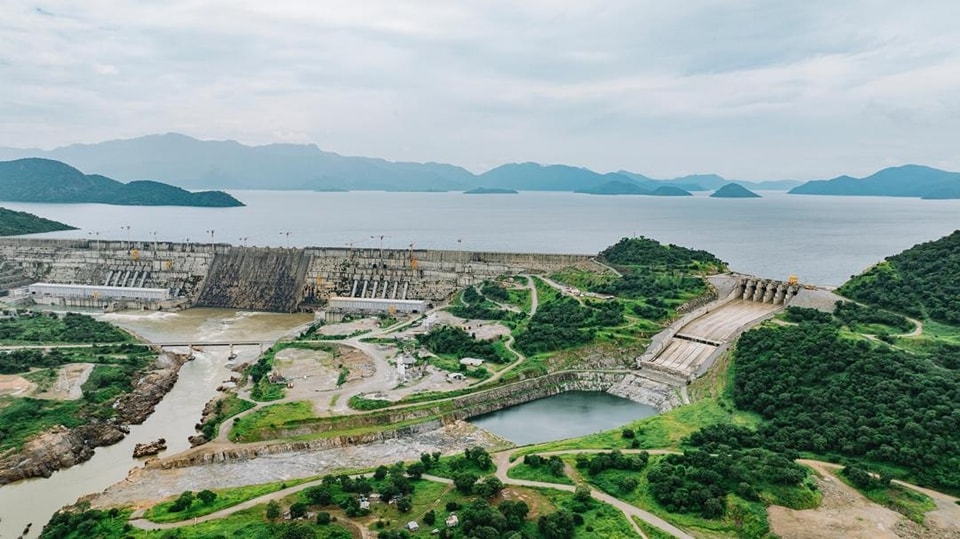
From the standpoint of an established power, the Grand Ethiopian Renaissance Dam, or GERD (which became operational in February 2022 and inaugurated in September 2025) therefore represents an existential threat, as it risks reducing the volume of water available downstream and causing sudden floods (as in Sudan) [5]. However, Egypt has not yet experienced a significant reduction in its share of the Nile’s water, even if they start to implement restrictive agricultural policies, particularly with water-intensive crops like rice.
Ethiopia — long overshadowed by Egypt — experienced record economic and demographic growth between 2012 and 2016, and joined the ranks of African Lions (Acha Leke) in 2017 [6]. At a time when Ethiopia seeks to assert itself as a regional power, the GERD has become a powerful symbol: one of unity and of development in a region scarred by conflict (the Tigray war claimed around half a million lives in 2022) and where 60% of the population still lacks access to electricity and cannot even rely on basic lighting [7]. This dream of national grandeur, launched in 2011 at a cost of nearly $5 billion, is central in Ethiopian politics, actively promoted by the government and Prime Minister Abiy Ahmed, in order to pursue its ambitions of modernity, prosperity and power [7]. In fact, it’s expected to more than double the country’s electricity production and enable the continued export of horticultural products, which are both water-intensive and input-heavy [8].
Ethiopia does not appear ready to yield to Egyptian pressure, even with Egypt having twice brought the matter before the UN Security Council, without any legal consequences. And Egypt is not expected to drop the issue, as its leadership in the region is being threatened and they fear reduced water access [9]. As Thomas Rijntalder from the Foreign Policy Institute notes, Egypt accuses “Ethiopia of violating international law by continuing to fill the GERD basin without the approval of the downstream riparian countries. Ethiopia, in turn, argues that Egypt persists in undermining negotiations and points to its repeated threats of violence, while simultaneously stressing how the GERD can provide a mutual benefit. One of these additional benefits, Ethiopia argues, is that the GERD will be instrumental in avoiding future Nile floods throughout extremely wet years, which regularly threaten Khartoum, the capital of Sudan” [10].
While tensions remain high, the likelihood of armed conflict is relatively low, as disputes are largely sectoral, centered on water access, and do not amount to a broader systemic confrontation.
The Renaissance Dam is not a threat, but a shared opportunity. The energy and development it will generate have the potential to uplift not just Ethiopia.” – Prime Minister Abiy Ahmed, cited at the GERD inauguration (2025)
On top of that, Sudan occupies a pivotal yet ambivalent position in the tensions between Egypt and Ethiopia, as it lies geographically between the two and is directly affected by developments along the Nile. While it has historically aligned with Egypt, particularly through shared agreements on water distribution, Sudan also stands to benefit from the Grand Ethiopian Renaissance Dam, which could improve irrigation, and access to electricity [11]. This dual set of interests leads Khartoum to adopt a fluctuating position, balancing between cooperation and caution. However, the ongoing war and ensuing political instability have significantly weakened Sudan’s ability to act as an effective mediator, limiting its role to that of a constrained but nonetheless essential actor in the dispute.
Moreover, the United Arab Emirates, a strategic partner to both nations, is playing a mediating role and has no interest in seeing another conflict erupt in the region. The UAE has a strong partnership with Al-Sisi, Egypt’s President since 2014, based on shared political and security interests, and at the same time has multiple investments in Ethiopia: in agriculture, logistics, port infrastructure, which favours quiet diplomacy and mediation rather than taking sides [12][13].
Ultimately, an agreement between Cairo and Addis Ababa thus seems essential, lest Egypt find itself disadvantaged in this equation — the consequences could be unpredictable then, in a region already marked by tensions. Beyond regional rivalries, this situation highlights the growing importance of water (as previously covered by the EIPS), now at the heart of climate challenges — a “blue gold” that proves far from inexhaustible.
Edited by Maxime Pierre.
References
[1] Britannica, T. Editors of Encyclopaedia. (2024, February 14). Nile River. Encyclopedia Britannica. https://www.britannica.com/place/Nile-River
[2] Mezran, K., & Pavia, A. (2025, July 15). The Nile at a crossroads: Navigating the GERD dispute as Egypt’s floodwaters rise. Atlantic Council. https://www.atlanticcouncil.org/blogs/menasource/the-nile-at-a-crossroads-navigating-the-gerd-dispute-as-egypts-floodwaters-rise/
[3] Ahram Online. (2023, July 13). Egypt, Ethiopia agree to initiate ‘expedited’ negotiations on GERD. https://english.ahram.org.eg/News/548898.aspx
[4] Orsam. (2021, July 1). Historical roots of the Blue Nile conflict between Egypt and Ethiopia and its present reflections. https://orsam.org.tr/en/yayinlar/historical-roots-of-the-blue-nile-conflict-between-egypt-and-ethiopia-and-its-present-reflections/
[5] LSE Africa at LSE Blog. (2025, November 18). The Grand Ethiopian Renaissance Dam offers a new vision of African development. https://blogs.lse.ac.uk/africaatlse/2025/11/18/the-grand-ethiopian-renaissance-dam-offers-a-new-vision-of-african-development/
[6] Tilouine, J. (2016, September 20). McKinsey continue de croire en la capacité économique des « lions » d’Afrique. Le Monde. https://www.lemonde.fr/afrique/article/2016/09/20/mckinsey-continue-de-croire-en-la-capacite-economique-des-lions-d-afrique_5000545_3212.html
[7] BBC News. (2024, May 22). Why the Nile River is at the centre of a diplomatic row. https://www.bbc.com/news/articles/cz71zndj001o
[8] BBC News. (2025, August 15). Ethiopia’s Nile dam: Will it lead to water wars? https://www.bbc.com/news/articles/cr4qx6377qgo
[9] United Nations Security Council. (2025, August 27). Report of the Secretary-General on the Nile Basin and the Grand Ethiopian Renaissance Dam (S/2025/23827). https://documents.un.org/doc/undoc/gen/n25/238/27/pdf/n2523827.pdf
[10] Foreign Policy Research Institute. (2025, October 12). The GERD dispute: Lessons for water governance and the future of the Nile Basin. https://www.fpri.org/article/2025/10/the-gerd-dispute-lessons-for-water-governance-and-the-future-of-the-nile-basin/
[11] Middle East Council on Global Affairs. (2025, November 5). With Ethiopia’s GERD active, tensions mount along the Nile. https://mecouncil.org/blog_posts/with-ethiopias-gerd-active-tensions-mount-along-the-nile/
[12] State Information Service. (2026, January 10). Bilateral relations: United Arab Emirates. https://sis.gov.eg/en/international-relations/bilateral-relations/united-arab-emirates/
[13] New Lines Magazine. (2024, March 12). The limits of the UAE’s push for food security. https://newlinesmag.com/spotlight/the-limits-of-the-uaes-push-for-food-security/
Histoire, géographie et géopolitique du monde contemporain; Florian Louis, 2021
[cover Image]: 2020, December 2. GERD 2 [Photograph]. Wikimedia Commons. https://commons.wikimedia.org/wiki/File:GERD_2.jpg


Leave a comment