The author is a French-American student at ESCP. In his book, “Vers un nouvel ordre mondial?”, he distinguishes the three dominant global spheres of influence from the autonomous Pivot States (Turkey, Israel, Iran) that navigate between them. He explores how these pivots exploit imperial rivalries to gain leverage, shifting the balance of power in a fractured world.
Tariff blackmail, outlandish statements, and interventionism in all directions: Donald Trump appears to many as a turbulent child who refuses to take no for an answer. Yet his doctrine is clear, his strategy complex, and his objectives obvious: to contain China’s rise and prevent the prophecy of “imperial overstretch” from coming true [1].
Donald Trump now behaves like an emperor. Trumperator proposes a new form of Pax Americana, built around the following axiom: a hyper-mediatised militarisation designed to secure access to raw materials. The three Ms of the “Mpire” are therefore the military, the media, and raw materials. Describing the situation in which an empire expands beyond its military and economic capacities, imperial overstretch is a prophecy that many American leaders have feared, despite the famous saying attributed to Warren Buffett, “never bet against America.” [2] It would seem that the two main pillars of Trump’s strategy are indeed economic and military capabilities, unfortunately at the expense of a soft power that the United States once projected. Accept the mercantilism of Mercury or suffer the wrath of Mars: such is the strategy of the Trumperator. In other words, accept an unfavorable deal or face tariff blackmail or unilateral interventionism.
A pillar of any empire, according to Jean Tulard, is the belief in an inherent superiority. The United States is rooted in the concept of Manifest Destiny [3] . It embodies the exceptionalism of the American politico-economic model and justifies its universalism, even a form of messianism. Beyond this almost moral dimension, Donald Trump’s doctrine appears as a synthesis rather than a rupture: a Monroe Doctrine (1823) combined with its “Roosevelt Corollary” (1904) [4], amplified by a form of unilateralism (Bush’s “booted Wilsonianism” [5]) rejecting international law as an outdated constraint, all of it hyper-mediatised, sometimes to warn, sometimes to entertain [6]. The “Golden Age” he frequently evokes will only be reached when every threat to American sovereignty has been eliminated and no power is able to challenge the United States in the economy, artificial intelligence, or defense.
Thus, Trump implements expansionist and interventionist strategies to secure access to raw materials, reduce US dependence on China, and, ultimately, weaken its strategic leverage. Hence the operation in Venezuela — in the hemisphere “that must remain American” as the US secretary of state Marco Rubio mentioned — which has accounted for around 5% of Chinese crude oil imports, while nearly 90% of Venezuelan oil exports are directed, directly or indirectly, toward China [7]. Controlling the Strait of Hormuz, Kharg Island, and overthrowing the Iranian regime would not only eliminate an anti-Zionist and anti-American threat, but also deprive China of a significant share of its imported oil, given its heavy reliance on Middle Eastern flows transiting through this strategic chokepoint. This logic also explains the growing interest in Greenland, rich in critical minerals and of major geostrategic importance for controlling emerging transpolar routes.
In a fractured world, Trumperator seeks to reduce external dependence on critical raw materials in order to guarantee American self-sufficiency, particularly with regard to chips, semiconductors, and, more broadly, everything related to artificial intelligence. For now, what drives the American war machine is still largely fossil fuels. However, this strategy is not viable in the long term, due to the finite nature of fossil fuels. China has taken up the challenge of renewable energy in recent years and now dominates a significant share of global investments in the sector (45% of global investments in the sector are Chinese) [8]. The United States must urgently catch up. Can its short-term thirst for oil give way to a hunger for energy innovation?
For an empire to endure, however, power cannot rest on the three Ms alone. Military strength, media dominance, and control over raw materials are necessary, but never sufficient. A sustainable “Mpire” requires three additional pillars: the three Es.
First, Europe. No American strategy can succeed in isolation. A strong transatlantic relationship remains indispensable: Europe is at once a military ally, a major trading partner, and a community bound to the United States by deep ideological and historical ties. To neglect this relationship is to weaken the very architecture of Western powers.
Second, the Environment. Persisting in climate skepticism undermines long-term credibility and strategic foresight. Ecological transition is no longer a matter of virtue but of power: those who lead in green technologies will shape the industries, norms, and dependencies of tomorrow.
Third, and above all, Energy. Fossil fuels may still power the present, but they cannot secure the future. The strategic use of hydrocarbons should serve a broader objective: financing the transition toward nuclear energy and renewables, as China pragmatically does. Energy independence, technological leadership, and sustainability must converge if the United States wishes to avoid decline.
An empire must inspire admiration among its allies and instill fear in its adversaries. Hard power alone cannot achieve this equilibrium. Soft power completes hard power; without it, influence becomes coercion, and leadership turns into domination. To neglect soft power is to accept an incomplete empire. Otherwise, the American empire risks remaining what it has become under Imperator Trump : powerful, disruptive, but strategically unfinished.
Edited by Maxime Pierre.
References
[1] Kennedy, P. (1987). The rise and fall of the great powers: Economic change and military conflict from 1500 to 2000. Random House.
[2] Li, Y. (2021, February 27). Warren Buffett says never bet against America in letter trumpeting Berkshire’s U.S.-based assets. CNBC. https://www.cnbc.com/2021/02/27/warren-buffett-says-never-bet-against-america-in-letter-trumpeting-berkshires-us-based-assets.html
[3] Rippy, J. F. (1937). The initiation of the Monroe Doctrine. The Hispanic American Historical Review, 17(4), 411–424.
[4] Encyclopedia Britannica. (n.d.). Roosevelt Corollary. https://www.britannica.com/event/Roosevelt-Corollary
[5] Ikenberry, G. J. (2004). United States: Empire by force or force for empire? (Chaillot Paper No. 69). European Union Institute for Security Studies. https://www.iss.europa.eu/publications/chaillot-papers/united-states-empire-force-or-force-empire
[6] Smith, G. S. (2004). The Roosevelt Corollary to the Monroe Doctrine (Audit of the Conventional Wisdom 04-08). MIT Center for International Studies. https://www.files.ethz.ch/isn/57185/Audit_04_08_smith.pdf
[7] U.S.-China Economic and Security Review Commission. (n.d.). China-Venezuela fact sheet: A short primer on the relationship. https://www.uscc.gov/research/china-venezuela-fact-sheet-short-primer-relationship
[8] International Energy Agency. (2025). World energy investment 2025: Executive summary. https://www.iea.org/reports/world-energy-investment-2025/executive-summary
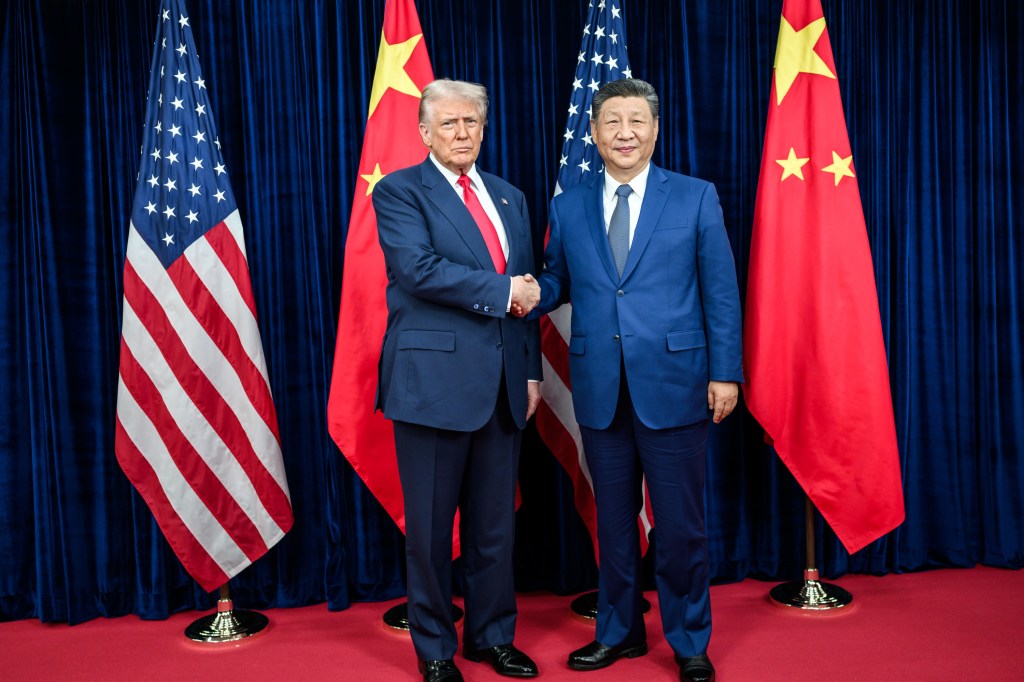
[Cover Image] Official White House Photograph. (2019, June 28). President Donald Trump greets Chinese President Xi Jinping before a bilateral meeting at the Gimhae International Airport terminal. Wikimedia Commons. https://commons.wikimedia.org/wiki/File:President_Donald_Trump_greets_Chinese_President_Xi_Jinping_before_a_bilateral_meeting_at_the_Gimhae_International_Airport_terminal_(54890669668).jpg


.jpg)
Leave a comment