“What I take away from this experience is the intensity of every moment lived, no matter how ordinary it may be.”
Born in Amiens in 1995, the author belongs to a familiar category – French, educated, trained in history – but his trajectory diverges early through an obsession he himself struggles to justify: an almost irrational intellectual attraction to the Arab world. Paris gave that intuition structure. A degree in History at the Sorbonne, an initial ambition to become a foreign correspondent, then a pivot: student in diplomacy at Sorbonne UN replaces journalism with international relations. The objective remains the same but the method changes. He deepens his academic grounding with a Master’s degree focused on North Africa and the Middle East, writing on France’s relations with the Gulf in the 1980s, while simultaneously undertaking serious Arabic study at INALCO. Then comes the rupture: Palestine.
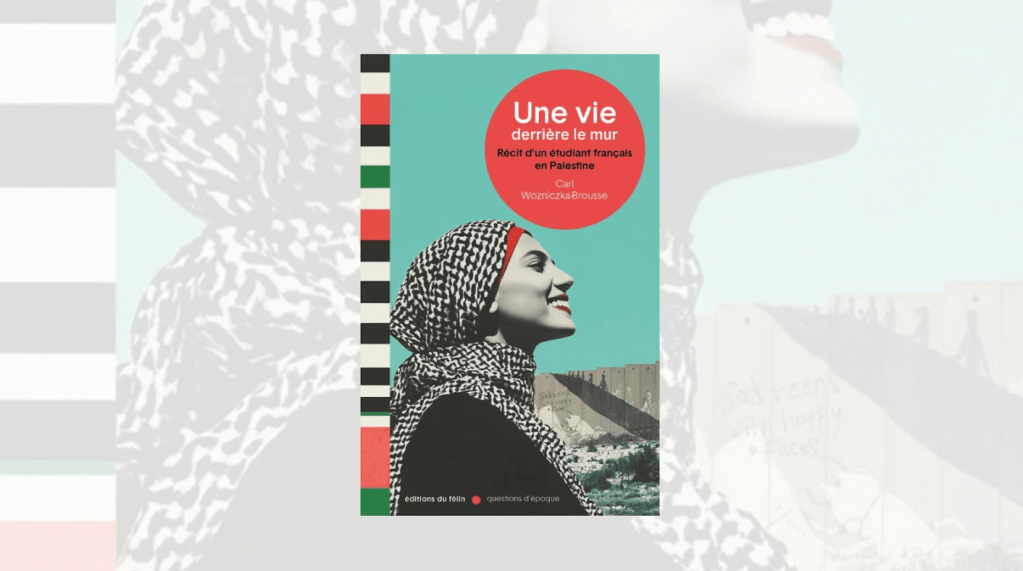
Carl is only 23 years old when leaving his home country for Palestine. Already passionate about the Arab-speaking world, he moved there to learn Arabic at Birzeit University and immerse himself in this culture he’s so interested in. Even if he knew that the country is laden with history, the primary ambition was to learn the language, there were no literary ambitions at the beginning. He arrived like any Erasmus student, intent on learning a language and confronting a new culture. There, he lived among young people who, unlike him, did not have the choice but to be here, and he felt a certain feeling of shame in returning home, in France, where he could be safe with his family. On-site, emotional isolation took the advantage. He lived on a day to day basis with this ambiguous feeling that he couldn’t share his thoughts and emotions to anyone, especially with his family, for they could not understand and instead get worried. Likewise to his local friends because it would not be fair for them, for them it’s daily life, but he is leaving. So he shut his own feelings down and found comfort in writing. Writing as salvation, to extinguish the guilt of having a home to come to, but also writing as a moral duty, not to remain silent. “When you’ve seen what happens behind the wall, you can’t keep it to yourself. Remaining silent means being complicit” he said. So, at the end of the experience, a question arose: what will we retain from all of this?
When I first read his book, I was shocked. I was so moved that I needed to process. I was sick of my own problems, my annoying problems of a privileged student living in London. And I think that this was the objective of the author, to raise people’s awareness and confront them to reality. “The world knows what is happening here, but no one wants to see—or rather, has any interest in seeing.” (Chapter XI)
What one can learn through history classes or through the media is nothing compared to this journey. This book is nothing but the truth about what is happening in Palestine and what is the everyday life of the Arabs on the West Bank. Carl refuses the dominant frame through which Palestine is usually perceived: permanent crisis, frozen in violence. Instead, it insists on continuity: life that does not stop. Through this note, he recounts daily existence in the West Bank before October 7, sharing what he calls the Palestinian rhythm; its power, its cadence. He introduces individuals rather than categories: friends, their lives, their tragedies, their joys, their struggles, their dreams. Why? To dismantle distance. It does not argue that conflict is absent but that conflict is insufficient as a lens. It rejects the reduction of the situation to a religious war, exposing religion as an instrument rather than a cause. It challenges media representations not by counter-ideology, but by accumulation of detail. It forces the reader to confront the gap between vocabulary, “occupation,” “colonisation”, and lived reality. Through these testimonies, the book allows the reader to grasp the impact of these words on individuals.
The writing process itself mirrors the political rupture it describes. After October 7, the project collapsed. The author finds himself unable to reconcile what he had witnessed, those moments of joy, celebration, ordinary life, with the devastation unfolding in Gaza. The question becomes almost obscene: how do you write about happiness in a place now associated with destruction? The manuscript is abandoned.
It resumes only in early 2024, pushed forward by Palestinian friends. The same people who generated the initial moral obligation restore it. The book was completed on February 7, 2025.
The book does not offer a synthesis because the author himself cannot produce one. What it does offer is clarity where discourse is usually blurred. Not neutrality—this is not a neutral book—but precision. It replaces slogans with scenes, categories with individuals, distance with proximity.
And now, what is the future for Palestine?
If the book reconstructs a lived reality, the author’s more recent reflections dismantle any illusion of a near-term political resolution. What emerges is not simply a conflict, but a system that reproduces itself. On the Israeli side, he describes a growing cognitive enclosure: a generation raised within a closed narrative, geographically and socially isolated from Palestinians, with little exposure capable of contradicting the official line. The map itself becomes ideological, erasing Palestine, normalising its absence. Distance produces fear; fear justifies separation; separation reinforces ignorance. The expansion and spatial organisation of settlements are not incidental but structure perception, entrenching the idea that the other is both invisible and dangerous.
On the Palestinian side, fragmentation dominates. Between the West Bank, Gaza, and Arab citizens of Israel, there is no unified political voice. These divisions are not accidental; they are, at least in part, cultivated. A divided opposition is a manageable one. Even within the West Bank, fractures are exacerbated, generating frustration that ultimately stabilizes the status quo.
The conclusion is blunt: the absence of a political solution is not a failure of the system—it is one of its outcomes. And as long as both separation and fragmentation persist, the conditions for change remain structurally undermined.
Edited by Maxime Pierre.


Leave a comment