
By Eitan Michelland.
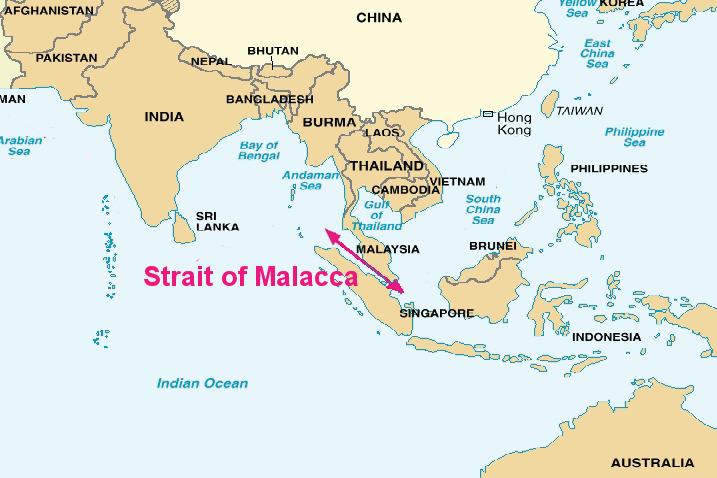
A strait is a strip of water between two expanses of land. The Strait of Malacca is located in Southeast Asia, between the Malayan peninsula and the Indonesian island of Sumatra. Due to its location and the lack of alternatives, it is one of the most strategic places in world trade today. According to the French Center of Strategic Studies of the Marine, in 2022, 2 billion tons of goods went through the strait, or 20% of world trade [2].About 85,000 boats pass through the strait each year, averaging one boat every 8 minutes. [2]. This heavy traffic often leads to congestion, delaying the arrival of goods and disrupting industries’ supply chains. The Strait is also plagued by piracy. During the first half of 2024, 21 incidents of piracy or armed robbery were reported in the straits of Malacca & Singapore. While the number shows a significant decrease from 41 incidents reported from January to June 2023 (a 49% decrease), it indicates that piracy remains a concern in the strait [12]. This piracy presence can be a reason for carriers to bypass the strait, choosing longer and more expensive journeys.
This strait has a strategic importance for several powers among the globe, especially the US, India, China and Japan. The interest of the US in this region is to ensure the viability of international shipping lanes [5]. To do so, they rely on the US Indo-Pacific Command (US INDOPACOM), one of the oldest and largest unified combatant commands of the US Armed Forces. Approximately 375 000 US military and civilian personnel are assigned to the US INDOPACOM [11]. Regarding India, the country has a territory in the Strait of Malacca, the Nicobar Islands. In 2023, the Indian government decided to build a naval base on the biggest of those islands, the Great Nicobar [3] to face China in the Strait. Another way for the Indian navy to face China in the Strait is cooperation with the US navy. Concerning Japan, the Strait is vital for its economy as 41% of the Japanese imports and 80% of its petrol importation goes through Malacca [4]. Thus, Japan is actively struggling against piracy in the Strait through strategic cooperation with other stakeholders of the region, such as the ASEAN+3 (Indonesia, Malaysia, Philippines, Singapore, Thailand, Brunei, Vietnam, Laos, Cambodia, Myanmar, China, South Korea, Japan) [10]. Finally, the Strait is even more important for China as most of its importation and exportations are shipping through the Strait. Also, as for Japan, 80% of the petrol imported by China goes through the Strait of Malacca [1]. Should the strait become too dangerous due to piracy or other states, it is estimated that the yearly loss in shipping costs could range from $84 billion to $250 billion for Chinese ships [9].
Moreover, China fears that the strait might be blockaded by the US and its allies (India, Philippines, Indonesia, etc.), a concern known as the Malacca Dilemma. Thus, China launched in 2013 its new Belt and Road initiative and is considering several projects to reduce its dependence on Malacca.
China invested billions of dollars in infrastructure projects connecting Chinese cities to ports in allied, friends or partners’ states such as Pakistan and Myanmar [7]. Managing these investments is complex due to regional instability, which can involve China in conflicts like the Myanmar civil war, where it supports different factions based on its interests [8].
Another large-scale project China is trying to set up is the Kra Canal. Their ambition is to dig a canal through the Kra isthmus, a thin strip of dirt in Thailand connecting the Malaysian peninsula to the continent. China claims that unclogging the Strait of Malacca could redirect 30% of traffic and create economic opportunities and thousands of jobs in Thailand. The project is expected to cost $30 billion, funded by China. Until now, the Thai government refused the project due to their fear of losing sovereignty if China finances it. Yet the Chinese government didn’t abandon the project and are still negotiating to build the canal [6].
Edited by Justine Peries.
References
[1] Bessiere, Rémi. “Les « dilemmes » chinois : de grandes stratégies pour tenter de répondre à la géographie.” Portail de l’IE, 23 November 2022, https://www.portail-ie.fr/univers/enjeux-de-puissances-et-geoeconomie/2022/les-dilemmes-chinois-de-grandes-strategies-pour-tenter-de-repondre-a-la-geographie/. Accessed 6 November 2024.
[2] Centre d’études stratégiques de la Marine (CESM). “Avril 2022 : Le détroit de Malacca.” Ministère des Armées, https://www.defense.gouv.fr/cesm/nos-publications/carto-du-mois/avril-2022-detroit-malacca. Accessed 6 November 2024.
[3] Chopra, Kriti. “China has been expanding its naval presence and constructing ports.” Commonwealth Round Table, 14 June 2023, https://www.commonwealthroundtable.co.uk/commonwealth/eurasia/india/opinion-the-malacca-strait-contest-between-china-and-india/. Accessed 6 November 2024.
[4] Fau, Nathalie. “Archive. Le détroit de Malacca : porte océane, axe maritime, enjeux stratégiques — Géoconfluences.” Géoconfluences, 29 November 2004, https://geoconfluences.ens-lyon.fr/doc/transv/Mobil/MobilScient4.htm. Accessed 6 November 2024.
[5] Indo-Pacific Defense Forum. “Freedom of the Seas – Indo-Pacific Defense Forum.” Indo-Pacific Defense Forum, 29 May 2024, https://ipdefenseforum.com/2024/05/freedom-of-the-seas/. Accessed 6 November 2024.
[6] le Carrou, Jérome. “Le projet du canal de Kra en Thaïlande : un enjeu économique et stratégique majeur pour l’Asie.” IRIS, 11 December 2020, https://www.iris-france.org/152627-le-projet-du-canal-de-kra-en-thailande-un-enjeu-economique-et-strategique-majeur-pour-lasie/. Accessed 6 November 2024.
[7] Myers, Lucas. “China’s Economic Security Challenge: Difficulties Overcoming the Malacca Dilemma.” Georgetown Journal of International Affairs, 22 March 2023, https://gjia.georgetown.edu/2023/03/22/chinas-economic-security-challenge-difficulties-overcoming-the-malacca-dilemma/. Accessed 6 November 2024.
[8] Myers, Lucas. “Mismanaging of the Unmanageable: China Tries to Play All Sides in Myanmar’s Metastasizing Civil War.” War on the Rocks, 27 March 2024, https://warontherocks.com/2024/03/mismanaging-of-the-unmanageable-china-tries-to-play-all-sides-in-myanmars-metastasizing-civil-war/. Accessed 6 November 2024.
[9] Parrot, Luc. “Dire Straits: China’s energy import insecurities and the ‘Malacca dilemma’ — London Politica.” London Politica, 22 March 2023, https://londonpolitica.com/global-commodities-watch-1-blog-list/dire-straits-chinas-energy-import-insecurities-and-the-malacca-dilemma. Accessed 6 November 2024.
[10] Pflimlin, Edouard. “Le Japon et la lutte contre la piraterie internationale : Golfe d’Aden et détroits d’Asie du Sud-Est.” IRIS France, 28 September 2011, https://www.iris-france.org/43236-le-japon-et-la-lutte-contre-la-piraterie-internationale-golfe-daden-et-detroits-dasie-du-sud-est/. Accessed 6 November 2024.
[11] US INDOPACOM. “About United States Indo-Pacific Command.” PACOM, https://www.pacom.mil/About-USINDOPACOM. Accessed 6 November 2024.
[12] Yeo, Gareth. “51 incidents of Piracy and Armed Robbery Against Ships in Asia in First Half of 2024.” ReCAAP ISC, ReCAAP ISC, 10 July 2024, https://www.recaap.org/resources/ck/files/news/2024/Press%20release%20-%20ReCAAP_ISC_Half-Year_Report%20(Jan-Jun%202024)%20-%20final.pdf. Accessed 6 November 2024.-la-carte-avec-drapeau-gm583734594-99888875.
[Cover Image] Strait of Malacca licenced under google commons by US DOD.


Leave a comment