It is fair to say that for decades after the fall of the Soviet Union, the world seemed to move steadily towards a liberal international order. Economic globalization flourished; multilateral cooperation was a rule. Moreover, there seemed to be no ideology that could challenge the dominance of the Western liberal order. However, this global order that has stood for almost four decades (from the fall of the Soviet Union), is now starting to be challenged. BRICS is one actor posing some questions regarding that order, suggesting that the distribution of influence within global politics requires change. Rather than challenging the existing order, BRICS represents dissatisfaction with the way global politics operates. Thus, the fundamental question of whether BRICS replaces Western liberal hegemony becomes less relevant.
There is a considerable contradiction between the way the modern global economy functions and the way international political institutions operate. Organizations such as the International Monetary Fund (IMF), the World Bank, and even the UN Security Council were founded after the Second World War. These institutions proved themselves to be extremely persistent throughout all those years, despite their structures becoming increasingly obsolete in the conditions of twenty-first century globalization. The economic power of emerging economies keeps growing. However, the degree to which their political influence grows alongside their economic strength leaves much to be desired (1).
In fact, the aforementioned problem is widely recognized across the Global South. Most developing and emerging economies believe that the international order does not take their interests into account. Nevertheless, unlike their critics, these countries do not reject multilateralism in international politics. Instead, they demand certain changes to the existing order, making sure that their positions and voices are heard within global institutions and decision-making processes (2).
From this point of view, BRICS can hardly be perceived as a revolutionary initiative. Rather, it is a reformist initiative that calls upon the members of the global community to reconsider the distribution of influence among its participants. In fact, BRICS has always represented the reformist approach, never advocating for replacing the existing international order. BRICS has been advocating for creating a more flexible and open order, where representatives of all states have a chance to make their opinions known (2).
The fact that BRICS is an organization consisting of emerging economies poses some questions regarding its goals and ambitions. Indeed, the members of BRICS greatly benefit from economic globalization and international cooperation. At the same time, they criticize the excessive influence of Western countries in global political institutions, exempli gratia – Security Council’s permanent members . Therefore, instead of challenging the current order, BRICS seeks its diversification. By developing its own institutions, BRICS aims to provide alternative cooperation channels, thus reducing reliance on institutions controlled by the West. The creation of institutions such as the New Development Bank (NDB) (established by the BRICS to take on sustainable and infrastructure development projects in emerging countries) and the Contingent Reserve Arrangement (providing mutual liquidity support to member central banks) reflects this strategy of institutional diversification rather than confrontation (3).
The growing relevance of BRICS has been recently illustrated by expanding membership. In 2024, four new member-states of the bloc were appointed: Egypt, Ethiopia, Iran, and the United Arab Emirates. Finally, on January 1st, 2025, Indonesia joined the bloc as a fully-fledged member. This addition significantly strengthens the position of BRICS in the context of global economics and politics. Given the large size of Indonesia’s economy and the size of its population, Indonesia can be considered the strongest state of Southeast Asia (4; 5).
Nevertheless, expanding membership poses another challenge for the bloc: the issue of internal diversity. Traditional alliances usually emerge under the pressure of common enemies and threats. BRICS members are united not by any particular threats but by their understanding that the present structure of international institutions no longer reflects the balance of power in the global economy. In addition, each member of the bloc represents a completely different political regime and pursues distinct geopolitical priorities.
Thus, India and China compete in influencing the course of events in Asia. Russia and Brazil try to maintain somewhat “friendly” relationships with the United States. At the same time, Saudi Arabia and the United Arab Emirates tend to rely on strategic freedom of maneuver in their external actions. As a result, it is rather difficult to speak about a cohesive political coalition. In accordance with classic realist approaches, strong and effective coalitions are formed only under the threat of war. Therefore, BRICS appears to deviate substantially from conventional patterns.
However, the idea of BRICS is in many ways similar to the concept developed by Amitav Acharya, short explanation on who he is please!!. In his book The End of American World Order and later in Constructing Global Order, Acharya describes a multiplex world where global politics is shaped by multiple centers of influence rather than a single dominant power. According to the international relations scholar, this world features decentralized authority dispersed among regional organizations, international institutions, and transnational networks. The emergence of BRICS can thus be regarded as one of many developments indicating the rise of a more multiplex global order.
To summarize, the appearance of BRICS is a direct reflection of the dissatisfaction of a great number of countries with the current international order. Despite being a rather unstable coalition, BRICS represents one of the means through which rising economies seek greater influence in global governance. Therefore, although BRICS does not necessarily represent a threat to the existing order, the very fact of its existence indicates that the international system is undergoing significant change. The rise of BRICS reflects a broader transition toward a more pluralistic and contested distribution of power in world politics.
Edited by Adrian Kai Fraile Itagaki.
References
(1) Stephen, Matthew D. (2022). Emerging Powers, Global Governance and Institutional Change. International Political Science Review. Available at:
https://journals.sagepub.com/doi/pdf/10.1177/01925121211052211
(2) International Institute for Strategic Studies (IISS) (2024). Reshaping Global Governance: The Global South, BRICS and the West. Available at:
https://www.iiss.org/online-analysis/online-analysis/2024/10/reshaping-global-governance-the-global-south-brics-and-the-west/
(3) Cooper, Andrew F. & Farooq, Asif B. (2015). Testing the Club Dynamics of the BRICS: The New Development Bank from Conception to Establishment. International Organisations Research Journal. Available through JSTOR:
https://www.jstor.org/stable/27358064
(4) Government of Brazil (2025). Brazil Announces Indonesia as Full Member of BRICS. Available at:
https://www.gov.br/planalto/en/latest-news/2025/01/brazil-announces-indonesia-as-full-member-of-brics
(5) Associated Press (2025). Indonesia Becomes Full Member of BRICS Bloc. Available at:
https://apnews.com/article/c05b0c8e2ae493f9046479e62a45d8fa
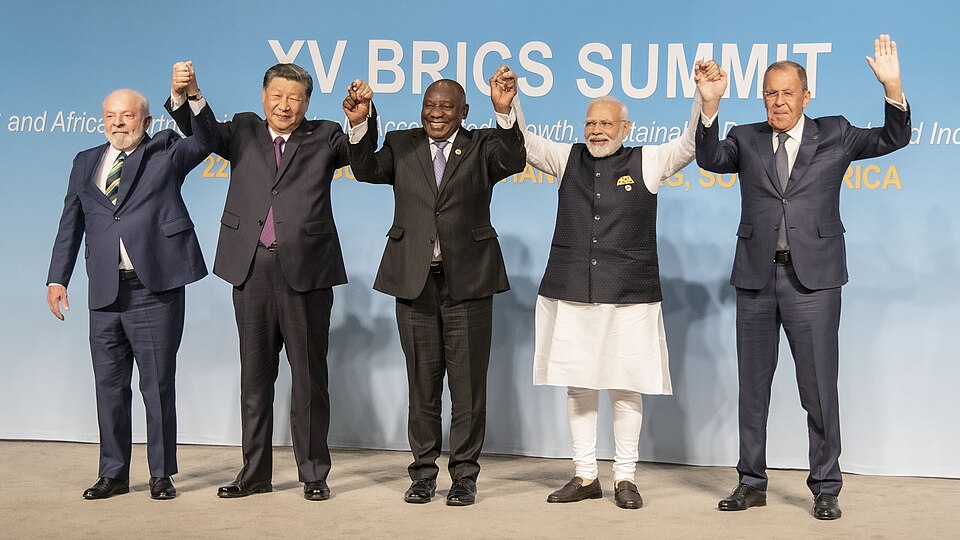
[Cover image] 15th BRICS Summit. (2023, August 23). XV BRICS Summit family photo [Photograph]. Wikimedia Commons. https://commons.wikimedia.org/wiki/File:XV_BRICS_Summit_family_photo.jpg


Leave a comment