
By Raphaëlle Abi Haila and Maxime Pierre
I. Introduction
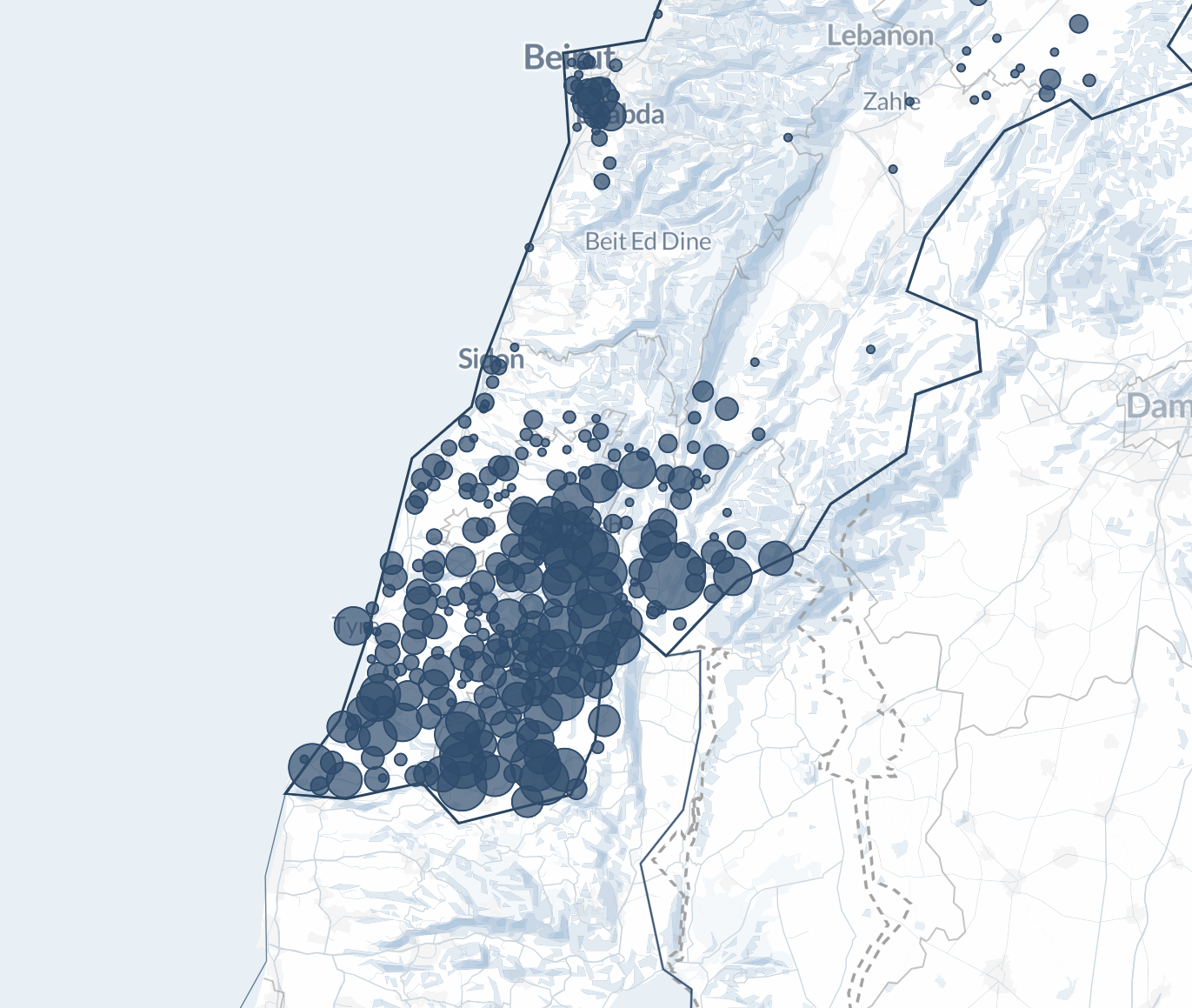
On Thursday March 12, Turkey’s Foreign Minister warned that due to the ongoing conflict, Lebanon will soon reach “a state of collapse”, if hostilities between Israel and Hezbollah are not halted urgently [1]. That warning is not overstated, for the intensification of Israeli bombardments and mass evacuation orders threaten the collapse of a country already on the brink. The numbers speak for themselves: since the first rockets were fired on March 2 by the Iran-backed group Hezbollah, more than 2,000 people have been reportedly killed [2], while over 1 million were forced to flee from the south of the country, almost one in five Lebanese [3].
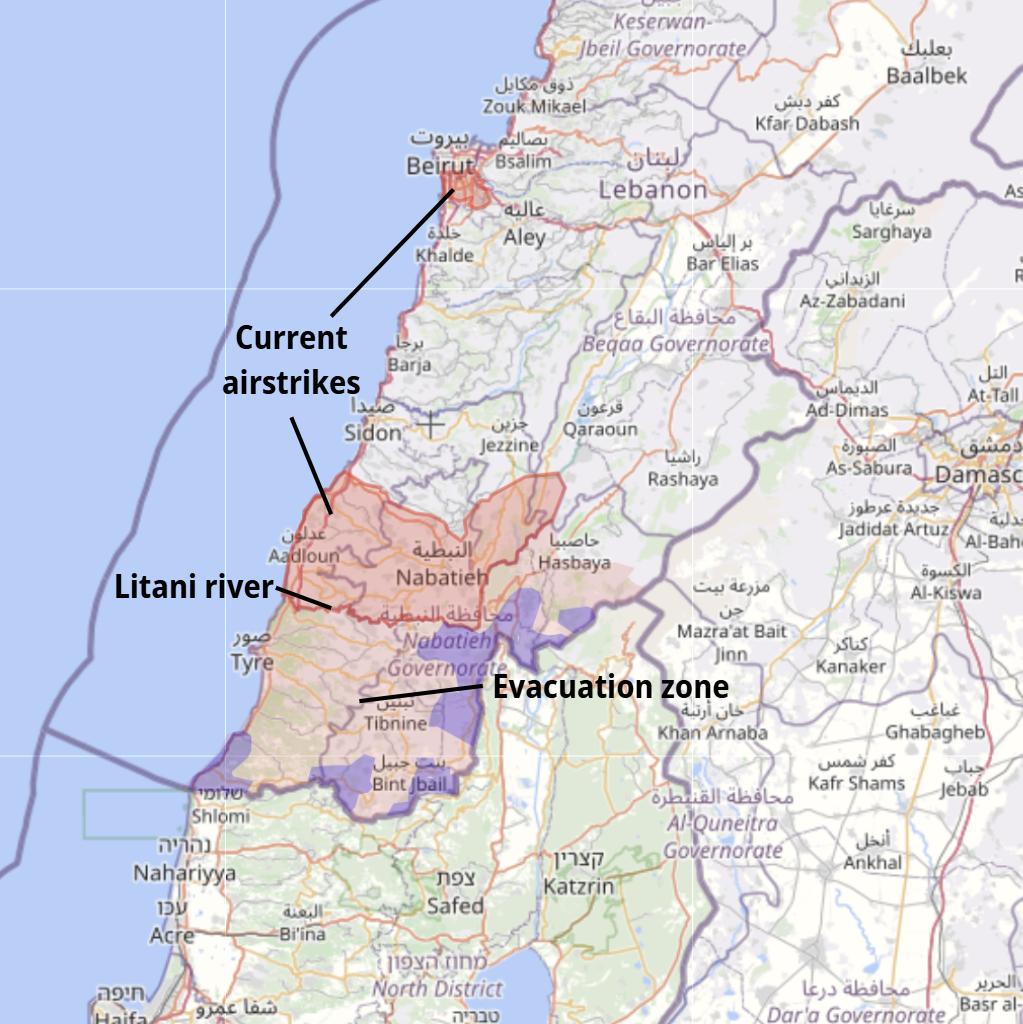
The Israel Defense Forces (IDF) keep expanding their evacuation orders, now beyond the Litani River, 30 km north of the border. The IDF’s stated goal is to seize Southern Lebanon and create a buffer zone [4]. In an attempt to isolate that part of the country, 7 bridges have already been destroyed or severely damaged by Israeli strikes.
Iran’s new leader, the son of the slain Khamenei, saluted Hezbollah’s “sacrifice” and the “resistance front” composed of other Teheran-sponsored armed groups. But the unilateral decision to strike Israel and open a new front goes against Lebanon’s government and its citizens, both staunchly opposed to this unprovoked aggression. In this war embroiling the entire Middle East and beyond, the Lebanese population is cruelly caught between an armed group in tatters and a brutal asymmetric response from Israel [5][6].
On Wednesday April 8, hopes of de-escalation raised by the ceasefire with Iran were dashed within hours as Israeli strikes intensified sharply. At around 2 p.m., Israeli forces launched an unprecedented wave of attacks, carrying out around one hundred strikes on residential neighbourhoods in just 10 minutes. For civilians, the hope of the morning gave way to panic and despair. With no warning issued before the bombardment, residents had little or no time to escape. At least 357 people were killed and 1,223 injured [7][8].
Twenty-four hours after the strike, an announcement was made of planned negotiations — the first direct talks between Lebanon and Israel since the war. Israel said it was responding to repeated calls from Lebanese President Joseph Aoun to engage in direct negotiations. The first round of talks is expected to begin during the week of April 13 in Washington, led by Israel’s ambassador to the United States, Yechiel Leiter, and his Lebanese counterpart, Nada Hamadeh Moawad. However, Israel has stated that these negotiations will not lead to a ceasefire. [9]
Whilst the world observes the events unfolding from an impersonal military standpoint, Lebanon is “crumbling from inside out”, as an economical adviser living outside of Beirut told the publication. The EIPS (ESCP International Politics Society) contacted a dozen Lebanese nationals, from different parts of the country, to understand the ramifications of this international conflict for local populations, and the complexities on the ground that are underreported by western media.
II. A shared responsibility
The majority of people contacted by the EIPS considered the responsibility for this current war does not rest on one, but multiple actors who have long contributed to the worsening situation. They all underlined the difficulty of imputing the entirety of the fault to either Hezbollah, Iran, Israel, the United States or the Lebanese State. “Each one plays a role in the escalation in different ways […] It is very difficult to attribute the responsibility to a single part” – according to a local residing in northern Lebanon.
Nevertheless, the role of one group in particular – Hezbollah – is a major source of division among the population.The responses received by the EIPS paint a complex picture. On one hand, Lebanese consider that the group acts according to its rights, in order to defend the country’s territorial sovereignty, in contrast with the inaction of the Lebanese State. Yet, the Hezbollah movement is viewed to have gone beyond its political role to embody an ideology of the resistance of the Lebanese people in the face of ‘invaders’. As stated by a university professor, “it’s an ideology, not a political thing, we are all resistants somehow in Lebanon” he told the EIPS. “They will never erase Hezbollah from Lebanon, and anyone who thinks that is foolish. And even if they did, as long as Israel is in the South stealing it, there will always be a new resistance”, underlined another respondent.
However, the growing hostility towards Hezbollah is palpable. “Hezbollah is 100% responsible for all the misfortunes that happen to us, it should not be just desarmed but also DESBANDED once and for all” – responded an architect from Beirut. That fallout with the Lebanese people comes in stark contrast to the popularity it enjoyed after Israel’s definitive withdrawal from Southern Lebanon in 2000, following its 18 year-occupation [10]. But the armed group, who have since entered politics and the government, have in effect built quasi-state power in the country. Osama, from eastern-Beirut, desperately observed that the current situation is “the high price [the Lebanese people] have to pay for having tolerated for so long the existence of a ‘state within a state’.”
For a large part of the population, says Osama, “international inaction is interpreted as an implicit message: as long as Hezbollah imposes its law by arms and acts outside all state legitimacy, Lebanon will remain alone in the face of the consequences of this drift. This feeling is all the more violent because it reveals a truth that is difficult to accept: the world no longer distinguishes Lebanon from those who have taken it hostage. This observation fuels a muffled anger, but also a brutal awareness of the price to pay for having tolerated for too long the existence of a State within the State.”
In light of its growing unpopularity, demands for its disarmament, or even its dissolution are commonplace: “The responsibility of Hezbollah in the current escalation is no longer a hypothesis nor a simple political reading: it imposes itself as an observable reality through its military, security and strategic choices, often taken outside any sovereign national decision. The group acts today as an autonomous actor, whose priorities go beyond the immediate interests of Lebanese society and are inscribed in regional dynamics that expose the country to repeated conflicts. This position weakens the State and its institutions and accentuates internal divisions, while locking Lebanon into a logic of permanent confrontation.”
Furthermore, while many responses acknowledge that the Lebanese State is overwhelmed and finds itself in a crisis exceeding its operational capacity, the state faces accusations of systemic inaction and betrayal on different levels: citing both an abandonment of civic protection, and its reluctance to disarm Hezbollah and to assert its sovereignty. “The Lebanese government also bears a share of responsibility, insofar as it struggles to fully exercise its authority and to effectively protect the population or to avoid the country being drawn into such an escalation.”
Since a fragile ceasefire was brokered by the US and France in November 2024, supposedly halting hostilities between Hezbollah and Israel, progress to disarm the militant group remained lackluster. Even with some notable progress, the Lebanese army — which set the deadline for the first part of its multi-phased disarmament plan to the end of 2025 — noted that more work ought to be done to clear unexploded ordnance and tunnel networks. Whilst Israel authorities said in January that the disarmament process was “encouraging, but far from sufficient”, the ceasefire was in effect never applied. International observers noted nearly daily strikes by Israel against Hezbollah positions [11][12].
III. An absent Lebanese State
This feeling of abandonment and anger against the Lebanese State is ubiquitous in the testimonies received by the EIPS, and particularly underline the perception of Southern-Lebanese of having been forgotten and neglected: “When you can’t rely on a government or a state to protect you or provide even basic needs, it becomes impossible to feel safe.” “The most common emotion they express is anger. Realising that your own state is not able to protect you can feel like a child discovering that their mother cannot, and will not, be able to protect or be there for them. It creates a deep sense of abandonment and frustration.”
Indeed, today, the inhabitants of the South find themselves in a total impasse. Although none of our witnesses were displaced, many are those who live in proximity (for several, within a few blocks) of bombing zones. They mention friends, acquaintances, or even clients who have been forced to leave everything, without any prospect of return, and incapable of imagining the future. “I have many friends who have been forced to flee — some have had their homes threatened or destroyed. They are understandably in shock: losing their homes, and everything their families built, in a matter of seconds just to stay alive, with nowhere to return to and no clear plan for what comes next”, “many had to leave their home precipitously, without knowing if they will be able to return to it nor in what state they will find it. They describe very difficult conditions of displacement: lack of resources, temporary housing” explained a Beirut resident.
If understandable compassion towards the displaced is expressed, some division nevertheless emerges. Notably, several residents put forward an incapacity for dialogue with the refugees from the South, due to a seemingly unbridgeable political and ideological rift. Osama states that “[Lebanese] voluntarily avoid any discussion with displaced friends, because they belong to opposing political and ideological camps. In the current context, any exchange would be perceived as hypocritical or provocative.”
As a result, the refugees can be perceived with mistrust, and have difficulty finding housing, whether because of their political opinions, or simply because the inhabitants live in fear that a member of Hezbollah may be among them, most cities won’t rent them houses or apartments, out of fear that having someone linked to Hezbollah nearby could bring danger or bombings” told another Beirut resident. These sectarian tensions have been documented by the United Nations and MedGlobal, who gathered accounts of local municipalities seeking to discourage residents from renting homes to displaced people coming from the South, because of suspected links with Hezbollah [13]. Antoine, from central Lebanon, evokes how people from the South “cannot be living under the State, because they do not share our vision of a neutral and sovereign Lebanon”, bleakly underlining the lingering divide.
The million individuals displaced find themselves alone and destitute, receiving no truly conclusive help either from the State, or from their fellow citizens.
Nevertheless, several respondents recall that the Lebanese must not forget that South Lebanon is, and fully forms part of, Lebanon, and that the territory and its people deserves to be protected: “the South is part of Lebanon, just like North and Bekaa”; “[We’re] forgetting that South Lebanon is one of the most precious things we have”; “the South is part of Lebanon, and it always will be”, “South Lebanon will remain to Lebanon.” One Beirut resident put it plainly: “10,452 is our number”, alluding to the country’s internationally-recognised surface area (in square kilometers).
IV. The “last straw?”
Faced with this impasse, all our witnesses are affected, although on different scales. The deep structural crisis that has affected Lebanon for years, if not decades, is perceived to be only worsening.
All mention a “constant feeling of insecurity and anxiety.” What Western media does not manage to capture, due to its impersonal distant lens, is how disoriented Lebanese are, unable to imagine, one crisis after another, a stable future: “We live in a state of permanent crisis, where each conflict is added to the previous ones without ever being resolved. The weariness is deep, the capacity for resistance is diminishing, and the possibility of getting out of it by our own means becomes more and more illusory. It is not only a war that we are undergoing, but the continuous erosion of every perspective of stability, security and future”, “The Lebanese community has been enduring immense hardship for nearly six years. The Beirut port explosion, the economic collapse, the war in Palestine, and the current war have all caused profound damage. Despite these repeated crises, people continue to rebuild, only to see their efforts undone time and again. This has created a pervasive sense of instability, leaving many feeling psychologically unsafe and unable to function as they once did. They are exhausted, unprotected, and deeply insecure.”
On a daily basis, all Lebanese are affected by the rise in prices, in particular gasoline. The new evacuation maps create terrible chaos, forcing workers to spend several hours in traffic jams before being able to go to work or return home. One respondent underlines that “the impact on children is particularly worrying. They feel the fear and the tension around them, even when one tries to protect them. Some become more anxious, have difficulty sleeping, or ask many questions to which it is difficult to respond. Their routine is disrupted, which affects their sense of security and their emotional well-being.”
The professional life of many is affected, notably with a crumbling demand for products and services. A business owner from central Lebanon cites “revenues in freefall.” A clinic worker from Ghazir saw the number of patients decrease because many are simply too afraid of the journey to seek care. Another witness, an adviser in economy, finance, transport and infrastructure, laments the total stoppage of all his projects: “Among [all the frozen projects], is the Levant Gate project, on which we worked for eight years: a structuring project of regional connectivity comprising a railway line, a tunnel, a pipeline and a free zone, aiming to connect Beirut to Syria, then to the East and West axes. This project embodied a vision of development, transit and regional economic integration for Lebanon. The current conflict and security instability have brought a brutal end to this long-term effort, concretely illustrating how war does not destroy only the present, but methodically annihilates every perspective of future.”
All mention an accumulation, and feel that this time, if the war continues, Lebanon will cease to function. Lebanese perceive the international community’s support as non-existent, and that it acts like a spectator, passive, or even complicit.
One witness thinks that “the international community often underestimates how fragile the situation in Lebanon already is. After years of economic collapse, political instability, and previous conflicts, the country’s resources are extremely limited. Some parts of Lebanon are slowly deteriorating, and rebuilding what has been lost is much more difficult than people might imagine. Reconstruction is not only about rebuilding buildings; it is also about rebuilding institutions, trust, and a sense of stability.”
One Beirut resident expresses the long-lasting impact of an international community failure. “The international community continues to treat the Lebanese situation as one crisis among others, whereas it is a matter of an advanced process of state and social disintegration. What it does not manage to understand is that Lebanon is no longer simply threatened by a punctual military escalation, but by the simultaneous collapse of all the structures that make a state functional: sovereignty, institutions, social contract and collective trust.
The danger is not only the visible war, but the normalisation of chaos. A country where the decision of war escapes the State, where justice is paralysed, where the economy is destroyed and where the population has lost every perspective of the future does not recover through simple ceasefires or temporary humanitarian aid.
By underestimating the depth of this decomposition, the international community risks confusing crisis management and durable solutions. Lebanon is not on the brink of a collapse: it is already living its consequences. Each day of inaction, relativisation or diplomatic calculation brings the country closer to a point where any reconstruction will become theoretical, or even impossible.
The peril with which Lebanon is confronted is not only Lebanese. It concerns the credibility of international law, the very notion of a sovereign State and the collective responsibility in the face of the collapse of a country abandoned to dynamics that surpass it.”
V. Conclusion
Throughout the testimonies gathered by the journal, one feeling was expressed unanimously, that of powerlessness. In the geopolitical game played by international actors in the region for centuries, Lebanese “know that [the current conflict] is much bigger than all of [them]”, as a 62 year old Beirut resident stresses.
Stuck between a rock and a hard place, with Hezbollah waging its “Iranian war”, Israel punishment on civilians and its infrastructures and the advanced level of discomfiture of the Lebanese state, a path out of this doom-spiral seems elusive. One of the questions asked to the people reached was if the latest conflict was indeed the “last straw” for the state. The answers were an unequivocal “yes”. So long as Lebanon is co-governed by a “mafiocracy”, where illegal armed groups and their allies impose their will on the whole territory, domestic and regional peace cannot be conceived. There is a hope, although not explicitly told, that the current war could once and for all cut off Iran’s support for its regional proxies. The current trajectory of the war does not appear to align with such assessment.
According to locals contacted by the EIPS, a threefold solution might break the deadlock. Firstly, territorial integrity. In the testimonies collected, grievances can only dissipate if internationally recognised borders are respected and defended by the regular armed forces. Only through this process can inhabitants of both sides of the border, Lebanese as Israeli, end this constant threat hanging over the region. The buffer-zone project of the IDF would go against that long-term solution.
Secondly, the international community could intervene urgently to assist Lebanon forces in disarming all militias, training and supplying the regular army to regain full control of the territory. This process was already facilitated by UNIFIL (United Nations Interim Force in Lebanon) and underpinned by UN Resolutions 1559 and 1701. Adopted between 2004 and 2006, these two pillars mandate that Lebanon be ‘placed under the exclusive authority of the Lebanese Government’ (1559) and require a ‘zone free of any armed personnel’ — excluding state forces and UNIFIL — between the Blue Line and the Litani River (1701).
Lastly, it is for the entrenched elite political class, whose late-stage clientelism and corruption have largely contributed to the current crisis, to democratically hand-over power to a new leadership that would rally broad-based support rather than subsist through sectarian divide [14].
One Beirut resident — echoing online chatters about preventing the country’s downfall — mentioned the invocation of Chapter VII of the UN Charter, giving mandate to an international coalition to “take action by air, sea, or land forces as may be necessary to maintain or restore international peace and security” [15]. Invoking it is far from convoluted.
The dispossession of decision-making from the Lebanese people due to regional and international forces entails an equally global assistance to sustain long-lasting peace and territorial sovereignty.
Past the global repercussions of this war on the region and world economies, citizens of the Land of the Cedars yearn for a better day. As a 14 years old girl from Beirut told the EIPS, “Lebanon just wants to live in peace.” Beyond headlines of the latest military developments, an entire region is sharing that girl’s sentiment.
Edited by Adrian Kai Fraile Itagaki.
References
[1] France 24. (2026, March 12). Turkey talking to US, Iran in bid to end war: Minister. https://www.france24.com/en/live-news/20260312-turkey-talking-to-us-iran-in-bid-to-end-war-minister
[2] Al Jazeera. (2026, April 13). Lebanon Latest: Talks scheduled as Israeli strikes continue
https://www.aljazeera.com/video/newsfeed/2026/4/13/aje-onl-aje_onl_lebanon_wrap-130426
[3] Al Jazeera. (2026, April 6). Israeli airstrikes devastate Lebanese villages and displace millions. https://www.aljazeera.com/gallery/2026/4/6/israeli-airstrikes-devastate-lebanese-villages-and-displace-millions
[4] Reuters. (2026). The toll on Lebanon’s infrastructure: Mapping the impact of the crisis. https://www.reuters.com/graphics/IRAN-CRISIS/LEBANON-ISRAEL-INFRASTRUCTURE/gkvlklaxypb/
[5] CNN. (2026, March 12). Iran war: US, Israel and Trump updates. https://edition.cnn.com/world/live-news/iran-war-us-israel-trump-03-12-26
[6] ACLED. (2026). Israel prepares ground invasion as Hezbollah formally joins war. Armed Conflict Location & Event Data Project. https://acleddata.com/report/israel-prepares-ground-invasion-lebanon-hezbollah-formally-joins-war
[7] Le Monde. (2026, April 9). Le Liban, écrasé sous les bombes israéliennes, compte ses morts : « Un tel carnage dépasse l’entendement » https://www.lemonde.fr/international/article/2026/04/09/le-liban-vise-par-les-plus-importantes-frappes-israeliennes-depuis-le-debut-de-la-guerre-les-israeliens-nous-bombardent-par-vengeance-parce-qu-ils-ont-perdu_6678547_3210.html
[8] Le Monde. (2026, April 11). Les Libanais enterrent les morts du « mercredi noir » : « Nous ne sommes pas que des chiffres »
[9] Le Monde. (2026, April 10). Benyamin Nétanyahou annonce des négociations entre Israël et le Liban mais prône une « paix par la force»
[10] Black, I. (2000, May 24). Israel ends 22-year occupation of South Lebanon. The Guardian. https://www.theguardian.com/world/2000/may/24/israelandthepalestinians.lebanon
[11] Al Jazeera. (2026, January 8). Lebanon’s army says phase one of Hezbollah disarmament in south completed. https://www.aljazeera.com/news/2026/1/8/lebanons-army-says-phase-one-of-hezbollah-disarmament-in-south-completed
[12] Al Jazeera. (2026, March 11). The Israel-Hezbollah ceasefire was built to fail. https://www.aljazeera.com/opinions/2026/3/11/the-israel-hezbollah-ceasefire-was-built-to-fail
[13] NBC News. (2026). Lebanon’s displaced face dire conditions, turned away over Hezbollah fear. https://www.nbcnews.com/world/lebanon/lebanons-displaced-face-dire-conditions-turned-away-hezbollah-fear-rcna266534
[14] Université de Sherbrooke. (n.d.). Résolutions 1559 et 1701 du Conseil de sécurité des Nations Unies sur le Liban. Perspective Monde. https://perspective.usherbrooke.ca/bilan/servlet/BMDictionnaire/1614
[15] United Nations. (1945). United Nations Charter: Chapter VII. https://www.un.org/en/about-us/un-charter/chapter-7
[Cover image] [16] Pexels. (2018, June 28). Beirut city skyline [Photograph]. Pixabay. https://cdn.pixabay.com/photo/2018/06/28/17/52/city-3504445_1280.jpg


Leave a comment