
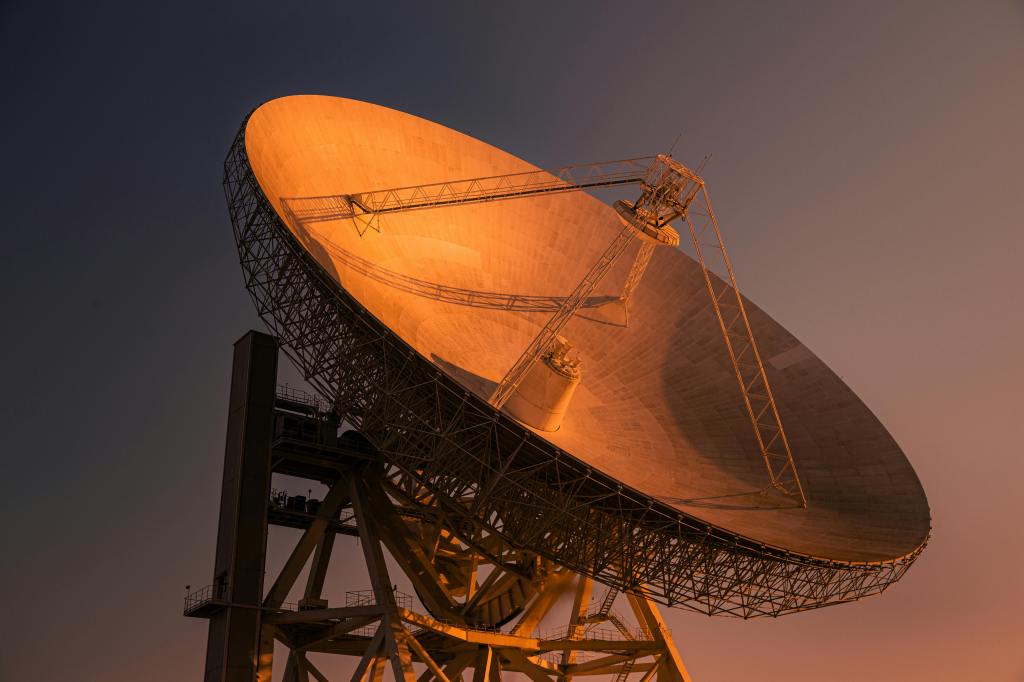
The global competition for space dominance is routinely framed as a high-stakes contest of rockets and satellites. Analysts meticulously track launch cadences, debate orbital slot allocations, and map the rapid expansion of mega-constellations. Yet, this popular framing systematically omits a critical layer of the space infrastructure stack: the ground stations. These networks of antennas, relay terminals, and mission control facilities serve as the indispensable physical interface between orbiting assets and the organisations that depend on them. Without these terrestrial nodes, no satellite however sophisticated can receive commands, transmit data, or maintain positional awareness. In effect, the most advanced constellation in orbit remains inert without its ground-based anchors. As the space industry enters an era of “de-globalisation” [6], nations are increasingly treating this segment not merely as a logistical afterthought, but as a matter of absolute national security.
The Architecture of Multinational Dependency
The standard mental model of space power focuses on what is visible: the gleaming rocket and the orbital trajectory. Ground infrastructure is invisible by design, often buried in long-term basing agreements and obscured by civilian mission branding. However, the operational logic necessitates a global footprint. A satellite in Low Earth Orbit (LEO) passes over any given point for only a few minutes; to maintain continuous contact, operators must position stations at strategic latitudes in politically stable, bandwidth-rich environments.
The European Space Agency’s (ESA) Estrack network exemplifies this technical requirement. Its core relies on three deep-space antennas of 35 metres in diameter, located in New Norcia (Australia), Cebreros (Spain), and Malargüe (Argentina), positioned roughly 120 degrees apart in longitude to provide continuous coverage as the Earth rotates [3]. While technically elegant, this topology is a risk register waiting to be read. A satellite network without secure ground access is comparable to a global telephone exchange where every switching station is located in a foreign country, accessible only under a lease that can be revoked at a moment of political inconvenience.
Dual-Use Ambiguity: The New Scramble for Antenna Rights
The competition for ground access has intensified as China expands its space footprint, particularly in South America. The Espacio Lejano station in Neuquén, Argentina, has become the focal point of strategic concern. Run by a sub-entity of the People’s Liberation Army Strategic Support Force, the Chinese Communist Party’s military wing, the station is officially for civilian research. However, reports from the Center for Strategic and International Studies (CSIS) highlight that, while its three band frequencies are intended for scientific research, its X- and Ka-band capacities are “typically reserved for government use, which may include the transmission of sensitive information” [2].
The Neuquén case illustrates a broader structural ambiguity: the line between civilian and military applications is architecturally indistinguishable. As the CSIS report bluntly observes, much of the technology used at ground stations is inherently dual use [2]. A facility receiving data from a lunar probe can, with modest modification, support reconnaissance satellites or counter-space operations. This blurred line makes ground stations a primary vector for espionage and strategic interference.
Data Sovereignty and the GSaaS Model
In an age where data is frequently termed the “new oil”, jurisdiction over ground nodes is paramount. Nations now demand that their black gold be processed and hosted within their own borders to reduce dependence on foreign infrastructure and assert legal control [6]. This push for sovereignty is further driven by cybersecurity concerns; as data flows through foreign territories, it creates vulnerabilities to interception and attack [6].
For mid-tier powers, building a bespoke sovereign network is often prohibitively expensive. This has led to the rise of Ground-Segment-as-a-Service (GSaaS), where operators purchase contact time on a per-minute or per-pass basis [1]. This model has attracted Big Tech giants such as Amazon Web Services and Microsoft, which leverage their existing data centre assets to dominate the segment [1]. However, outsourcing the antenna does not solve the strategic problem; it merely repackages it within the regulatory framework of another jurisdiction.
Strategic Leverage: The Starlink Variable and NATO’s Response
No development illustrates the geopolitical stakes more than SpaceX’s Starlink. With approximately 10,000 satellites using inter-satellite laser links, Starlink reduces though does not eliminate the need for dense ground coverage [7]. It has become the backbone of communication in conflict zones such as Ukraine, coordinating drone operations and military units [7]. Yet, this concentration of power in a single private operator creates a new category of risk. Elon Musk’s refusal to activate coverage for a Ukrainian operation in Crimea demonstrates that infrastructure held by private parties whose interests may diverge from users is, by definition, leverage [7].
In response, the EU is developing IRIS (Infrastructure for Resilience, Interconnectivity and Security by Satellite) to ensure strategic autonomy by 2029 [7]. Similarly, NATO has recognised that the weakest link is often on the ground. NATO’s Senior Space Coordinator, Daniel Hilgert, warns that excessive reliance on single commercial providers creates structural vulnerabilities [4]. Consequently, NATO is developing the THOR programme to create playbooks for offensive and defensive counter-space operations, operating on the principle that “the biggest threat is not actually in space, but on this planet” [4].
The Fragmented Regulatory Frontier
Finally, the global regulatory environment remains a significant hurdle. Licensing processes for ground stations can range from as little as two days in the United Kingdom to nine or twelve months in the United States [5]. This patchwork includes hidden rules regarding national security that operate outside published manuals [5]. Experts argue that without international harmonisation, this unevenness will continue to distort competition and concentrate power in the hands of those able to navigate the complexity [5].
Conclusion: A Reckoning Long Overdue
The space race of the twenty-first century will not be won at the launchpad. It will be won in the quiet negotiations over antenna rights in Patagonia, in the commercial contracts governing the downlink, and in the regulatory choices that determine whether the ground is treated as a simple commodity or a sovereign asset. Ground stations are unglamorous and terrestrial, yet they are the physical layer upon which all space capabilities depend. Any asset that is essential, distributed across foreign territories, and susceptible to dual-use interpretation is a strategic liability. That reckoning is overdue.
References
[1] Nova Space. (2025, June 26). A New Dawn for Satellite Ground Stations. Retrieved from https://nova.space/in-the-loop/a-new-dawn-for-satellite-ground-stations/
[2] Pelcastre, J. (2022, November 21). China’s Ground Stations in South America Raise Concerns. Diálogo Americas. Retrieved from https://dialogo-americas.com/articles/chinas-ground-stations-in-south-america-raise-concerns/
[3] European Space Agency. (n.d.). Estrack: ESA’s global ground station network. Retrieved from https://www.esa.int/Enabling_Support/Operations/ESA_Ground_Stations/Estrack_ESA_s_global_ground_station_network
[4] SES Space & Defense. (2026, January 28). How Geopolitics is Reshaping the Space Domain. Retrieved from https://sessd.com/gsr/how-geopolitics-is-reshaping-the-space-domain/
[5] Rasila, T., & Ojala, A. (2024). National Regulation of Satellite Ground Stations: A Global Comparison. In A. Ojala & W. W. Baber (Eds.), Space Business: Emerging Theory and Practice. Palgrave Macmillan. Retrieved from https://link.springer.com/chapter/10.1007/978-981-97-3430-6_8
[6] Faith, R. (2024, February 22). Navigating the New Frontier: The Rise of Sovereign Satellite Ground Stations in the Age of De-Globalization. RBC Signals Blog. Retrieved from https://rbcsignals.com/blog/navigating-the-new-frontier-the-rise-of-sovereign-satellite-ground-stations-in-the-age-of-de-globalization/[7] Latschan, T. (2026, February 14). Starlink: How Elon Musk’s company influences geopolitics. Deutsche Welle. Retrieved from https://www.dw.com/en/starlink-how-elon-musks-company-influences-geopolitics/a-75963477
[Picture] Chris Lyo. (n.d.). Large Satellite Dish in Golden Sunset. Pexels. Retrieved from https://www.pexels.com/photo/large-satellite-dish-in-golden-sunset-30688669/


Leave a comment