By Cyprien Guillot de Suduiraut
Part 1: The West’s Fateful Hesitation
Part 1: The West’s Fateful Hesitation (Published May 12)
Part 2: Western Blindness: From the Bucharest Appeasement to the Abandonment of Tbilisi (Upcoming)
Part 3: The Roots of the Georgian Conflicts and the Five-Day War
Part 4: The Unlearned Lessons of the Georgian Case
Post-independence Georgian conflicts are generally hardly known or understood by Westerners. One would tend to believe that they come down to the Russo-Georgian War of 2008, also commonly referred to as the Russian invasion of Georgia. As counterintuitive as it may seem, those conflicts are actually not centred on a direct showdown between Tbilisi and Moscow, but rather on the separatist aspirations of two Georgian provinces: Abkhazia and South Ossetia. These two small Caucasian regions are far from being familiar to Western Europeans. But Putin’s Russia has been actively exploiting them in its efforts to restore a fantasised sphere of influence previously crushed by the fall of Communism [1].
The reason for Westerners’ general unawareness towards disputes still taking place on European soil lies mainly in the perception of their remoteness. This impression affected the way in which peaks of violence – for instance, in 2008 – were reported in Western media. As Finnish journalist Salla Nazarenko put while analysing the covering of various phases of the conflicts: “the regions were not perceived as important enough by all of the [newspapers] to send their journalists there to cover the news” [2]. More importantly, it suggests that “Abkhazia and South Ossetia – and even Georgia despite its aspirations of integration with the West – remain on the edge of Europe, and also on the edge of the news agenda” [3].
That mediatic isolation was proven once again through the case of the October 2024 parliamentary election and the protests which promptly followed the reveal of the results. In the final moments of the campaign and on election day, Western newspapers naturally evoked the ballot and what was then at stake for Georgia. After the election was deemed rigged by various actors [4,5], most of these news outlets followed up with coverage of the firsts post-voting demonstrations which, because of their notable scale, also gained traction online, notably on social media. Nevertheless, journalists’ interest did not take long to wane and articles on the situation in Georgia slowly disappeared. As protesters in Tbilisi heroically held on for a whole month despite growing repression from the pro-Russian authorities, the number of Western pieces surged again in December 2024 before facing an indisputable collapse. It has never risen again since then, although many Georgians remain demonstrating in huge numbers – as shown by the popular uprising attempt on 4 October 2025 [6].
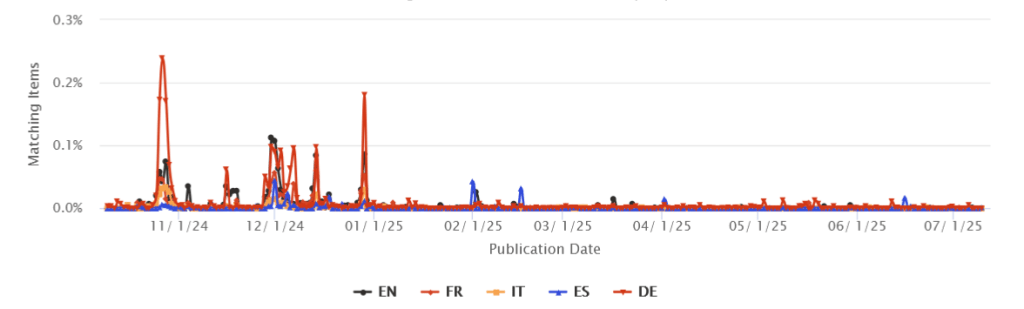
This lack of coverage must have logically resulted in an immediate relapse of Georgia into oblivion among Western citizens’ minds. But it should not be one’s reason to forget about it once and for all. Such a course would entail repeating the grave mistakes of the past.
The 2008 Bucharest NATO summit
At the 2008 Bucharest NATO summit, Tbilisi – as well as Kyiv – was partially (but deliberately) left behind by France and Germany in its candidacy to join the Alliance. Both Paris and Berlin then blocked Georgia’s and Ukraine’s access to the Membership Action Plan (MAP), the canonical route to NATO membership since the fall of the Berlin Wall. The main stated reason behind then-President Sarkozy’s and then-Chancellor Merkel’s joint decision was that the two countries’ political instability supposedly rendered their bid too hasty [7]. The French and German delegations’ firm position could also be explained by their unconcealed will to avoid antagonising Vladimir Putin [8], who perceived NATO’s eastward expansion – i.e. towards Russia’s claimed sphere of influence – as a threat to Russian national security.
Further similar argumentation came afterwards. Senior German officials repeatedly argued over the years that maintaining stable relations with Russia was a direct path to economic prosperity, since it would pave the way to energy agreements, especially on cheap gas. Anything the indirectly-German-backed Kremlin could have concurrently attempted on the world stage would have simply been collateral damage to secure jobs for German citizens and competitiveness for the whole country [9]. After all, there is a reason why realpolitik comes from Germany.
Over time, this stance, which amounts to nothing less than sacrificing Georgia and Ukraine for the sake of German economic interests, clearly turned out to be a monumental failure – to say the least. Georgia was aggressed four months after the 2008 NATO summit; the fate Ukraine had to face since is quite revealing of what giving in to Moscow’s whims leads to.
Yet, as the Czech saying goes, ‘after the battle, everyone’s a general’; meaning that it is easy to be wise after the event. Angela Merkel’s decision needs to be studied through a 2008 lens to be truly comprehended. First, as the former chancellor wrote in her memoirs [10], the Black Sea Fleet of the Russian Navy was then stationed in Ukrainian-controlled Crimea [11], making Ukraine a country “entangled with Russian military structures” like never before for a state aiming to join NATO (i). Second, she feared that advancing Kyiv’s candidacy would split the country in half, since “only a minority of [Ukrainians] backed NATO membership at the time” (ii). As for Georgia, the “unresolved territorial disputes in the regions of South Ossetia and Abkhazia” (which this article will come back to later) were “reason enough” to reject its bid (iii). Merkel adds in her book that accepting the two post-Soviet states’ request for a MAP would have led to the same consequences as in our timeline. According to her, Putin would have acted in the meantime to prevent them from becoming full members of the Alliance (iv) – a theory that Russia’s offensive against Georgia in the summer of 2008 lent some credibility to.
Influential figures like former Italian premier Matteo Renzi stepped in publicly to back the chancellor’s past choices, arguing that back in the 2000s “[good relations with Russia] were a goal of everyone in Europe, not only a goal of Angela Merkel” [12], thus carelessly condoning what indirectly led to the bloodiest war on European soil since WWII.
Let us not be mistaken. Merkel’s explanations are perfectly rational (although extremely debatable). Her decisions were taken in light of the information, data, and pressures of the time – and backed by a powerful European actor, France. Yet their underlying cowardice cannot be fully obscured by the guise of lucidity and purported realism.
(i) The concern of Russian and Ukrainian militaries being too ‘nested one inside the other’ raised concerns because it was considered a brake to the alignment of the Armed Forces of Ukraine (ZSU) with NATO requirements to be granted full membership. But one could reasonably imagine that this matter could have been solved through the application of the MAP. Why? Because it is precisely the very goal of the Plan: “to assist the [NATO] aspirants in developing forces and capabilities that could operate with NATO under its […] Operational Capabilities Concept (OCC)” [13]. The OCC is an evaluation aimed at testing the levels of interoperability of NATO’s nations and partners. The Alliance defines ‘military interoperability’ as “the ability of military forces to train, exercise and operate effectively together in the execution of assigned missions and tasks” and, more broadly, ‘interoperability’ as “the ability to act together coherently, effectively and efficiently to achieve Allied tactical, operational and strategic objectives” [14].
Therefore, a proper application of a MAP on the ZSU would likely have been expected to prioritize the handling of its alleged problematic interconnection with the Russian Armed Forces, so that it becomes compatible with Allied standards and interests. When the Membership Action Plan was formalised in the late 1990s, it was imagined as a transition program for countries of the former Eastern Bloc to fix the issues they had inherited from the Soviet era – the “burden of a Warsaw Pact culture” [15] – which barred them from NATO eligibility. Considering this may well contribute to showing how deeply flawed Merkel’s decisions were. Figuratively, the chancellor had the opportunity to administer a vaccine to a sick patient but refused to do so because the patient was sick. Worse still, she made a leap and acted as if welcoming Kyiv into a MAP amounted to immediately welcoming a ‘Russia-imbricated country’ in NATO [16]. In fact, it would have engaged it into an incremental process that would have necessarily needed, in order to be successful, to address the very problem used as an excuse by Berlin to reject Ukraine’s candidacy. This whole reasoning is misguiding, if not blatantly dishonest. And it proved to have serious consequences over time.
(ii) The democratic argument may be the most substantial of all. It is factually correct to affirm that, going back almost two decades ago, the prospect of joining NATO was far from stirring genuine excitement among most Ukrainians. Many polls consistently illustrated it. Yet, they had elected pro-European & Atlanticist presidential candidate Viktor Yushchenko in 2004. President Yushchenko was still in office four years later, and his desire and ambition to lead Ukraine’s integration into Western structures had been no secret to anyone during his tenure [17]. Consequently, both French and German delegations in Bucharest should have honoured the “European choice made [in 2004] by the Ukrainian people” [18], through heeding – and more importantly, backing – the sovereign message that was then conveyed to NATO and the EU. The exact same idea applies to Georgia, whose people had voted 77% in favour of the “[pursuance of] integration into NATO” in a January 2008 non-binding referendum [19].
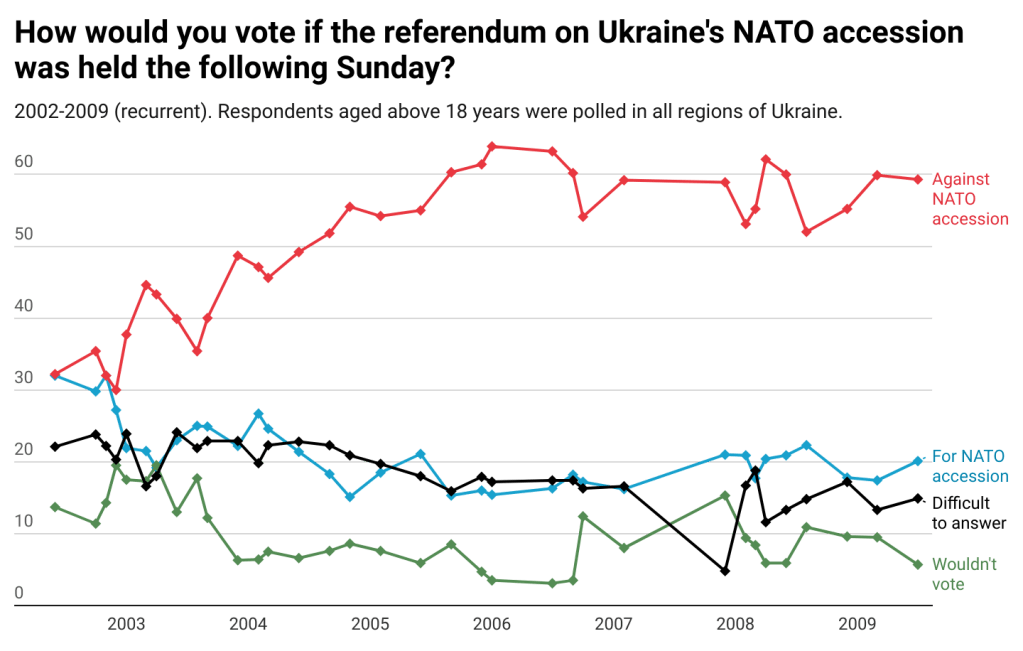
In Ukraine’s case, one may object that, had Paris and Berlin done so by offering Kyiv a MAP, nothing would have been much different in the medium and long run than in our timeline. Indeed, Ukrainians may well have reversed their stance and returned to neutrality thereafter, just as they did with their country’s pro-European leaning in the 2010 elections [20]. But what truly mattered in Bucharest laid elsewhere.
The true stakes were not really about whether the Allies should grant MAPs to Ukraine and Georgia. At any rate, such outcome would have been merely a symbolic formalisation of a bound-to-happen NATO rapprochement with these countries, not a genuine invitation to the Alliance with all that such a step entails. The real issue was more the Atlantic bloc’s inability to remain united enough to send a daring signal to the Kremlin, one that would have made Putin think twice before following through with his threats. Instead of that, Moscow’s pressures eventually worked and were publicly cited as the main cause of the West’s abandonment of the two former Soviet republics. Other arguments raised against the MAP option – however conceivable – were nothing more than excuses of inherently fearful leaders and diplomats.
It is self-evident that, in a multilateral organization like NATO which requires a consensus of its parties to incorporate new countries, each member’s position on the candidacy of a particular state is governed by political considerations [21]. In the case of Georgia and Ukraine, countries like Germany or France simply feared irritating Russia, and therefore avoided doing so to secure relations with a state they intended to remain close to [22]. Had Kyiv or Tbilisi managed to meet all the criteria on which the ‘MAP-sceptics’ placed so much emphasis, it remains far from certain that the Merkel–Sarkozy tandem would have been any more eager to welcome them than they were in reality.
This is why Merkel (or any other official of the time) persisting in seeking refuge for past decisions behind a mountain of endless justifications almost twenty years later – when the harm has already been done and continues to worsen by the day – is problematic. To quote Shakespeare’s Hamlet, “methinks the lady doth protest too much”; meaning that one’s excessive self-justification may betray a form of guilt. A wiser response to the criticism directed at her would involve acknowledging that she erred while trying to strictly protect German geopolitical interests.
Again, all the invoked reasons to justify the rejection of Ukraine and Georgia from the MAP process can be promptly refuted by reference to the latter’s very spirit. ‘Georgia cannot be offered a MAP since it lost control of a fifth of its territory over ethnic separatists’ (iii); ‘the rule of law is still very imperfect in Georgia’ [23] in the then-NATO Secretary-General’s own words; etc. Yet the Alliance’s very press release outlining the ways and means of MAPs back in 1999 had stated itself that “[MAP countries] would […] be expected” to “demonstrate commitment to the rule of law” and “to settle ethnic disputes […] by peaceful means” [24]. Following that reasoning, every issue because of which Ukraine and Georgia were deemed ‘not ready’ would have been addressed more effectively with a MAP than without one. In fact, Georgian officials had precisely told NATO ambassadors ahead of the Bucharest summit that failing to grant Tbilisi one would jeopardize the country’s democratic reforms, whereas doing so would provide a “positive impetus” regarding the matters of Abkhazia and South Ossetia [25].
In a nutshell, the reasons advanced by certain Allied countries to justify their unwillingness to risk antagonizing Putin were hollow. Their leaders sought to present those reasons as objective, while they were actually crafted to serve their self-interested aims.
That obstinate attitude led to an undesirable decision at the close of the Bucharest summit. Its final declaration states that the Alliance “agreed […] that [Ukraine and Georgia] will become members of NATO” [26] without further clarification. Even though this outcome might appear to have been a resort to the ‘compromise’ option – that is, the most ‘reasonable’ or ‘moderate’ one – it was, in reality, a wolf in sheep’s clothing. Countries of the former Communist Bloc which had joined NATO by 2008 firmly spurned it, arguing that “no one would stand to gain anything from […] [what they called] the ‘halfway-house’ scenario” [25]. Merkel herself was sceptical. To her, the move equated to a blow to the Euro-Atlantic aspirations of the Ukrainian and Georgian governments [27], while remaining a provocation in Moscow’s perception since the two post-Soviet countries were still given a promise of NATO integration over time [28]. Then-Russian Deputy Foreign Minister Alexander Grushko effectively framed the decision as a “huge strategic mistake which would have most serious consequences for pan-European security” [8].
Thus, the Bucharest decision was irresponsible in the sense that it jeopardized the security of both Ukraine and Georgia by offering Moscow a narrative opportunity to depict them as potential enemies (and therefore, future targets) without actually guaranteeing them proper protection from the Kremlin’s claws.
What were the other options worth considering? Two, rather obviously: accepting or declining Ukraine’s and Georgia’s bids in their entirety.
The latter would have set a precedent to renounce once and for all to the idea expressed only four years earlier by President George W. Bush that “the door to NATO [remains] open until the whole of Europe is united in freedom and peace” [29], regardless of any third country’s views on the matter [30]. Put another way, it would have constituted a direct capitulation to Russia’s threats – an option Washington could scarcely have contemplated less than two decades after prevailing in the Cold War against the USSR. Furthermore, it would have signified yet another instance of ‘Western betrayal’ for two former Soviet-bloc nations, something the then-newly admitted U.S. allies in Central Europe and the Baltic states would have found difficult to brook.
Granted, the former would have likely triggered a Russian reaction (iv) to reconquer what Putin considered (and still considers as of today) to be his private turf in Europe. But what would have been so different from what the world spectated in 2008, 2014, 2022, both in Ukraine and Georgia? Probably not much.
Given what is now known about Russia’s long-term reaction to NATO’s decision to limit itself to vague promises of future membership for the two nations, it can be argued that the only plausible means of preventing war on European soil would have been their immediate entry into the Alliance – ideally within the 2008 window of opportunity. Clearly, such an option was simply impossible. Kyiv and Tbilisi were factually not ready to join NATO at the time of the Bucharest summit. Admitting them so rapidly would have set a precedent for ‘express integration’ – one that other aspirant countries might have sought to claim for themselves thereafter. Had that occurred, the demanding criteria for NATO membership would have been undermined, and the Alliance itself risked becoming a free-access organisation devoid of substance.
In summary, the Allies delaying MAPs for Georgia and Ukraine in 2008 was a total “miscalculation” – in President Zelenskyy’s very terms [31] – that eventually “emboldened” Russia to revive its imperialistic tropism [12]. At the same time, welcoming them into the program would have likewise made them legitimate targets in Putin’s eyes, as integral parts of his imagined russkiy mir [1]. The alternative options – immediate integration or outright rejection of their candidacies – were both equally unrealistic. From there, the self-evident conclusion follows: there was no genuine way out of the Ukraine-Georgia dilemma of 2008.
Even so, Europe faced a crucial symbolic choice in Bucharest. One reflecting its readiness at the time, or lack thereof, to confront an irredentist fallen empire craving to restore its former prestige, if necessary, through conquest, intimidation or destruction. Maybe Angela Merkel was right about the risk of Russian retaliation to welcoming Ukraine and Georgia into MAPs [32]. No one will ever know for sure. But that would, in turn, mean that confrontation with Vladimir Putin’s Russia was inevitable (see the previous paragraph); which, in itself, implies that any attempt to ‘appease’ Moscow through “concession” [33] was bound to fail, if not a nonsensical move. Yet, when given the choice between war or dishonour (to echo Winston Churchill’s legendary quote), the German chancellor maintained that opting for dishonour would preserve peace – or at least ‘buy time for Ukraine to prepare’ as she opportunistically claimed from 2022 onwards [12]. So, dishonour she chose. Only for Europe to finally have war on its soil. In this respect, one may argue Angela Merkel is to Bucharest what Neville Chamberlain was to Munich.
Edited by Félix Dubé.
References
[1] Russian authorities often refer to this notion of sphere of influence through the euphemistic term of ‘Russian world’ (русский мир / russkiy mir). Interestingly, this term can also mean ‘Russian peace’ (‘Pax Russica’).
[2] Salla Nazarenko, “With or Without Georgia? Portrayal of Abkhazia and South Ossetia in The New York Times, Süddeutsche Zeitung, The Guardian and Novaya gazeta during the conflicts of 2004, 2006 and 2008” University of Oxford, 84, June 22, 2009.
[3] Ibid.
[4] European institutions (see the joint report from the European Parliament and the parliamentary assemblies of the OSCE, the Council of Europe and NATO : https://www.osce.org/files/f/documents/3/0/579346.pdf), EU ministers (https://civil.ge/archives/632072), Georgian leaders of the opposition coalitions (Coalition for Change, For Georgia, Strong Georgia, Unity – National Movement ; see https://www.politico.eu/article/georgia-elections-marred-by-intimidation-and-interference-observers-warn/), Georgian President Salome Zourabichvili (https://civil.ge/archives/631657), NGOs like the Washington-based International Republican Institute (https://www.iri.org/wp-content/uploads/2024/12/IRI-International-Election-Observation-Mission-to-Georgia.pdf) all contested the democratic nature and integrity of the election. Vote-buying, voter intimidation, ballot-box stuffing, among other irregularities, constituted the basis of their statements.
[5] See also “Statistical and Mathematical Evidence of Rigged Parliamentary Elections in Georgia” Free University of Tbilisi, 2024 (https://arxiv.org/pdf/2412.01845) and HarrisX’s final exit poll analysis: https://www.harrisx.com/content/harrisx-final-georgia-2024-exit-poll-analysis
[6] “Georgia PM says protesters tried to overthrow government, vows crackdown” Al Jazeera, October 5, 2025. www.aljazeera.com/news/2025/10/5/georgia-pm-says-storming-of-presidential-palace-aimed-at-overthrowing-govt
[7] “Merkel ‘stands by’ 2008 NATO decision after Zelenskyy jab” DW, April 4, 2022. https://www.dw.com/en/merkel-stands-by-past-ukraine-nato-decision-after-zelenskyy-criticism/a-61359003
[8] “Nato denies Georgia and Ukraine” BBC, April 3, 2008. http://news.bbc.co.uk/2/hi/europe/7328276.stm
[9] Matthew Karnitschnig, “Why Merkel chose Russia over US on Nord Stream 2” Politico, July 26, 2021.
[10] Guy Chazan, “Nato right to heed Russian anger over Ukraine accession plan, Angela Merkel says in memoirs” Financial Times, November 21, 2024. https://www.ft.com/content/053c369e-0903-4062-a910-20d5dd31827f#selection-2209.0-2235.200
[11] In accordance with the provisions of the Russo-Ukrainian Partition Treaty on the Status and Conditions of the Black Sea Fleet of 1997. The accord was later extended by the Kharkiv Pact of 2010, then unilaterally terminated by Russia in 2014.
[12] Katya Adler, “Angela Merkel defends ties with Russia and blocking Ukraine from Nato” BBC, November 25, 2024. https://www.bbc.com/news/articles/c3e8y1qly52o
[13] Jeffrey Simon, “NATO’s Membership Action Plan (MAP) and Prospects for the Next Round of Enlargement” Wilson Center, 8, November 2000 https://www.wilsoncenter.org/sites/default/files/media/documents/publication/ACF45B.pdf
[14] See NATO glossary of terms and definitions (2020 edition), 70 & 82 : https://www.coemed.org/files/stanags/05_AAP/AAP-06_2020_EF_(1).pdf
[15] Simon, op. cit., 8
[16] Participation in a MAP does not “prejudge any eventual decision by the Alliance on issuing an invitation to begin accession talks” whatsoever. See the April 1999 NATO statement on the open-door policy: https://web.archive.org/web/20220512101216/https://www.nato.int/docu/comm/1999/9904-wsh/pres-eng/04open.pdf
[17] See for instance the “Opening statement by Viktor Yushchenko, President of Ukraine, at the meeting of the NATO-Ukraine Council at the level of Heads of State and Government” February 22, 2005 https://www.nato.int/cps/en/natohq/opinions_21972.htm
[18] Ibid.
[19] Official results of the 5/1/08 referendum can be accessed on the website of the Central Election Commission : https://web.archive.org/web/20130718052605/http://www.cesko.ge/index.php?lang_id=ENG&sec_id=13&info_id=1166
[20] Pro-Russian candidate Viktor Yanukovych was then elected to the presidency. The Verkhovna Rada approved a bill sanctioning Ukraine’s neutrality and effectively abandoning NATO ambitions shortly after. See “Ukraine’s parliament votes to abandon Nato ambitions” BBC, June 3, 2010. https://www.bbc.com/news/10229626
[21] See https://www.rferl.org/a/1079718.html
[22] Both for economic reasons (for Germany, cf. supra). Since the mid-Cold War, France has also sought to maintain a realist approach to international relations, aiming to be a ‘balancing power’ [puissance d’équilibre], capable of weighing on the world stage by positioning itself between major powers – yet without ever disowning its firm anchoring in the West. It still upheld that goal as of 2022 (see the preface of the 2022 Revue nationale stratégique [National strategic review] by President Macron : https://www.sgdsn.gouv.fr/files/files/rns-uk-20221202.pdf). For a time, this vision implied maintaining ties with Russia.
[23] Ahto Lobjakas, “NATO: Georgian, Ukrainian MAP Bids Likely To Go To The Wire At Summit” RFE/RL, March 27, 2008. https://www.rferl.org/a/1079695.html
[24] See NATO press release NAC-S(99)66 released on April 24, 1999 (section I ; 2.a. & 2.c.) https://www.nato.int/docu/pr/1999/p99-066e.htm#1
[25] Lobjakas, op. Cit.
[26] See “Bucharest Summit Declaration Issued by the Heads of State and Government participating in the meeting of the North Atlantic Council in Bucharest on 3 April 2008” (remark n°23) https://web.archive.org/web/20200714204022/http://www.summitbucharest.gov.ro/en/doc_202.html
[27] Chazan, op. Cit.
[28] Ibid.: “the fact that Nato had made a general pledge of membership to the countries still amounted to a ‘declaration of war’ [for Putin]”
[29] “Ceremony as 7 former Soviet-bloc nations joins NATO” AP Archive (from March 30, 2004), July 30, 2015 https://youtu.be/m1IN7bfv20Y?t=107
[30] See NATO website’s page on “Enlargement and Article 10” (last updated October 3, 2024): https://www.nato.int/en/what-we-do/partnerships-and-cooperation/enlargement-and-article-10
[31] Zoya Sheftalovich, “Zelenskyy calls out Angela Merkel, Nicolas Sarkozy for blocking Ukraine’s NATO bid” Politico, April 4, 2022. https://www.politico.eu/article/zelenskyy-calls-out-angela-merkel-nicolas-sarkozy-for-blocking-ukraines-nato-bid/
[32] One may still fairly imagine that embarking on this winding path would have sent a strong signal of resolve to Putin, who might have then hesitated to regard a more firmly Western-backed Kyiv and Tbilisi to be easy targets.
[33] As the Bucharest summit’s outcome was framed by American officials in Bucharest (“concession to Moscow”) and then-Georgian president Mikheil Saakashvili (“appeasement of Russia”); see “Nato summit: George Bush abandoned over Ukraine and Georgia” The Times, April 3, 2008. https://web.archive.org/web/20090109011027/http://www.timesonline.co.uk/tol/news/world/europe/article3670335.ece
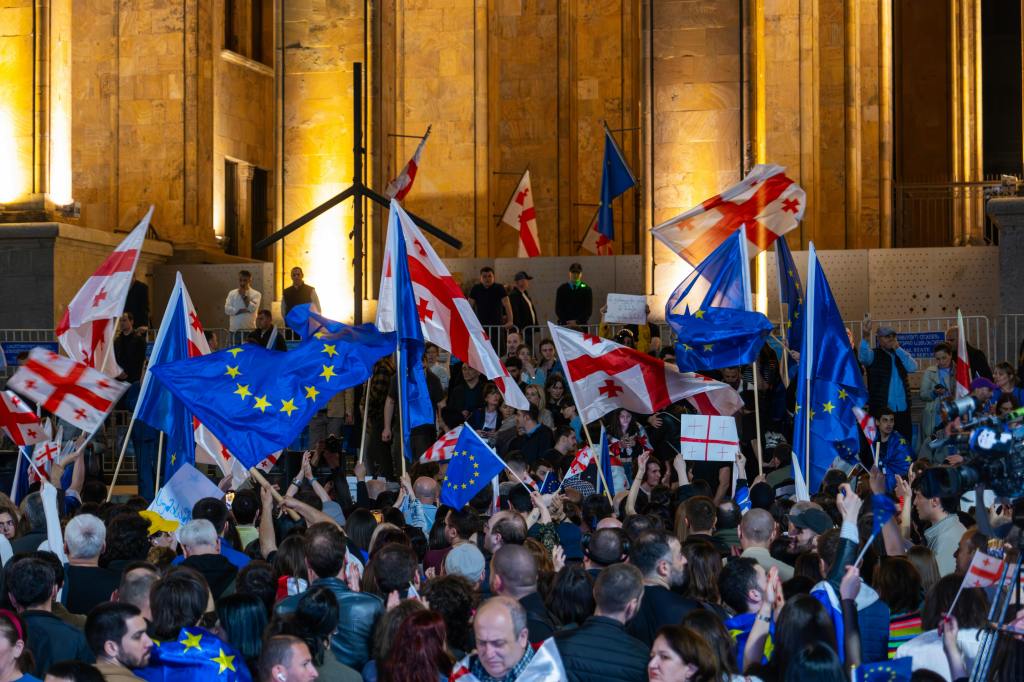
[Cover picture] Pexels. (n.d.). Protesta en Tbilisi con banderas de Georgia y de la UE [Photograph]. Pexels. https://www.pexels.com/es-es/foto/protesta-en-tbilisi-con-banderas-de-georgia-y-de-la-ue-31582769/
[Figure 1] Attention paid in Western newspapers (media database: US, UK, France, Italy, Spain, Germany) to the Georgian crisis over the 10/24-10/25 period, by language. Chart generation: Media Cloud Search tool (www.mediacloud.org)[Figure 2] Evolution of Ukrainians’ voting intentions in case of a referendum on NATO membership, 2002-2009. Source: Razumkov Center, Kyiv (https://razumkov.org.ua/en/)


Leave a comment