By Emilie Gay
Six coups since 2020 suggest not a simple return, but a reshaping driven by domestic dynamics.
Since 2020, West Africa has experienced a succession of six takeovers, a phenomenon that can be explained by the geopolitical concept of “Coup Belt” [4]. This concept describes all the countries where the powers have been overthrown in recent years. The “Coup Belt” refers to a geopolitical corridor extending roughly 6,000km across Africa, from the Atlantic coast to the Indian Ocean. It geographically highlights the instability of several states whose governments suffer from weak domestic and international legitimacy. In some cases, these regimes have searched for political, diplomatic, or security support from Russia after relations with Western partners deteriorated [1]. The countries having experienced a Coup in the last 6 years are: Mali (2020, 2021), Chad (2021), Guinea (2021), Burkina Faso (January and September 2022), Sudan (2021), Niger (2023) and Gabon (2023) [3]. The following question arises: is it a return to the past or a new phenomenon [2] ?
From 1990, 78% of the 27 Coups in sub-Saharan Africa have taken place in former French colonies – only about 17 of the 46 sub-Sahara African countries being French colonies. This leads one to wonder whether French influence in Africa is at the center of the instability leading to these overthrows [5].
Following growing tensions between France and the Malian junta,French President Emmanuel Macron announced during an interview with newspaper Le Journal du Dimanche on May 30 2021, that given the rise of radical Islamism in Mali under General Assimi Goïta’s government, Paris “could not stand by a country where there is no longer any democratic legitimacy.” The French leader also announced that France would not hesitate to withdraw its troops from Mali, if the country continues to move towards radical Islamism. On February 17 2022, Emmanuel Macron officially announced the withdrawal of French forces from Mali, under Operation Barkhane, accompanied by his European partners [7]. The French leader reportedly communicated that: “France intervened in Mali, first to fight terrorism, and at the request of a sovereign state. “[…] And why do we decide today to leave ? it is that the junta, which is responsible for Mali, no longer takes responsibility for it.” This speech highlights a sense of powerlessness in the face of the threat of an escalation of extremist tendencies, and helps to understand the political fragility of the countries of the “Coup Belt”, placing them at the forefront of extremist attacks.
Colonel Abdoulaye Maiga, elected Prime Minister of Mali in September 2022, then accused France, while praising Russia. According to the political figure of Mali, France would have “stabbed in the back” the nation of West Africa by withdrawing its troops. It was then reported that he declared at the United Nations General Assembly that French leaders had “renounced universal moral values, betrayed the rich history of enlightenment philosophers, and turned into a junta in the service of obscurantism.” On the contrary, he would have welcomed the successful cooperation between Mali and Russia. Indeed, the military juntas of Mali, as well as those of Burkina Faso and Niger, have annulled the military agreements authorizing French troops to operate on their territory, even going so far as to eliminate French in 2023 as an official language, in the case of Mali [8].
This is where ECOWAS, the Economic Community of West African States, comes in. The organization intervened to ease tensions by trying to change the label associated with the region, but in vain. It suspended Mali after the Coup d’état in 2021, and then Guinea on September 8 2021 [6]. Solidarity among military juntas weakens ECOWAS: in 2023, Mali, Burkina Faso, and Niger formed the Alliance of Sahel States, creating a bloc that openly bypasses the organization’s authority.
Not all coups in Africa follow the same pattern. It was on 23 July 1952 that the Egyptian army came to power, marking the first coup in modern Africa. Since then, more than a hundred takeovers in 35 countries on the continent have taken place. The overthrows in Africa follow three major dynamics. First of all, their frequency is highly variable, depending on the governance. But also their causes, as well as the elements that trigger them, their protagonists and their possible consequences. Measures have been put in place to deal with it, although they still differ widely from one country to another, such as the management by the African Union of the 2014 coup, which is different from how it handled the 2013 coup in Egypt. Key moments leading to Africa’s current political instability can be explained by Coup waves; three different periods that allow us to identify how insecurity in Africa has evolved throughout the years.
The first wave began in 1960 and ended in 1970. It was mainly the political context of independence in Africa that triggered it: post-independence leaders were overthrown, leading to massacres, extremely violent extrajudicial executions, and human rights violations. Some of these overthrows have been glorified, for ending the old one-party rule as well as lifetime presidencies (for example, the overthrow of Jean-Bédel Bokassa in the Central African Republic in 1979). The second wave of coups spread between 1990 and 2001. African leaders, unable to respond to their people’s expectations, had failed to deliver on their promises to establish democratic rule and meet socioeconomic aspirations, resulting in military uprisings. Since 2019, Africa has been facing a third wave of coups affecting Sudan, Mali, Guinea, Burkina Faso, Niger, and Gabon. What distinguishes this new wave is the changing motivations of their authors: some invoke democratic setbacks, the deterioration of security, and the rise of an anti-colonial sentiment.
The recent overthrows in Guinea, Niger, and Gabon were all led by members of the presidential guard, or elite army units, a specificity to modern Coups. Indeed, putsches seem easier to carry out in some French-speaking African countries, where security is often entrusted to a presidential guard integrated into the army. Better equipped and better trained than the rest of the forces, this unit alone can then facilitate a takeover.
The takeovers following the 1990s showed no violence or executive execution, highlighting the transformation of its characteristics. More recent coups have generally been led by military officers presenting themselves as agents of political stabilization (for example, General Abdourahamane Tchiani in Niger in 2023). Former leaders are often detained by the junta before being released once the new leadership is in place. These new dynamics mentioned, encourage us to reflect on the evolution of the nature and forms of coups d’état in Africa [9].
It is thus possible to observe that in the past, the overthrow of power in Africa was mainly the work of the military, who seized power claiming they would restore political stability. From now on, coups are accompanied by legitimizing speeches, often based around the fight against corruption but also the rejection of foreign influence. Contemporary coups are thus more politicised, and seek to present themselves as the expression of a popular will, rather than as military takeovers.
This is not a cyclical return, it is a structural transformation. From now on, every power overthrow in the countries of the “Coup Belt” is explained by an arrival of mercenaries from Wagner representing a providential support for these fragile regimes. This is notably the case of Niger, whose takeover has particularly alerted Western powers such as the United States: the overthrow of its political order means a continuity of ground for Russian paramilitaries in Africa, a threat to its opponents. As one of the world’s largest uranium producers, Niger’s seizure of power, like that of other African countries, is creating a threatening destabilisation among border countries. Chad and Senegal are the next tests of this reconfiguration, and their trajectories will determine whether the “Coup Belt” continues to expand or stabilize.
Edited by Adrian Kai Fraile Itagaki.
References
[1] Saferworld. “How not to lose the Sahel: Community perspectives on insecurity and international interventions in Mali, Niger and Burkina Faso.” Saferworld, February 2022, https://www.saferworld-global.org/resources/publications/1385-how-not-to-lose-the-sahel-community-perspectives-on-insecurity-and-international-interventions-in-mali-niger-and-burkina-faso. Accessed 19 March 2026.
[2] UK Parliament. “Coups and political stability in West Africa.” UK Parliament, 18 September 2023, https://commonslibrary.parliament.uk/research-briefings/cbp-9861/. Accessed 19 March 2026.
[3] Felix, Bate, and Nick Macfie. “Niger coup: List of recent military takeovers in West and Central Africa.” Reuters, 27 July 2023, https://www.reuters.com/world/africa/recent-coups-west-central-africa-2023-07-26/. Accessed 19 March 2026.
[4] franceinfo. “Niger : en Afrique, la ceinture des coups d’État redessine la carte du continent.” franceinfo, Claude Guibal, 15 August 2023, https://www.franceinfo.fr/replay-radio/le-monde-est-a-nous/niger-en-afrique-la-ceinture-des-coups-d-etat-redessine-la-carte-du-continent_5912414.html. Accessed 22 April 2026.
[5] BBC. “Niger coup: Is France to blame for instability in West Africa?” BBC, 2023, https://www.bbc.com/news/world-africa-66406137. Accessed 22 April 2026.
[6] Aljazeera. “ECOWAS suspends Mali over second coup in nine months.” Aljazeera, 2021, https://www.aljazeera.com/news/2021/5/31/ecowas-suspends-mali-over-second-coup-in-nine-months. Accessed 24 April 2026.
[7] Public Séat. “Emmanuel Macron annonce le retrait de la « présence militaire » de la France au Mali.” Public Sénat, 17 February 2022, https://www.publicsenat.fr/actualites/non-classe/la-france-annonce-le-retrait-coordonne-du-territoire-malien-de-l-armee-francaise?utm_source=chatgpt.com. Accessed 24 April 2026.
[8] United Nations. “Mali | General Debate.” General Debate, 26 September 2022, https://gadebate.un.org/en/80/mali. Accessed 24 April 2026.
[9] ISS Africa. “L’évolution des coups d’État en Afrique | PSC Report.” ISS Africa, 11 October 2023, https://issafrica.org/pscreport/psc-insights/levolution-des-coups-detat-en-afrique. Accessed 24 April 2026.
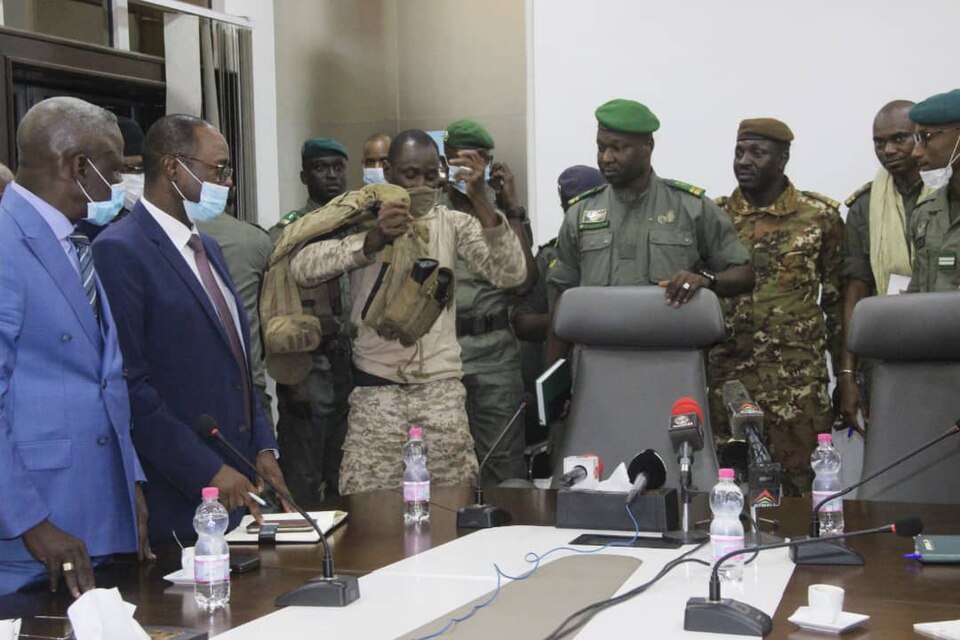
[Cover picture] Sgmap. (2020). Comité national pour le salut du peuple – 2020 Malian coup d’état [Photograph]. Wikimedia Commons. https://commons.wikimedia.org/wiki/File:Comité_national_pour_le_salut_du_Peuple_-_2020_Malian_coup_d%27Etat.jpg


Leave a comment