By Cyprien Guillot de Suduiraut
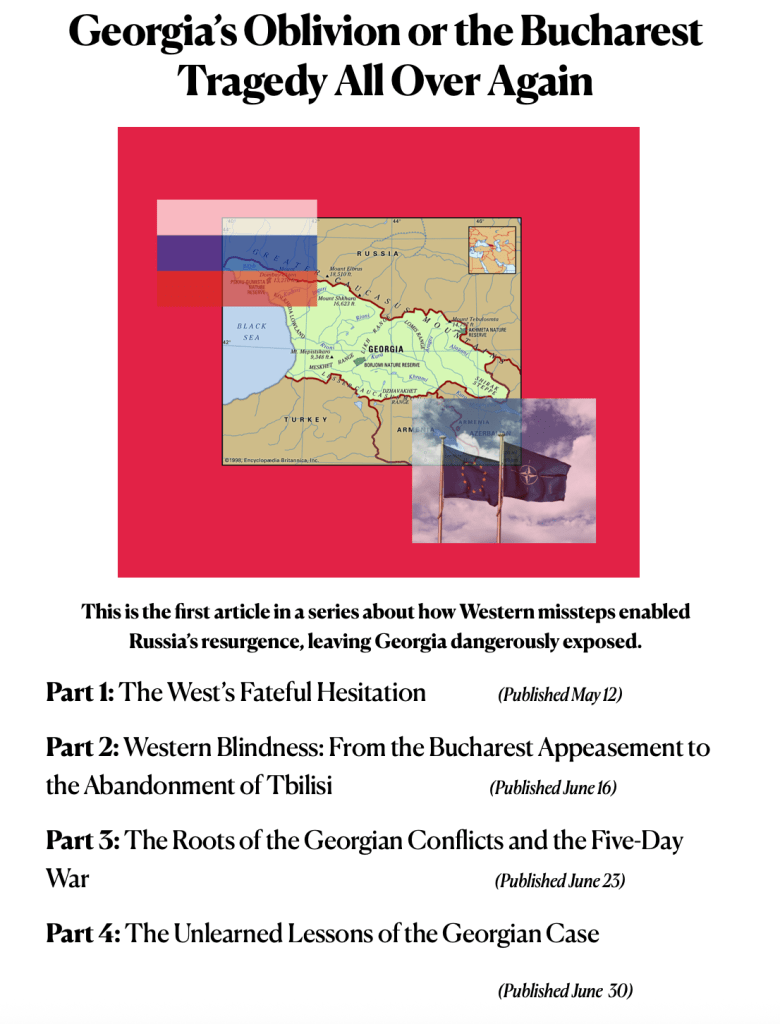
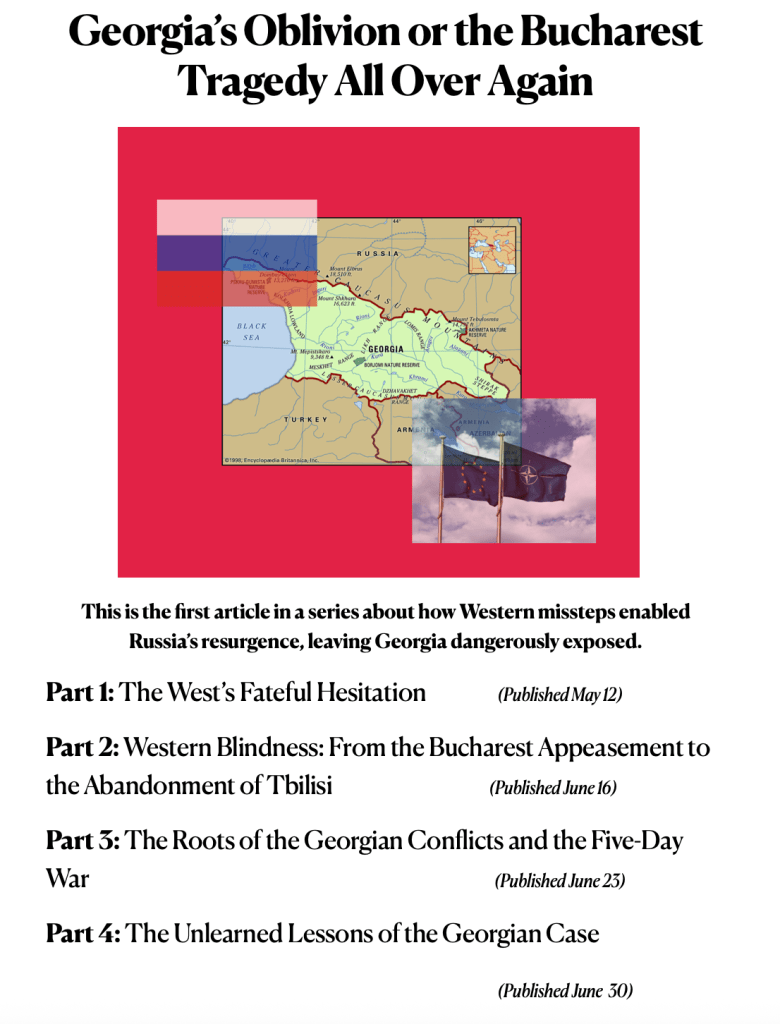
Part 4: The Unlearned Lessons of the Georgian Case
Part 1: The West’s Fateful Hesitation (Published May 12)
Part 2: Western Blindness: From the Bucharest Appeasement to the Abandonment of Tbilisi (Published June 16)
Part 3: The Roots of the Georgian Conflicts and the Five-Day War
Part 4: The Unlearned Lessons of the Georgian Case
The West facing the Kremlin’s first information offensives
Russia’s war against Georgia was followed by extensive disinformation campaigns designed both to obscure responsibility for the conflict and advance spurious arguments aimed at legitimising it. These operations marked an early attempt to mislead Western perceptions through Kremlin-made self-victimising narratives. They had not yet crystallised around the now familiar trope of a treacherous NATO ‘encirclement’ of Russia, [119] allegedly leaving Moscow with no choice but to retaliate by subduing neighbouring states – Ukraine foremost among them – in order to preserve its coveted sphere of influence [1]. However, by taking a step back from the current situation in Ukraine, one may easily identify patterns in several of the groundless myths emanating from the Kremlin since 2008. In that regard, the following examples, while not exhaustive, are quite instructive.
Firstly, then-Russian Prime Minister Vladimir Putin [120] and various Russian senior officials accused Tbilisi of perpetrating a ‘genocide’ against South Ossetians, implicitly adumbrating the notion that Moscow bore a responsibility to protect them on the grounds that a “major part of [their population were] Russian citizens”. [121] This bears a striking resemblance to the Kremlin’s claims of a Kyiv-induced genocide against Russian speakers in Donbas since the outbreak of the Russo-Ukrainian War (2014–present), claims that Putin himself repeatedly invoked [122] to the point of making them a cornerstone of his justification for the announcement of a ‘Special Military Operation’ on 24 February 2022. [123] In the case of Ukraine, such contention was soundly refuted by leading experts from the International Association of Genocide Scholars, who found it ‘baseless’. [124]
Secondly, Moscow’s propaganda apparatus sought to portray President Saakashvili as a mentally unstable individual – the first step in advancing the idea that he had essentially suffered a breakdown on the night of August 7, 2008, thereby launching an unprovoked military offensive against South Ossetia. This narrative was propagated through a coordinated long-term campaign spanning Russian media, official diplomatic channels [125] and the highest echelons of government, up to former President Medvedev himself. [126] The parallel with the notion developed by Putin in 2022 of a criminal ‘junta’ at the head of a “Kiev regime” [123] allegedly run by “a gang of drug addicts and neo-Nazis who [had taken] the entire Ukrainian people hostage” [127] is equally striking. In both cases, the underlying objective is identical: to depict the leaders of a foreign pro-Western government as erratic, neurotic authoritarian figures out of touch with reality, irrational in their so-called ‘russophobia’ and deluded as to their prospects of successfully defying Moscow. This depiction serves to render them wholly responsible for the Kremlin’s aggressions against their countries, astutely framed as ‘defensive measures’ directed at neutralising the threats they were purportedly held to represent.
Thirdly, as if the supposed genocide of South Ossetians or Saakashvili’s alleged mental derangement were not already sufficient grounds in Russia’s estimation for the aggression of a sovereign nation, Putin also openly accused the United States of having entirely orchestrated the 2008 war against Georgia. A few days after the cessation of hostilities, and despite an apparent lack of substantial evidence, he declared to CNN: “ [Russia has] serious reasons to believe that there were US citizens right in the combat zone […]. If my suppositions are confirmed, then there are grounds to suspect that some people in the United States [read: the White House] created this conflict deliberately. […] [These US citizens fulfilling their duties there] can only do that under orders from their superiors.” [128] The Russian leader reiterated similar assertions during the full-scale invasion of Ukraine, notably blaming the “Kiev regime” for having “brought into play new groups of foreign mercenaries […], military units trained according to NATO standards and receiving orders from Western advisers”. [129] The contention that NATO troops have been deployed on the ground in Ukraine since 2022 remains wholly unsubstantiated. [130] The underlying Russian tactic at play here consists in presenting conflicts in Moscow’s ‘near abroad’1 as Western-fomented proxy wars manipulating ostensibly ‘historically-friendly’ peoples (e.g. the ‘brotherly’ Ukrainians) into pawns serving a broader long-standing ‘anti-Russian’ cabal. In the Kremlin’s telling, this plot would have been schemed by the so-called ‘collective West’ with the explicit aim of destroying Russia – the logical next step, in Moscow’s imagination, after ‘having dealt with the Soviet Union’. Such narrative serves to discredit and delegitimise Moscow’s adversaries (e.g. Saakashvili’s Georgia or Zelenskyy’s Ukraine), reducing them to insignificant puppet states rather than sovereign nations bravely fighting wars of independence against a revanchist power. Their common struggle and legitimate aspiration to scrap three centuries of Russian influence are thus dismissed as mere Western subterfuge.
It is essential to bear in mind that these relentless self-victimising talking points are not solely intended to furnish an official justification for Putin’s imperialism. They are also designed to insidiously spread westward, where ignorant or credulous relays – not to say useful idiots, when they are not simply outright accomplices of the Kremlin’s regime – have at times readily taken them up in service of their own agenda.
A recent polemic is quite revealing in this regard. During the campaign for the 2024 European elections, French politician Raphaël Glucksmann – an advisor to President Saakashvili during the final years of his presidency (2009–2012) – was targeted by a Chinese online disinformation operation labelling him as a ‘CIA agent’ formerly in the service of a ‘dictator’. While the Kremlin was not, on this occasion, the source of such defamation, it was nonetheless its narrative playbook regarding Georgia that was opportunistically repurposed by Beijing to undermine a political candidate firmly committed to the Uyghur cause. The fabrications were widely disseminated by an assortment of French far-left and far-right figures and groups, radical activists, as well as conspiracy theorists. [131] Even Jordan Bardella – the president of the far-right National Rally [132] and a prominent player in French politics – tacitly joined in during a debate against Glucksmann, accusing him of acting as the “transmission belt of foreign interests within European institutions” and of having worked on behalf of “foreign governments”. [133] Again, these lies originated from China, not Russia. But the incident clearly illustrated how effectively Russian narrative angles can be recycled and propagated by third parties, ultimately playing into the Kremlin’s hands. The episode left a lasting imprint on Glucksmann’s reputation, the falsehood having continued to dog him ever since. In late 2025, while taking questions from the public on a political television programme, a left-wing activist briefly challenged him over his time in Georgia, asserting in passing that he had somehow defended “an elite that [imposed] a quasi-dictatorship” there, thus reproducing a Kremlin-aligned trope. [134] Little more was needed for the clip to be widely circulated on social media by various uncompromising activists, in a bewildering conflation of ideological zeal and striking ignorance of the Georgian dossier.
Given that Glucksmann has emerged as one of Europe’s most prominent, vocal critics of Russian imperialism and the threat it poses to NATO and the EU, he represents a particularly high-value political target. One can only imagine the satisfaction with which Putin’s inner circles may well have observed two-decade-old Kremlin-crafted tall tales being dusted off by a third actor to torpedo so significant an adversary amid a Western electoral campaign. Such a coincidence could have hardly been more opportune for Moscow and its misinformation networks.
The malleability of these narratives and their capacity to infiltrate even contexts entirely unrelated to Russia represent a threat not only to public discourse, since they have also occasionally demonstrated a remarkable ability to permeate Western institutions themselves. The highly contentious debate surrounding the attribution of responsibility for the Russo-Georgian War warrants closer examination to corroborate this argument.
In late 2008, reports from Western outlets like the BBC or the New York Times [135] casted doubt on Georgia’s assertion that its attack on South Ossetia was purely defensive. Such accounts were naturally welcomed by the Kremlin, which held Tbilisi responsible for the conflict on account of its August 7–8 march on Tskhinvali. Consequently, the Georgian ambassador to the UN called on the EU to conduct a “very thorough” international inquiry into the attribution of guilt for the five-day conflict. [136] In the following days, Swiss diplomat Heidi Tagliavini was appointed by Brussels as head of the ‘Independent International Fact-Finding Mission on the Conflict in Georgia’ (IIFFMCG). [137]
The first part of the Mission’s conclusions was published in September 2009. While it utterly rejected Moscow’s allegations of a Tbilisi-led ‘genocide’ in South Ossetia, [138] it also stated that “open hostilities [had begun] with a large-scale Georgian military operation against the town of Tskhinvali […] in the night of 7 to 8 August 2008”. [139] It went even further by asserting that Tbilisi’s attack was not “justifiable under international law” and “illegal”. [140] Nevertheless, the report also showed that “any explanation of the origins of the conflict cannot focus solely on the artillery attack on Tskhinvali in the night of 7/8 August” in that the war evidently followed years of threats, tensions and provocations coming from both sides. Its authors explained that “while it is possible to identify the authorship of some important events […], there is no way to assign overall responsibility for the conflict to one side alone”. [141] Yet it was predominantly the notion that Georgia had ‘triggered the war with Russia’ that was reflected in Western media headlines. [142] These outlets largely failed to capture the nuances of the Mission’s assessments in their banners.
Regarding the escalation’s chronology, the IIFFMCG found that the Georgian claim of a “large-scale Russian military incursion into South Ossetia before August 8, 2008” was not “sufficiently substantiated”. In the weeks following the conflict, Tbilisi had indeed attempted to justify its assault on Tskhinvali by arguing that its intelligence services had detected an incursion of Russian troops into South Ossetia – legally Georgian territory – through the Roki Tunnel, the only road linking the two Ossetias through the Caucasus Mountains, on August 7. The Tagliavini report contradicted this contention, pointing out that “there was no ongoing armed attack by Russia before the start of the Georgian operation”. [143] However, it confirmed the “presence of some Russian forces in South Ossetia before the escalation of hostilities”, “an influx of volunteers or mercenaries from the territory of the Russian Federation to South Ossetia […] in early August” and that “Russia had provided training and military support to South Ossetian and Abkhaz forces” in the lead-up to the war. [144] It is now common knowledge that several Russian units had crossed the internationally recognised Georgia–Russia border into South Ossetia in early August, well in advance of the fighting’s outbreak. [145] This is one of the grounds on which the Mission’s findings have been criticised: they applied a simplistic, rigid interpretation of international law in which the culpable party is simply the one who fires the first shot, even if it is in response to mounting pressure amid long-standing frictions. [146] In adhering to this logic, the IIFFMCG also revealed an internal contradiction. It unambiguously acknowledged the presence of Russian troops on de jure Georgian soil, while simultaneously declining to characterise this as an ‘armed attack’ on Georgia’s sovereignty capable of constituting a legitimate self-defence casus belli for Tbilisi. That position is difficult to sustain analytically, not to say nonsensical.
Besides, the Tagliavini commission was not criticised uniquely for the content of its evaluation. It was also portrayed as the fruit of the sole insistence of the aforementioned then-German Foreign Minister Frank-Walter Steinmeier, who allegedly manoeuvred within EU institutions to establish a commission of inquiry into the origins of the war. This initiative was reportedly driven by the expectation – ultimately borne out – that responsibility would be primarily attributed to Georgia. Such a finding would have served to attenuate pressure on the EU to adopt a more confrontational posture towards Russia – especially at a time when several member states were advocating a downgrading of relations with Moscow in response to its aggression against Georgian sovereignty. This position has been interpreted by some commentators as reflecting a broader policy inclination towards sustained engagement with the Kremlin, consistent with Steinmeier’s Russia-friendly political background. [147] In the press release accompanying the publication of the first part of the Mission’s report, the German Federal Foreign Office welcomed its conclusions while recalling that the Mission had indeed been established at Steinmeier’s initiative. [148]
According to Western policy expert Gustav Gressel, the IIFFMCG’s investigation was additionally influenced by Russian state propaganda. He asserted that “lines of Russian disinformation” had penetrated the report, “which overplayed the significance of US support and military assistance to Georgia”. [149]
In summary, the Tagliavini commission was flawed for three principal reasons. The first concerns the attribution of responsibility for the initiation of the war. The report declined to recognise Russian responsibility for initiating the five-day conflict, preferring instead to lay the bulk of blame on Georgia through a quixotic, perfunctory, and arguably disingenuous reading of international law.
This conclusion is objectively unfair, but considerably more convenient, since it enabled a ‘business as usual’ approach vis-à-vis Moscow and spared European institutions the far thornier prospect of establishing a tribunal to adjudicate Russian aggression and war crimes. The fact remains that it completely overlooked the evidence that, when the war broke out, one party to the conflict, Georgia, had seen portions of its territory claimed by ethnic separatists for nearly two decades – a situation the Mission itself acknowledged to be illegal under international law, pursuant to the uti possidetis juris principle. [150] These separatists had been sustained throughout by Russian support – itself a clear violation of the UN Charter, which prohibits the threat or use of force against the territorial integrity and political independence of a state. [151] That support intensified markedly during the 2000s, for instance through Moscow’s passportisation policy. Confronted with a persistent erosion of its sovereignty, Saakashvili’s Georgia ultimately overreacted, precipitating a war in which it narrowly escaped annihilation. Moscow, by contrast, ordered the invasion of an independent neighbouring state without facing any genuine threat whatsoever. The fundamental dynamics of this conflict admit of little ambiguity: there was a clear aggressor and a clear victim from as early as 1991. Georgia did not ‘trigger’ the war with Russia, and such repugnant, absurd false equivalences should have no place in a self-styled ‘fact-finding’ report funded by European taxpayers.
The second reason for the report’s shortcomings pertains to the distortion of some of its findings by Russian disinformation. The third concerns the very rationale behind its establishment: the intervention of European politicians sympathetic to Russia, aimed at whitewashing the Kremlin’s actions and rehabilitating it on the international stage with a view to restore ‘business as usual’. Years after leaving office, Saakashvili himself contended that the Tagliavini commission had been “politicised”, owing in no small part to the influence of Moscow’s Trojan horses within the German political class – Steinmeier foremost among them. [152]
Overall, the report succeeded in casting Georgia in the role of aggressor, largely through the reductive media headlines its publication generated.[142] Saakashvili further commented in this regard: “it was all about headlines; it was a Steinmeier game; I think backed by Merkel to dilute Russia’s blame”. [153] Berlin’s plan did, in the event, prove remarkably effective. The IIFFMCG amounted to a considerable windfall for Russia, which was promptly rehabilitated on the international stage, as attested, inter alia, by the ‘Russian reset’ policy formulated by Washington in the early Obama years. Such godsend let the Kremlin free to turn to its next target: Ukraine.
The truth about the Russian invasion of Georgia is that it was by no means attributable solely to some blunder by Saakashvili. As US political scientist (and then-foreign policy advisor to presidential candidate John McCain) Robert Kagan asserted a few days into the invasion: “ [Saakashvili]’s truly monumental mistake was to be president of a small, mostly democratic and adamantly pro-Western nation on the border of Putin’s Russia”. [154] According to the scholar, beyond the prospective enlargement of the NATO bogeyman, the foremost driver behind the initiation of the war was Putin’s determination to reverse the Georgian and Ukrainian colour revolutions of 2003–2004, pro-Western democratic openings interpreted as ideological and geopolitical encirclement by the Kremlin. Moscow’s invocations of the ‘protection of South Ossetians’ to justify its intervention amounted to nothing more than pretexts concealing a transparent bid for regional dominance, underpinned by a post-1991 revanchist nationalism. [155]
In reality, this war had been deliberately engineered and orchestrated by Putin through a methodical stoking of intra-Georgian tensions intended at manufacturing a full-scale confrontation. In a column published by the independent Moscow-based opposition newspaper Novaya Gazeta in the days following the invasion, Russian military analyst Pavel Felgenhauer disputed the assumed ‘spontaneity’ of the conflict, asserting it had been “planned beforehand” with “the final political decision of preparation and beginning the war in August” supposedly having been taken “in April [2008]”. [156] He reiterated this claim in the wake of Putin’s return to the presidency in 2012, on this occasion corroborating it with a direct quotation from Putin himself: the Kremlin’s strongman then expressly acknowledged that a contingency ‘plan of military action’ against Georgia had been crafted by the Russian general staff and sanctioned by the executive in 2006–2007. From there, the conclusion is unambiguous: the Kremlin laid a vicious trap for Saakashvili, and the Georgian president simply walked headlong into it. [157] As Felgenhauer summarized: “Ossetians provoked Georgians intentionally, and any response, tough or mild, would have been used anyway as a pretext [by the Russians to] attack”. Referring to Moscow’s ‘contingency’ plan, he added that “when the war is planned, there is always the pretext”. [156] In an open letter published in support of Georgian sovereignty a year after the Russian invasion, a collective of European activists, politicians, and intellectuals made the similar pointed observation that a great power will invariably find or contrive a “pretext to invade a neighbour whose independence it resents” – drawing a direct parallel between Moscow’s claims of ‘Georgian aggression’ and Hitler’s accusation that Poland had initiated hostilities in 1939, or Stalin’s similar pinning of blame on Finland upon his invasion of that country in 1940. [158]
To settle the South Ossetian question once and for all, the Saakashvili-ordered offensive on Tskhinvali was, upon rigorous legal examination, entirely legitimate: constituting a pre-emptive rather than preventive strike, conducted within de jure Georgian territory as a proportionate response to what multiple sources confirm was a premeditated Russian military build-up. Under any rigorous application of international law, responsibility for the conflict lies doubtlessly with Russia, which had distinctly schemed for an offensive while deliberately refraining from firing the first shot – precisely so that Tbilisi would do so instead.
Conclusion
Returning to the two arguments advanced at the outset, the Georgian case commands attention on two principal grounds. It was first of all the crucible in which Russian imperialism rose from its 1991 ashes – a renewal that subsequently engulfed Ukraine and which, should Europe persist in its lethargy, may yet extend its reach to other bordering states. It was, second and perhaps more insidiously, the earliest proof of the Kremlin’s capacity to project disinformation and biased narratives around the globe, seeping into not only Western public opinions but institutional spheres as well – aided, in no small part, by its local complacent pawns. According to Swedish scholar Svante Cornell, past the erroneous EU-mandated report produced by the Tagliavini commission (a telling illustration, if any were required, of the then deep entanglement between Russian interests and certain senior European politicians), Moscow also “spent millions in a public relations campaign to convince the world that Georgia, not Russia, [had] started the war”. [159] Viewed against the backdrop of the large-scale propaganda campaigns Russia has conducted since its full-scale invasion of Ukraine in 2022, the Georgian case appears in retrospect to have constituted a veritable dress rehearsal for what would become a sustained and systematic disinformation offensive against the West. Saakashvili and South Ossetia were only the beginning. Tbilisi was merely the appetiser preceding the Kyivan plat de résistance with, perhaps, a Baltic dessert still to come.
In a nutshell, Georgia provided the earliest harbingers of what would subsequently befall the largest country in Europe – and the EU looked away. It equally furnished the first demonstrable proof of post-Soviet Russia’s renewed capacity to infiltrate our liberal democracies with its fabrications – and the West remained indifferent. The collective response to the Georgian crisis of 2008 should have served as a cautionary lesson regarding Moscow’s imperial ambitions. Instead, it stood as a resounding testament to Western weakness, one that the Kremlin would not fail to exploit.
To conclude, the strategic myopia that pervaded the Bucharest summit of 2008 bore a responsibility for the bloody conflicts that followed, whether in Georgia or Ukraine. The lesson has yet to be fully learned. Today, Georgians once again demands of the West a clarity of vision and firmness of purpose that have too often been found wanting – for the country now languishes under a repressive, pro-Russian administration that has held power since the fraudulent elections of 2024. The pressure on the criminal and illegitimate Georgian Dream-led government must not only be maintained but intensified. Should the West once again succumb to the temptation of passivity, it will have condemned a people yearning for Europe to be crushed beneath the weight of a history it had every means to alter.
Recommendations
In March 2026, Brussels suspended the visa-free travel regime for diplomats and officials of the pro-Moscow Georgian authorities. [160] This constitutes an encouraging step in the right direction, though it is worth noting that it took the EU approximately fifteen months to negotiate the requisite amendments for such a measure to be implemented. [161] Further sanctions at the supranational level remain not only necessary but urgent, particularly with respect to financial instruments such as asset freezing, which would bear more directly on the material interests of those responsible for Georgia’s democratic regression. Following the release of the European Commission’s 2025 report on Georgia, the European Parliament Committee on Foreign Affairs stressed that “targeted personal sanctions imposed by the EU and its Member States against […] key Georgian Dream leaders, judges, prosecutors and other officials responsible for the continuous democratic backsliding in Georgia […] are an important instrument against impunity” and thus supported the establishment of such sanctions. [162] Yet a lack of unanimity among EU member states persists on the question of Union-level coercive measures. In early 2025, the European External Action Service (the EU’s diplomatic corps) pushed to “sanction lawmakers from Georgian Dream, as well as judges and Tbilisi’s interior ministry officials, for the crackdown on protests”. [161] The Russian-aligned political leaderships of Hungary and Slovakia, however, moved to informally veto the proposal, effectively burying it. Recent prospects of sanctions against pro-government Georgian television channels for disseminating Kremlin propaganda were similarly obstructed by Budapest and Bratislava. [161]
Regarding Hungary, the task of putting Brussels’ sanctions projects back on the table should now be considerably easier, given the accession of the markedly more pro-European Péter Magyar to the premiership following the 2026 parliamentary elections and his Tisza party’s resounding defeat of Viktor Orbán’s Fidesz. The Slovak situation is rather less propitious: with the next parliamentary elections not due until late 2027 at the latest, the Russophilic Smer party of incumbent Prime Minister Robert Fico shows little prospect of losing power in the foreseeable future – though the pro-Brussels Progressive Slovakia party is encouragingly leading in the polls. [163] This does not mean the EU is without leverage. According to a recent piece published by the EU-focused outlet Euractiv, “MEPs urged the European Commission to consider freezing EU funds as concerns grow over rule-of-law backsliding under [Fico]”. [164] The notion of deploying such instruments against growing illiberalism within a member state is not new. Both Hungary (2022–present) and Poland under its former populist-led government (2022–2023/24) have already borne the cost of such measures. The Hungarian experience, in particular, demonstrated the utility of the European Commission’s funds-freezing mechanism in Brussels’ broader struggle against Russian aggression in Ukraine. When Orbán vetoed an €18 billion EU aid package for Kyiv in the winter of 2022, the remaining member states agreed to a compromise whereby a portion of the withheld funds was partially released in exchange for Budapest lifting its veto. [165] The episode repeated itself a year later, on this occasion over a €50 billion assistance package for Ukraine, after the nationalist leader announced he had “received guarantees about billions of euros in suspended EU aid in return for lifting his veto”. [166] This form of cross-issue bargaining may prove instrumental in deterring Fico’s Slovakia from actively obstructing European measures aimed at supporting Georgia’s democratic aspirations and sanctioning those responsible for their suppression – provided, however, that sufficient pressure is brought to bear on Bratislava, as was successfully done with Budapest over aid to Ukraine. Until such pressure yields results, Georgian pro-democracy activists will have to make do with sanctions at the national level alone – measures that are, by their nature, less far-reaching and therefore considerably less effective. [167]
Across the Atlantic, the political context renders the establishment of sanctions more arduous, though not insurmountable. In the early days of 2025, a bipartisan group of members of Congress introduced the MEGOBARI Act. [168] This bill would require the US president to sanction individuals, and their relatives, linked to the Georgian Dream government who are determined to have “knowingly engaged in significant acts of corruption, or acts of violence or intimidation in relation to the blocking of Euro-Atlantic integration in Georgia”. [169] Widely regarded as largely uncontroversial, the bill passed smoothly through the House of Representatives the following spring. [170] The same outcome was anticipated in the Senate, until Republican senator Markwayne Mullin took the singular step of unilaterally stalling the bill – where it has remained buried ever since. [171]
The stakes of reviving it are considerable. The director of the Georgian branch of Transparency International contended that the MEGOBARI Act coming into effect would constitute a “disaster” for the pro-Russian authorities in Tbilisi. [172] Former senator Mullin has since been elevated to President Trump’s cabinet, replacing Kristi Noem as head of the Department of Homeland Security – meaning he can no longer act as a unilateral obstructionist on Capitol Hill. Meanwhile, strong bipartisan and bicameral support for the bill persisted among members of Congress as of the end of last year, lending credence to calls for its swift revival. A significant obstacle may, however, have recently emerged: reports of a diplomatic ‘reset’ of US–Georgian relations amid business dealings between associates of Donald Trump and Tbilisi-based companies with close ties to the current Georgian authorities. [173] While this hypothesis warrants considerable qualification in the absence of any concrete official policy announcement from Washington, the troubling proximity between the second Trump administration and pro-Russian circles lends it a degree of credibility that cannot be entirely dismissed.
At any rate, Congress must shake off the apathy for which it has been so frequently criticised since the President’s inauguration and act decisively. It is exceedingly unlikely that the White House will break the status quo; reviving the MEGOBARI Act is therefore a matter of congressional duty. The Republican majority in both chambers does not facilitate this prospect, as GOP representatives and senators find themselves under constant pressure from the executive – to say nothing of the sword of Damocles constituted by the MAGA sphere’s scrutiny of Congress members’ every move. In this regard, the midterm elections of November 2026 represent a genuine source of hope, with control of the Senate currently projected to be decided on a knife-edge. [174] Should the balance tip in the Democrats’ favour, the distribution of power may shift significantly, with the Democratic party reclaiming the political initiative for the remainder of Donald Trump’s final term.
Overall, the avenues available to support the Georgian people’s struggle are narrow, but they unquestionably exist. In the absence of sufficient political momentum in the United States for at least a few more months, the European Union must show the way. This is not solely a question of values or moral obligation: its very credibility on the world stage is on the line, precisely at a moment when it aspires to transform itself into a genuine geopolitical power.
Nearly twenty years ago in Bucharest, Georgia was abandoned. Should the West allow it to slip into oblivion once more, the consequences of that original failure will repeat themselves – with all their attendant implications: emboldening Russia, incrementally reinforcing its confidence in its imperial revival, and advancing an endeavour that may well, if left unchecked once again, reach EU soil within a foreseeable timeframe.
The ball is in our court.
Edited by Félix Dubé.
References
[119] Although no binding international treaty between Russia and the West prohibiting NATO from admitting countries of the former Eastern Bloc into the Alliance ever existed.
[120] See https://en.wikipedia.org/wiki/Medvedev–Putin_tandemocracy
[121] See “Moscow Accuses Georgia of ‘Genocide’” Civil Georgia, August 10, 2008. https://civil.ge/archives/116992
[122] See for instance “Putin says conflict in eastern Ukraine ‘looks like genocide’” RFI, December 9, 2021. https://www.rfi.fr/en/putin-says-conflict-in-eastern-ukraine-looks-like-genocide
[123] See Putin’s speech ‘on conducting a special military operation’, February 24, 2022. http://en.kremlin.ru/events/president/news/67843
[124] Alex Hinton & Sara E. Brown, “Russia’s Political Misuse of the Term Genocide as Pretext for Invading Ukraine” International Association of Genocide Scholars (IAGS), March 2022. https://genocidescholars.org/wp-content/uploads/2022/03/IAGS_HintonBrown_Mar22-Final.pdf
[125] See for example “Russian Envoy Says Saakashvili Needs Mental Health Check” RFE/RL, September 26, 2013. https://www.rferl.org/a/russia-churkin-saakashvili-mental/25118278.html
[126] See https://www.rt.com/news/435321-ossetia-agression-interview-medvedev/ (2018)
[127] See https://www.youtube.com/watch?v=rkos-aWbo7w
[128] See the transcript of Putin’s interview: https://edition.cnn.com/2008/WORLD/europe/08/29/putin.transcript/ Archival footage of the exchange between then-Prime Minister Putin and CNN correspondent Matthew Chance can be accessed at: https://www.youtube.com/watch?v=FiFAeluRtao; for further information on this specific claim by Vladimir Putin, see Clifford J. Levy, “Putin Suggests U.S. Provocation in Georgia Clash” The New York Times, August 28, 2008. https://www.nytimes.com/2008/08/29/world/europe/29putin.html
[129] See Putin’s address on “partial mobilisation” for the Ukrainian front of September 21, 2022: http://en.kremlin.ru/events/president/news/69390
[130] See for instance this September 2022 BBC’s factchecking report on the supposed presence of NATO soldiers fighting in Ukraine: https://www.bbc.com/news/62974506
[131] Perla Msika, “Européennes : comment Raphaël Glucksmann est devenu le punching-ball des complotistes” [“European Elections: How Raphaël Glucksmann Became the Punching Bag of Conspiracy Theorists”] Conspiracy Watch, April 19, 2024. https://www.conspiracywatch.info/europeennes-comment-raphael-glucksmann-est-devenu-le-punching-ball-des-complotistes.html (in French)
[132] A party traditionally regarded as close to Putin’s Russia, if not overtly pro-Russian or advancing Kremlin-aligned interests, albeit more discreetly so since the full-scale invasion of Ukraine.
[133] See https://x.com/J_Bardella/status/1778686720143229063 (in French)
[134] The clip can be accessed at: https://youtu.be/QAo5USPUhbE?t=7997 (in French)
[135] See for example C. J. Chivers & Ellen Barry, “Georgia Claims on Russia War Called Into Question” The New York Times, November 6, 2008. https://www.nytimes.com/2008/11/07/world/europe/07georgia.html
[136] Luke Harding, “EU asked to pinpoint aggressor in Russia-Georgia war” The Guardian, November 18, 2008. https://www.theguardian.com/world/2008/nov/18/russia-georgia-war
[137] See “Council Decision 2008/901/CFSP of 2 December 2008 concerning an independent international fact-finding mission on the conflict in Georgia” accessible at: https://eur-lex.europa.eu/legal-content/EN/TXT/PDF/?uri=CELEX:32008D0901&qid=1775314700963
[138] Independent International Fact-Finding Mission on the Conflict in Georgia (Volume I), 26-27, 2009. Accessible at: https://www.mpil.de/files/pdf4/IIFFMCG_Volume_I2.pdf
[139] Ibid., 19.
[140] Ibid., 22-23.
[141] Ibid., 31-32.
[142] Examples include the BBC (http://news.bbc.co.uk/2/hi/europe/8281990.stm), Reuters (https://www.reuters.com/article/world/georgia-started-war-with-russia-eu-backed-report-idUSTRE58T4MO/), France 24 (https://www.france24.com/en/20090930-georgia-war-russia-eu-south-ossetia-tskhinvali-putin-military) or Deutsche Welle (https://www.dw.com/en/independent-report-blames-georgia-for-south-ossetia-war/a-4746802). Such framing may have perpetuated confusion among the general public regarding the attribution of responsibility, casting Georgia as more culpable than the evidence would suggest.
[143] Independent International Fact-Finding Mission on the Conflict in Georgia (Volume I), 23.
[144] Ibid., 20.
[145] John B. Dunlop, “Georgia Didn’t Pick That Fight” Hoover Institution, January 22, 2009. https://www.hoover.org/research/georgia-didnt-pick-fightOn the evening of August 7, 2008, reports that further Russian troops were beginning to cross into South Ossetia through the Roki Tunnel – amid ongoing separatist shelling – shaped the Georgian leadership’s perception that a broader Russian military incursion was underway. Interpreting this movement as a direct challenge to Georgian sovereignty and honour, President Saakashvili concluded that a military response was necessary.
[146] Jonathan Eyal, “A war report short on facts and weak on findings” Royal United Services Institute (RUSI), October 5, 2009. https://www.rusi.org/explore-our-research/publications/commentary/war-report-short-facts-and-weak-findings
[147] Ibid.
[148] “Steinmeier commends the work of the Tagliavini Commission” Auswärtiges Amt (Federal Foreign Office), September 30, 2009. https://www.auswaertiges-amt.de/en/newsroom/news/090930-tagliavini-233248
[149] Gustav Gressel, “In the shadow of Ukraine: seven years on from Russian-Georgian war” European Council on Foreign Relations, August 6, 2015. https://ecfr.eu/article/commentary_in_the_shadow_of_ukraine_seven_years_on_from_russian_3086
[150] Derived from Roman law, the uti possidetis juris principle holds that newly independent states inherit the administrative boundaries of their predecessor entities. It was initially developed in the context of Latin American decolonisation in the 19th century and subsequently recognised by the International Court of Justice as a general norm of international law applicable to cases of state succession. Against the backdrop of the dissolution of the USSR, it conferred international legal validity on the internal administrative boundaries of former SSRs – meaning that the borders of the Georgian SSR (covering South Ossetia and Abkhazia) became the legitimate limits of post-1991 Georgia. The Tagliavini report itself explicitly invoked this principle (page 17), concluding that only former Union republics such as Georgia – and not territorial sub-units such as the Abkhaz ASSR or the SOAO – were entitled to independence upon the dismemberment of the Soviet Union. It thus confirmed that neither South Ossetia nor Abkhazia had any right to secede from Georgia. The report also held that the recognition of these breakaway entities by third states (in this case, Russia) constituted a violation of international law, amounting to unlawful interference in the sovereignty and territorial integrity of Georgia.
[151] See Article 2(4) of the Charter of the United Nations: https://treaties.un.org/doc/publication/ctc/uncharter.pdf
[152] Vazha Tavberidze, “’I Should Have Screamed More’ – Saakashvili on 2008 War” Institute for War & Peace Reporting (IWPR), August 7, 2019. https://iwpr.net/global-voices/i-should-have-screamed-more-saakashvili-2008-war
[153] Ibid. (see also footnote n°142)
[154] Robert Kagan, “Putin Makes His Move” The Washington Post, August 11, 2008. https://www.washingtonpost.com/wp-dyn/content/article/2008/08/10/AR2008081001871.html
[155] Ibid. Kagan compares this revanchist nationalism to the one that shook Germany under the post-Versailles Weimar Republic (1918–1933) and eventually led to the advent of the Third Reich (1933–1945). Interestingly, as Moscow’s tanks were advancing into Georgian land, Ukrainian political scientist Oleksandr Sushko simultaneously outlined the concept of ‘Weimar Russia’ to characterise Putin’s Russia of the 2000s, going so far as to foresee that, should NATO fail to integrate Kyiv by then (and Ukraine refuse to submit to Moscow’s revisionism), a Russo-Ukrainian war would erupt “no later than 2017”. He indeed predicted that, without a sufficiently resolute Western response to contain the Kremlin, Russia would inevitably grow increasingly voracious on the international stage – much as Hitler’s Germany had, ultimately to the point of triggering World War II. See Oleksandr Sushko, “Україна – наступна?” [“Is Ukraine Next?”] Ukrainska Pravda, August 12, 2008. https://www.pravda.com.ua/articles/2008/08/12/3517426/ (in Ukrainian)
[156] Pavel Felgenhauer, “It Was No Spontaneous, But Planned War” Novaya Gazeta, August 18, 2008. https://web.archive.org/web/20080930101732/http://en.novayagazeta.ru/data/2008/59/01.html
[157] Pavel Felgenhauer, “Putin Confirms the Invasion of Georgia Was Preplanned” Jamestown Foundation, August 9, 2012. https://jamestown.org/putin-confirms-the-invasion-of-georgia-was-preplanned/
[158] Vaclav Havel et al., “Europe must stand up for Georgia” The Guardian, September 22, 2009. https://www.theguardian.com/commentisfree/2009/sep/22/europe-georgia-russiaNB: on Nazi Germany’s and the Soviet Union’s false flag operations aimed at fabricating a casus belli for their military operations during World War II, see respectively Operation Himmler (most notably the Gleiwitz incident) and the Mainila shelling/incident.
[159] Svante Cornell, “Georgia feels Russia’s heavy hand” The Guardian, June 17, 2009. https://www.theguardian.com/commentisfree/2009/jun/17/russia-georgia-obama
[160] “EU suspends visa-free travel for Georgian diplomats and officials over democratic backsliding” AP, March 6, 2026. https://apnews.com/article/europe-georgia-visas-democracy-407f4268d428afa088407d10965cc7be
[161] See https://www.rferl.org/a/wider-europe-eu-sanctions-georgia-visa/33552283.html
[162] See “Draft report on the 2025 Commission report on Georgia” 2025/2257(INI), European Parliament (Committee on Foreign Affairs), 4 & 7, February 16, 2026. Accessible at: https://www.europarl.europa.eu/doceo/document/AFET-PR-782288_EN.pdf
[163] See https://www.politico.eu/europe-poll-of-polls/slovakia/
[164] Lucia Lauková, “European Parliament urges freezing EU funds for Slovakia over rule-of-law concerns” Euractiv, April 29, 2026. https://www.euractiv.com/news/european-parliament-urges-freezing-eu-funds-for-slovakia-over-rule-of-law-concerns/
[165] Paola Tamma, “EU strikes deal with Hungary, reducing funding freeze to get Ukraine aid approved” Politico, December 12, 2022. https://www.politico.eu/article/eu-deal-hungary-drop-vetoe-recovery-plan-approved-funding-freeze-ukraine-aid/
[166] “EU agrees on new €50 billion aid package for Ukraine, as Hungary drops veto threat” Le Monde, February 1, 2024. https://www.lemonde.fr/en/european-union/article/2024/02/01/eu-agrees-on-new-50-billion-aid-package-for-ukraine-despite-hungary-s-veto-threat_6484631_156.html
[167] These national-level sanctions were mostly enacted by the three Baltic states (see for instance https://www.commonspace.eu/news/eu-ready-more-action-against-georgia-including-sanctions) but also include, in the case of the United States, Biden-era measures (see for example: https://www.reuters.com/world/us-imposes-sanctions-georgian-ex-prime-minister-billionaire-ivanishvili-2024-12-27/ or https://home.treasury.gov/news/press-releases/jy2759).
[168] See “Congressmen Wilson, Cohen, Hudson, Veasey Re-Introduce MEGOBARI Act” (press release from US Representative Joe Wilson’s office), January 3, 2025. https://joewilson.house.gov/media/press-releases/congressmen-wilson-cohen-hudson-veasey-re-introduce-megobari-act
[169] The text of the bill is available at: https://www.congress.gov/119/bills/hr36/BILLS-119hr36pcs.pdf For the summary, see: https://www.congress.gov/bill/119th-congress/house-bill/36
[170] Laura Kelly, “GOP senator stymies Georgia sanctions bill, puzzling democracy activists” The Hill, September 5, 2025. https://thehill.com/homenews/senate/5488713-mullin-blocks-georgia-sanctions-act/
[171] Ibid.
[172] Ibid.
[173] Beka Chedia, “Georgian Dream Sends Mixed Messages Amid Push for U.S. Diplomatic ‘Reset’” Jamestown Foundation, May 7, 2026. https://jamestown.org/georgian-dream-sends-mixed-messages-amid-push-for-u-s-diplomatic-reset/
[174] See https://www.racetothewh.com/senate/26 & https://www.racetothewh.com/house (retrieved in May 2025)


Leave a comment