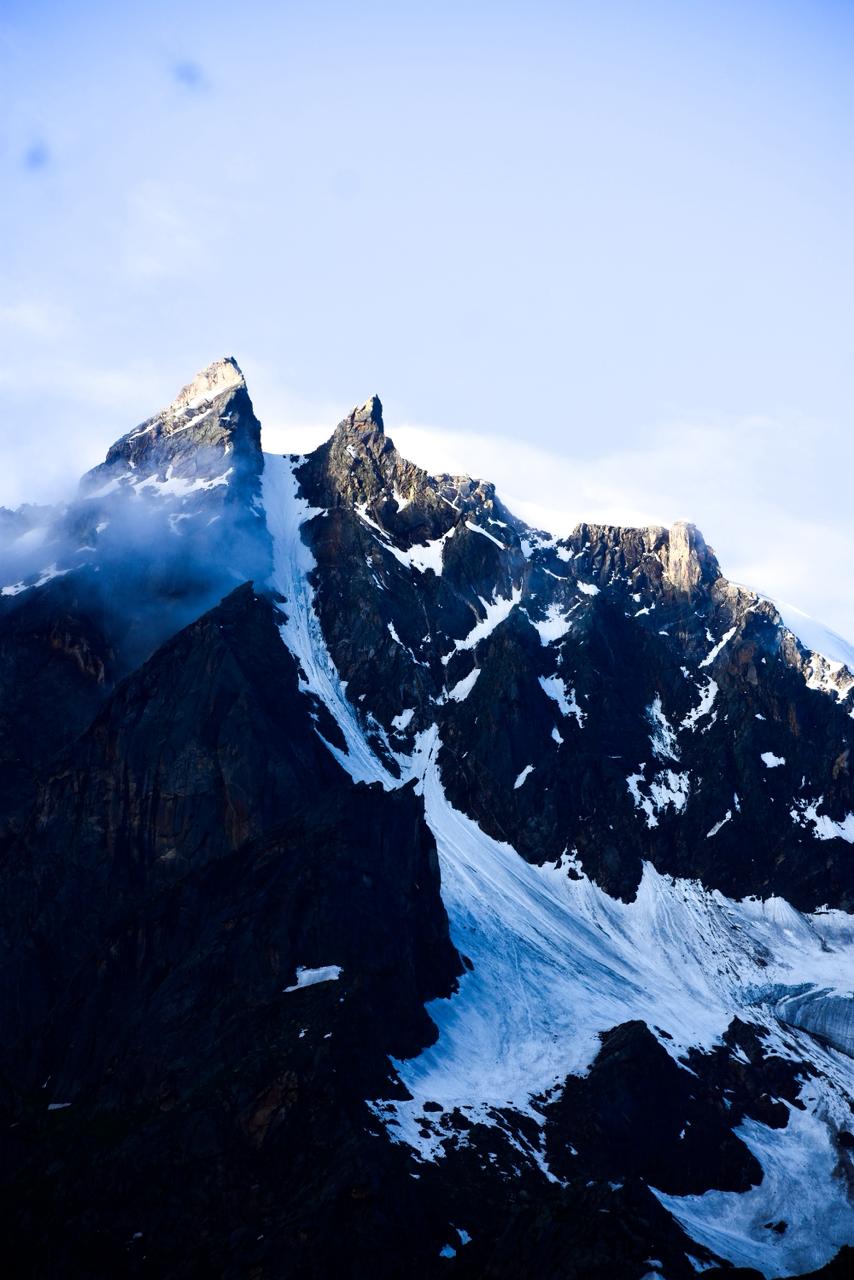
Four days. One backpack. 30 kilograms. An incredibly difficult trek. And I had finally reached Hampta Pass, almost 14,000 feet above sea level in the Indian Himalayas.
I walked through Kullu’s lush green valley to Lahaul’s cold desert, two valleys separated by just one mountain pass, yet bearing almost no resemblance to one another.
I held my heart on my sleeve as we descended, slipping down almost 90-degree bends, crossing rivers flowing in front of us, watching the snow patches slowly disappear behind us. And then, Chandratal appeared.
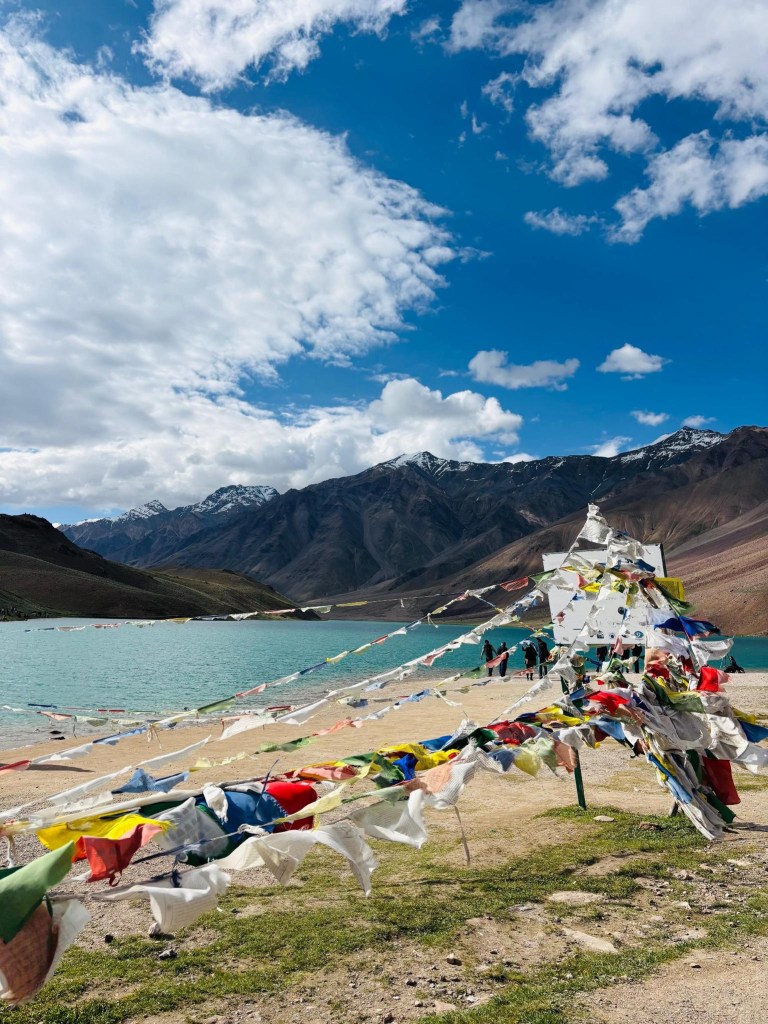
Chandratal Lake, prayer flags on its shore (Photo by the author).
I felt victorious. Swollen feet. Muddy shoes. Almost breathless. I finally stopped. I finally took a breath. This was probably the most treacherous journey we had to endure to stumble upon this scale of magnificence. It almost felt as though access to tremendous beauty had to be earned. As I sat by Chandratal, multiple questions crossed my mind. The half-made kutcha roads that could barely fit one vehicle, functioning as the only path to reach Chandratal. Rivers overflowing onto the roads. Is the river on the road, or is the road on the trajectory of the river? JCBs everywhere. Tiny pebbles running off the mountain at high speed. People risking their lives to make these roads. Is the need for accessibility worth the risk to their lives? Our vacation is their home. Every road carved through a fragile mountain ecosystem represents a trade-off between accessibility and preservation. How do we make the world’s most extraordinary places accessible without destroying the very things that make them extraordinary?
When access becomes a governance question
I pondered this question long after the trip. It was not a question unique to one stretch or just one lake. It was a question confronting the Himalayas as a whole.
The lifelines of remote and inaccessible regions such as Chandratal are the roads. Not only do they connect communities, but they also carry travellers like me to their place of fantasy.
Of course, the challenge isn’t whether the roads should exist.
The dilemma has always been how they should be built.
Environmental Impact Assessments (EIA), responsible disposal of construction debris, slope stabilisation through bioengineering, and avoiding historically landslide-prone zones are not simply engineering recommendations. They are governance decisions [1].
In regions like the Himalayas, which are ecologically sensitive [2], infrastructural excellence should not be measured by how quickly one can arrive at the destination, but by how responsibly the infrastructure coexists with the landscape it was meant to serve.
The Himalayas are not the only place facing this dilemma. So are the Great Barrier Reef, Antarctica, or the Galápagos Islands. Different ecosystems. Different continents. The same question.
When protection is no longer enough
The world’s most extraordinary places all ask the same question. They simply answer it differently.
The solution to the Great Barrier Reef’s issues extends far beyond tourism. It lies in governance. Protecting such a fragile ecosystem is not just about visitor regulation or managed access, but about skilfully responding to environmental challenges that no single government can control [3].
Rising ocean temperatures, climate change, and declining water quality continue to reshape the Reef despite decades of conservation efforts [3][5].
Protection alone does not cut it anymore. Governance has to evolve above and beyond that. The sensitivity of the issue demands scientific research and long-term monitoring but research alone cannot protect the reef.Governance is what turns that evidence into adaptive management, regulation and coordinated action, allowing protection strategies to change as the ecosystem itself changes [3][4][5].
In this case, the challenge is no longer simply preserving access to an extraordinary place. It is finding new and innovative ways to ensure that the ecosystem itself continues to exist.
Who governs a place that belongs to no one?
The Great Barrier Reef demonstrates what national governance can achieve. Antarctica asks a far more difficult question: who governs a place that belongs to no one?
Antarctica belongs to no one. But does it not therefore belong to all of us?
Under the Antarctic Treaty of 1959, territorial claims were effectively frozen, and it was decided that the entire continent would be dedicated to peaceful scientific cooperation [6].
Antarctica is currently governed collectively instead of by a single nation [6].
The world remains in a state where decision making lacks pace. Meanwhile, the glaciers keep melting, tourism continues to increase (more than 113,000 people travelled to Antarctica with IAATO operators during the 2025–26 season)[12], and penguins continue losing their habitat (populations in a key Antarctic region declined by 22% between 2009 and 2024)[13] [7][8].
Nature is not waiting for politics to catch up.
The environmental threats are compounding by the second, while international cooperation is moving at a snail’s pace. The challenge is clearly no longer simply agreeing on who should govern Antarctica. The challenge is how quickly the governments of the world can catch up with the environmental changes taking place.
How much access is too much?
The Galápagos Islands pose an extremely uncomfortable question.
Can a fragile place as such be shared before it loses itself?
Unlike Antarctica, the Galápagos are not empty. They are inhabited, visited, studied, and marketed [9].
However tightly controlled, tourism is also constant. Every landing, every guided walk, every boat route is a tough negotiation between access and preservation [9][10].
The islands exist in a very delicate balance.
On one hand, they are called the “living museum and showcase of evolution”. Their unusual flora and fauna inspired Darwin’s theory of evolution following his visit in 1835 [9].
On the other hand, their human presence is not theoretical. The real homes of real people – about 30,000 call the Archipelago “home” – cannot be a laboratory or a tourist gimmick.
There are too many stakeholders, namely local communities, national authorities, conservation bodies, and global tourism markets, which create a unique governance issue altogether [9][10].
This is where visitor management, controlled itineraries, tourism monitoring, and limits based on the islands’ carrying capacity become not just conservation tools, but governance choices [9][10].
Should there be humans present?
We are far beyond the point of asking that question.
There already are.
The question is how presence is managed without eroding the very uniqueness that makes the islands worth protecting.
If Antarctica forces us to rethink governance, Ecuador’s Galáagos Islands force us to rethink access.
When we love a place to death
Unlike the Galápagos, where access is deliberately governed before tourism overwhelms the ecosystem, Venice reminds us what happens when popularity begins to outpace governance [10][11].
We love Venice.
It was loved so much that today it is drowning [11].
Literally dying.
Perhaps the world’s most extraordinary places are rarely destroyed by hatred. They are loved to death.
The answer is neither to make these places inaccessible nor to open them without limits.
It is to govern them with the responsibility they deserve.
Everything is a governance choice. A road carved into a mountain, a visitor permitted onto an island, a marine boundary drawn across an ocean, and an international treaty signed for a frozen continent.
To witness places as extraordinary and stunning as these is an absolute privilege. Any technological, architectural, or infrastructural intervention that allows us to experience them should be guided by the same principle. It is to leave them no less extraordinary for future generations.
Perhaps that is the real measure of accessibility. It is always a question of preserving that wonder for those who come after us.
Because the world’s most extraordinary places do not need fewer admirers –they need better stewards.
Edited by Adrian Kai Fraile Itagaki.
References
[Photography] By the author.
[1] Saran, Shyam. “Safeguarding the Fragile Ecology of the Himalayas.” Centre for Policy Research, https://cprindia.org/safeguarding-the-fragile-ecology-of-the-himalayas/. Accessed August 27, 2026.
[2] UNESCO. “Mountains Provide Early Warning of Climate Change.” UNESCO, https://www.unesco.org/en/articles/mountains-provide-early-warning-climate-change. Accessed August 27, 2026.
[3] Great Barrier Reef Marine Park Authority. “Strategies to Manage the Reef.” GBRMPA, https://www.gbrmpa.gov.au/our-work/reef-management-strategies/strategies-manage-reef. Accessed August 27, 2026.
[4] Great Barrier Reef Marine Park Authority. “Science for Management.” GBRMPA, https://www.gbrmpa.gov.au/our-work/reef-management-strategies/science-management. Accessed August 27, 2026.
[5] Great Barrier Reef Marine Park Authority. “Reef 2050 Plan.” GBRMPA, https://www.gbrmpa.gov.au/our-work/reef-management-strategies/reef-2050-plan. Accessed August 27, 2026.
[6] Antarctic Treaty Secretariat. “The Antarctic Treaty.” Antarctic Treaty Secretariat, https://www.ats.aq/e/antarctictreaty.html. Accessed August 27, 2026.
[7] British Antarctic Survey. “Climate Change and Its Impact on the Antarctic Peninsula.” British Antarctic Survey, https://www.bas.ac.uk/data/our-data/publication/policy-brief-climate-change-and-its-impact-on-the-antarctic-peninsula/. Accessed August 27, 2026.
[8] Antarctic Treaty Secretariat. “Tourism and Non-Governmental Activities.” Antarctic Treaty Secretariat, https://www.ats.aq/e/tourism.html. Accessed August 27, 2026.
[9] UNESCO World Heritage Centre. “Galápagos Islands.” UNESCO World Heritage Centre, https://whc.unesco.org/en/list/1/. Accessed August 27, 2026.
[10] Burbano, Diana V., et al. “Rethink and Reset Tourism in the Galapagos Islands.” ScienceDirect, 2022, https://www.sciencedirect.com/science/article/pii/S2666957922000258. Accessed August 27, 2026.
[11] UNESCO World Heritage Centre. “Venice and Its Lagoon.” UNESCO World Heritage Centre, https://whc.unesco.org/en/list/394/. Accessed August 27, 2026.
[12] International Association of Antarctica Tour Operators. “Data & Statistics.” IAATO, https://iaato.org/news-room/data-statistics. Accessed September 2, 2026.
[13] British Antarctic Survey. “Emperor Penguin Populations in Antarctica Declining Faster Than Thought.” British Antarctic Survey, 10 June 2025, https://www.bas.ac.uk/news/emperor-penguin-populations-in-antarctica-declining-faster-than-thought/. Accessed September 2, 2026.


Leave a comment