
By Kenza Hammouda & Waleed Imran
“If your plan is not future-proof, the world is going to eat you.” That is how Justin Garcia, a Californian high-school student, explained his career choice to The New York Times in June 2026 [1]. At the heart of Silicon Valley, some teenagers are turning away from college in favour of trade classes, convinced that manual professions are less exposed to artificial intelligence than many white-collar careers.
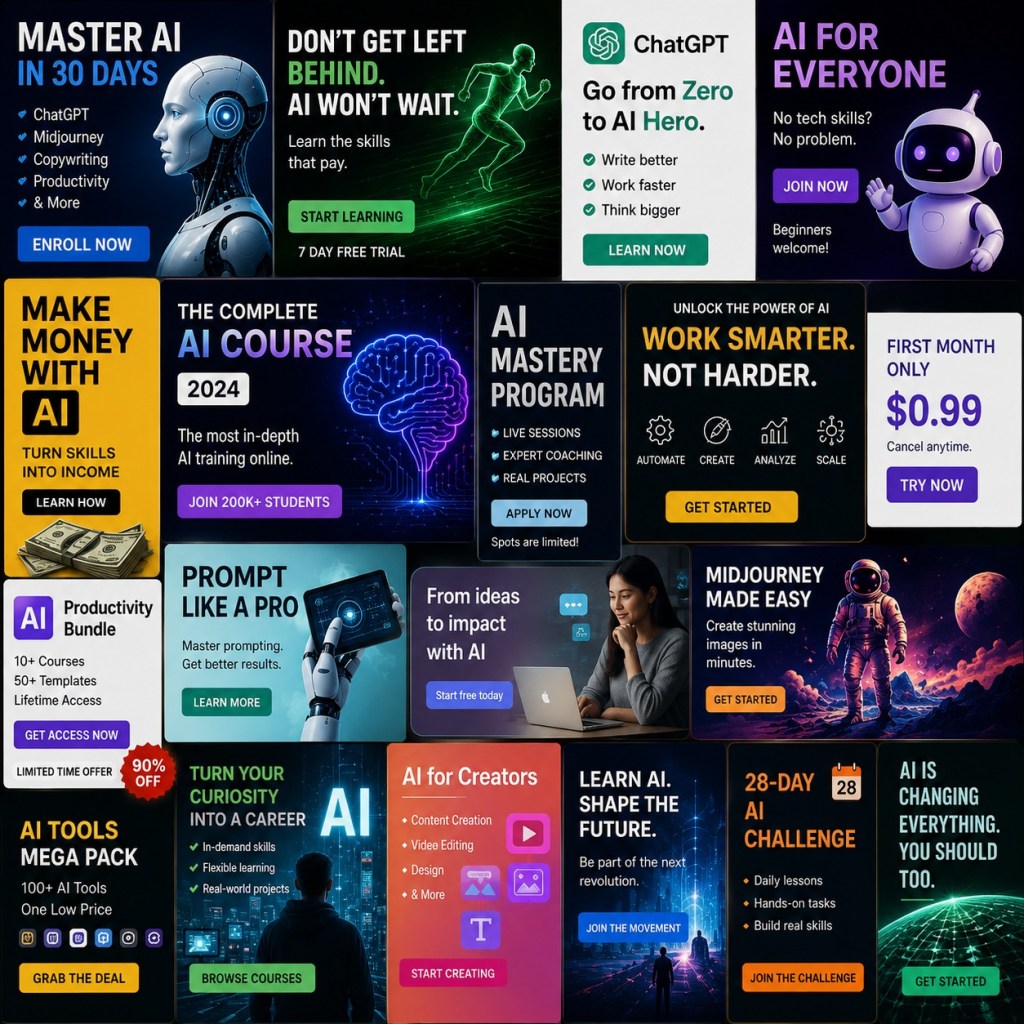
Others are drawing the opposite conclusion. AI courses, certifications, and “AI upskilling” programmes have proliferated online, built around the now ubiquitous promise that workers who learn to use AI will remain competitive in the labour market. Faced with the same technological change, one group is moving away from the knowledge economy while another is investing in it more heavily than ever.
At first glance, these strategies appear contradictory. In reality, they rest on the same assumption: there exists a reliable way to future-proof a career against AI. While one strategy cannot yet be designated as better than the other, we can at least examine the conditions under which either of them succeeds. Does AI increase the value of human expertise, or does it simply make that expertise less scarce?
2. The line everyone repeats
You’ve heard the line. Everyone has.
“AI won’t replace you. Someone who knows how to use AI will.”
It reads like career advice. Learn the tools, stay sharp, keep your seat.
Worth knowing where it started. Back in 2017, a Stanford radiologist named Curtis Langlotz said a narrower version of it: radiologists who use AI will replace radiologists who don’t [2]. Karim Lakhani, a Harvard professor, extended it to the rest of the workforce in 2023 [3]. Then Nvidia’s Jensen Huang put a version of it onstage at a keynote-presentation and made it famous – the idea that using AI, not AI itself, is what decides who keeps their job [4].
Worth noticing, too, who is holding the microphone. Huang sells the chips every one of these models runs on. The labs sell the subscriptions. A line that reassures people and moves product is a convenient one to keep repeating, if product is what you sell. That does not make the advice wrong. It does, however, suggest that those promoting it most prominently also benefit from wider AI adoption.
The quieter problem is different. The slogan presents adaptation as a universal strategy, but it says little about the conditions under which adaptation actually succeeds. For some workers, learning AI may increase the value of their expertise. For others, it may not. The slogan never explains the difference.
3. The hidden assumptions
According to a recent paper published by MIT economists David Autor, Daron Acemoglu and Simon Johnson (the latter two Economic Sciences Nobel laureates for research on institutions and national prosperity), 42% of workers who already use artificial intelligence at work believe it will reduce their future job opportunities, compared with 30% of workers who do not use AI [5]. This suggests that those with the most direct experience of the technology are not necessarily the most reassured by it.
Yet this does not invalidate the now familiar advice that workers should learn to use AI. It does, however, fragilise one of its underlying assumptions: individual adaptation alone is sufficient to secure a place in the future labour market.
The stake lies not just in adapting to AI, but in the conditions under which the adaptation actually pays off; namely, the nature of the tasks a profession demands, and the economy in which a worker happens to perform them.
This leads us to the next question: Which workers actually benefit from AI? The answer begins with the nature of the work they perform.
4. What you do
While Jensen Huang claims that “every job will be affected, and immediately” [4], David Autor argues that AI will not transform every occupation equally and at the same pace. Truck driving is likely to change slowly because replacing physical capital takes decades. By contrast, occupations such as call centers, translation or some software jobs could change very rapidly because AI can be deployed almost instantly [6].
AI will keep on augmenting highly specialized professionals in the health sector, and radiology remains one of the clearest examples. Rather than replacing specialists, AI largely increased their productivity and expanded demand for their expertise.
The picture looks different for many entry-level white-collar jobs. Analysing the largest payroll software records provider in the United States, Stanford researchers found that employment among 22- to 25-year-olds in the occupations most exposed to AI—including junior software developers and technical support roles—declined by around 16% following the arrival of ChatGPT [7], while older workers in the same occupations were comparatively unaffected. The profession itself may survive, but the same cannot always be said about apprenticeship. As workers are told to “learn AI”, the very first jobs which allowed them to gain hands-on experience are beginning to disappear.
Simon Johnson uses the concept of “expertise threshold” to explain how, above it, AI tends to complement workers by making already experienced professionals more productive, while below it, “you are being replaced by the AI [8].” While many cognitive tasks can now be partially automated, physical occupations remain considerably less exposed.
On the other hand, creative professions present a different challenge. A translator, illustrator, or voice actor can certainly learn to use AI. But what exactly are they adapting to if the models are already being trained to imitate the very thing that once made their work economically valuable?* Asking artists to use those same tools may increase productivity elsewhere, but it does not restore the ownership over the uniqueness that once gave their work its value.
*(We discuss economic value. The work of a creative worker, like an illustrator, will not be imitated to the same quality, and AI is also incapable of creativity. However, AI may be opted for instead of an illustrator – the price of creating an illustration with AI being much lower than engaging an illustrator; therefore, economic value).
5. Where you work
Occupation, however, is only part of the story. The slogan skips a second question: where you work.
The IMF estimates that around 60% of jobs in advanced economies are exposed to AI, compared with roughly 26% in low-income economies [9]. At first sight, this appears to suggest that poorer countries have less to fear. The opposite may be true for countries whose growth model was built on exporting cognitive labour that is becoming increasingly automatable. India’s IT and business-services sector, worth close to $283 billion, did not just create jobs; it created a middle-class pathway for a generation of graduates in an economy with few equivalent alternatives [10]. Tata Consultancy Services cut around 12,200 positions in 2025, materializing the beginning of a clear sector shift. The Philippines faces similar struggles. Its business process outsourcing (BPO) industry employs some 1.3 million people and generates roughly $30 billion a year [11], much of it in customer service, a task category with little technical barrier left between it and automation.
What connects these cases is not the sectors themselves, but the thinness of the ladder around them. A radiologist in Boston who loses ground to AI still works inside an economy with many adjacent well-paid occupations to move into. A call-centre worker in Manila or a mid-level developer in Bangalore is often operating inside an economy built around this exact kind of work, with far fewer rungs above or beside it.
The same advice to learn AI therefore carries a different weight depending on geography. For the Boston radiologist, adaptation is a career decision. For workers inside economies built on exportable cognitive labour, it is closer to a bet on whether an entire development model still holds.
6. The direction is a choice
By this point, one objection naturally arises. Technological revolutions have always produced winners and losers. Why should AI be any different?
AI’s uneven effects are not simply the inevitable result of technological progress. They reflect a choice: what kind of AI firms decide to build, and why.
An example of a company choosing a more “pro-worker” approach is Schneider Electric. The company has developed AI tools that support field technicians and engineers maintaining complex data centres, letting them take on problems that used to require years of experience, rather than replacing them. Yet even this approach involves trade-offs: expanding workers’ capabilities can also reduce the scarcity that makes some forms of expertise especially valuable. Whether this ultimately raises or lowers wages remains an open question [5].
The paper by MIT economists also argues that market incentives often favour AI systems that reduce firms’ dependence on scarce expertise [5]. Workers whose skills are difficult to replace command higher wages and greater bargaining power, giving firms an incentive to automate precisely those tasks.
The advice to “just adapt” leaves out that essential point. Workers are asked to adapt to a future whose direction is itself being shaped by choices which are made independently from them.
7. Conclusion
Perhaps the mistake was never in telling workers to learn AI, but in treating individual adaptation as an answer to a problem that is not entirely individual. The teenagers turning to trade schools may indeed be less exposed to AI, just as workers who learn to use it may gain an advantage; but neither strategy offers a universal way to future-proof a career.
Skills matter, but so do labour markets, development models and the incentives determining which technologies get built. Preparing for AI therefore cannot be reduced to teaching people how to use it; it also requires asking who has the power to decide what it is used for. That question may ultimately prove inseparable from the emerging debate over AI sovereignty, and who controls the technologies economies are already depending on.
You can go ahead learning AI, or not. Not everyone who learns it will be saved. And nor will everyone who does not learn about AI. Neither strategy offers a universal way to future-proof a career. Only time will tell. For now, we may settle to what Justin Garcia says: “if your plan is not future-proof, the world is going to eat you.”
Edited by Adrian Kai Fraile Itagaki.
References
[1] The New York Times. “These Teens Are Choosing Trade Classes to AI-Proof Their Futures.” YouTube, 3 June 2026, https://youtu.be/9kGPolaVGHQ?si=w4BFdfh5BDXCw1UI.
[2] Book, Christine. “One on One … with Curtis P. Langlotz, MD, PhD.” Imaging Technology News, 18 Jan. 2024, https://www.itnonline.com/article/one-one-curtis-p-langlotz-md-phd.
[3] Lakhani, Karim R. “AI Won’t Replace Humans – But Humans with AI Will Replace Humans Without AI.” Harvard Business Review, 4 Aug. 2023, https://hbr.org/2023/08/ai-wont-replace-humans-but-humans-with-ai-will-replace-humans-without-ai.
[4] Jackson, Ashton. “Nvidia CEO: You Won’t Lose Your Job to AI – You’ll ‘Lose Your Job to Somebody Who Uses AI’.” CNBC, 28 May 2025, https://www.cnbc.com/2025/05/28/nvidia-ceo-jensen-huang-youll-lose-your-job-to-somebody-who-uses-ai.html.
[5] Acemoglu, Daron, David Autor, and Simon Johnson. “Building Pro-Worker Artificial Intelligence.” The Hamilton Project, Feb. 2026, https://www.hamiltonproject.org/wp-content/uploads/2026/02/20260223_THP_ProWorkerAI_Paper.pdf.
[6] The Weekly Show with Jon Stewart. “AI & the Future of Work.” YouTube, 22 Apr. 2026, https://youtu.be/RB_WmoH5nQ4?si=B7vvBkAI3RBqkQ4C.
[7] Brynjolfsson, Erik, Bharat Chandar, and Ruyu Chen. “‘Canaries in the Coal Mine?’ Six Facts About the Recent Employment Effects of Artificial Intelligence.” Stanford Digital Economy Lab, 13 Nov. 2025, https://digitaleconomy.stanford.edu/publication/canaries-in-the-coal-mine-six-facts-about-the-recent-employment-effects-of-artificial-intelligence/.
[8] Strauss, Delphine, and Sam Fleming. “‘Nobody Needs as Many White-Collar Workers as They Used To’: Simon Johnson.” Financial Times, 22 June 2026, https://www.ft.com/content/233b76cf-2e30-48bd-96fc-b996ad5e307a.
[9] Georgieva, Kristalina. “AI Will Transform the Global Economy. Let’s Make Sure It Benefits Humanity.” IMF Blog, 14 Jan. 2024, https://www.imf.org/en/blogs/articles/2024/01/14/ai-will-transform-the-global-economy-lets-make-sure-it-benefits-humanity.
[10] Ishwarbharath B, Sai, and Haripriya Suresh. “India Tech Giant TCS Layoffs Herald AI Shakeup of $283 Billion Outsourcing Sector.” Reuters, 8 Aug. 2025, https://www.reuters.com/business/world-at-work/india-tech-giant-tcs-layoffs-herald-ai-shakeup-283-billion-outsourcing-sector-2025-08-08/.
[11] Ramos, Mariejo. “Lacking Job Security, Filipino Call Centre Workers Face AI Threat.” Context, 3 Dec. 2024,
https://www.context.news/ai/lacking-job-security-filipino-call-centre-workers-face-ai-threat
[Cover picture]: AI generated.


Leave a comment