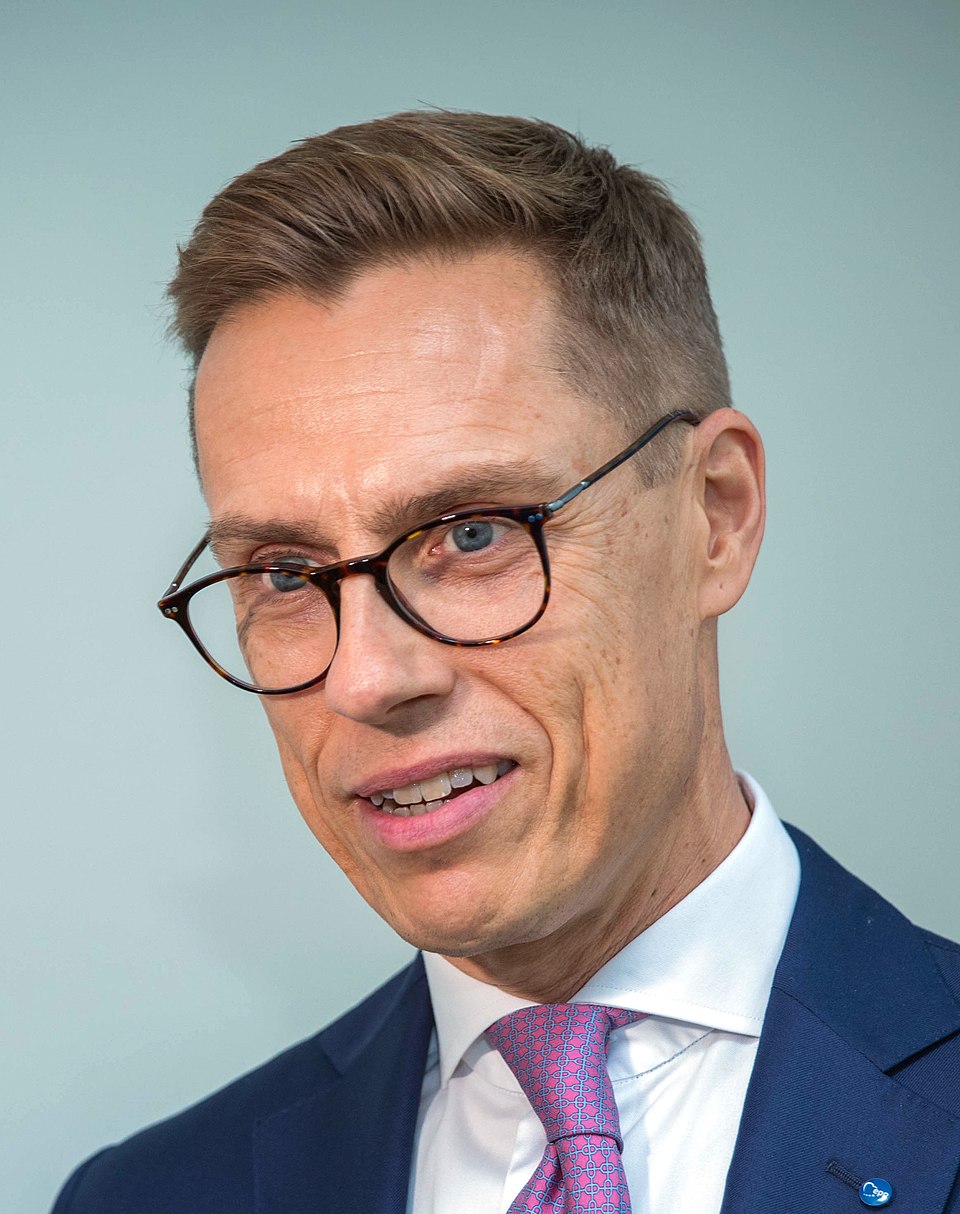
Representing a small nation of only 5.6m, whose role in the world order might seem inconsequential — Alexander Stubb has become a player to watch. The Finnish President has taken the covers. Among the reasons? “We’ve been friends for a long time” said Donald Trump about him, and few keep close relations with the American President. Alexander Stubb’s handsomeness and allure, along with his powerful golf swing, have put him on top of the table.
The Finnish President sat with The Economist for a one-on-one on February 14, during the Security Conference in Munich. David Rennie, British long time The Economist journalist, bombarded him with questions about his new book (The Triangle of Power: Rebalancing the New World Order), sharing a border with Russia and of course — playing golf with Donald Trump.
His interview ought to be scrutinised — Stubb’s ideas are worth listening to.
Introducing Stubb – golf as a soft power tool
“He’s become famous on the world stage. He’s tall, athletic, good at golf; and that makes him one of Europe’s top Trump whisperers. As a Finn, he also knows the danger of underestimating Russia, the giants next door” — The Economist introduces him.
David Rennie starts with the questions: “You are the stay calm guy. It’s a very Finnish thing to be right? Cool, calm, optimistic. We’re in a fight for the kind of future world order. So are you still a calm guy now?”.
Alexander Stubb is above all an optimistic leader. He’s well-spoken, assured and knows how to throw a glint of humor into each answer. He answers: “Yeah definitely. I guess Finns, we go to the sauna and after that would take a nice bath. And then we start reflecting on what’s going on.”
Interregnum – staying calm during the storm
He defines the current world order as a transition period — interregnum, of discontinuity in the social order. “These world order changes every so often” explains. Lasted two decades after WWI, four decades after WWII and 3 decades after Cold War. “It will take another 5 years for the world order to settle” while finishing with: “but in the middle of the storm, we just have to stay calm”.
He explained the same idea when he wrote for Foreign Affairs in December 2025: “The liberal, rules-based order that arose after the end of World War II is now dying” (2). Because yes, Stubb not only leads the Arctic country, but also devotes time to write his own pieces in journals like Foreign Affairs. For the FT, he co-wrote an article with Norwegian Prime Minister Jonas Gahr Støre about their shared Nordic and European identity.
The Triangle of Power – the new world order
The liberal rules based order — Stubb argues in his book — is in play, it is a big contest between the global West, the global East (led by Russia and China) and the global South. Among these, a leader should arise to safeguard the basic tenets of defending free trade and multilateralism. With the US currently focusing on other principles, “it’s a question of whether Europe can take the role of the global West in its leadership — I think the jury is still out on that”. In the book, the President explains that middle powers in the global south will be key in deciding which direction the world tilts towards: multipolarity or multilateralism.
The Finnish advocates for multilateralism, for international rules, norms, institutions and cooperation. He labels himself as a — in his own words — “pro-European, pro-American and a pro-Transatlanticist”. He clearly reckons the US now has a different more financially driven interest and that its power does not rely on alliances the way it used to. To address this: “we need to work on areas where we have common interests, such as defense, NATO, minerals, technology, or in the Finnish case — icebreakers”.
“Of course, I wished the transatlantic partnership was stronger than what it is now. But let’s make sure it’s not gonna crumble”.
Common interest – working with Trump 2
The US and Finland have a defense cooperation agreement. 25,000 soldiers train in Northern Norway and Finland, 5,000 of which are American. Washington is also acquiring 11 new icebreakers from Finland — proving the Finnish nautical expertise. Why this defense and security cooperation? “Is it in the interest of the US that Finland, bordering Russia 1340km, has one of the largest armies in Europe? Yes it is” — says Stubb. It is interest driven that the nordic country has one of the most powerful militaries bordering Russia — “and it’s in the interest of the US to have close defense cooperation with the Nordics”.
Conversations with Trump – hole-in-one for Helsinki
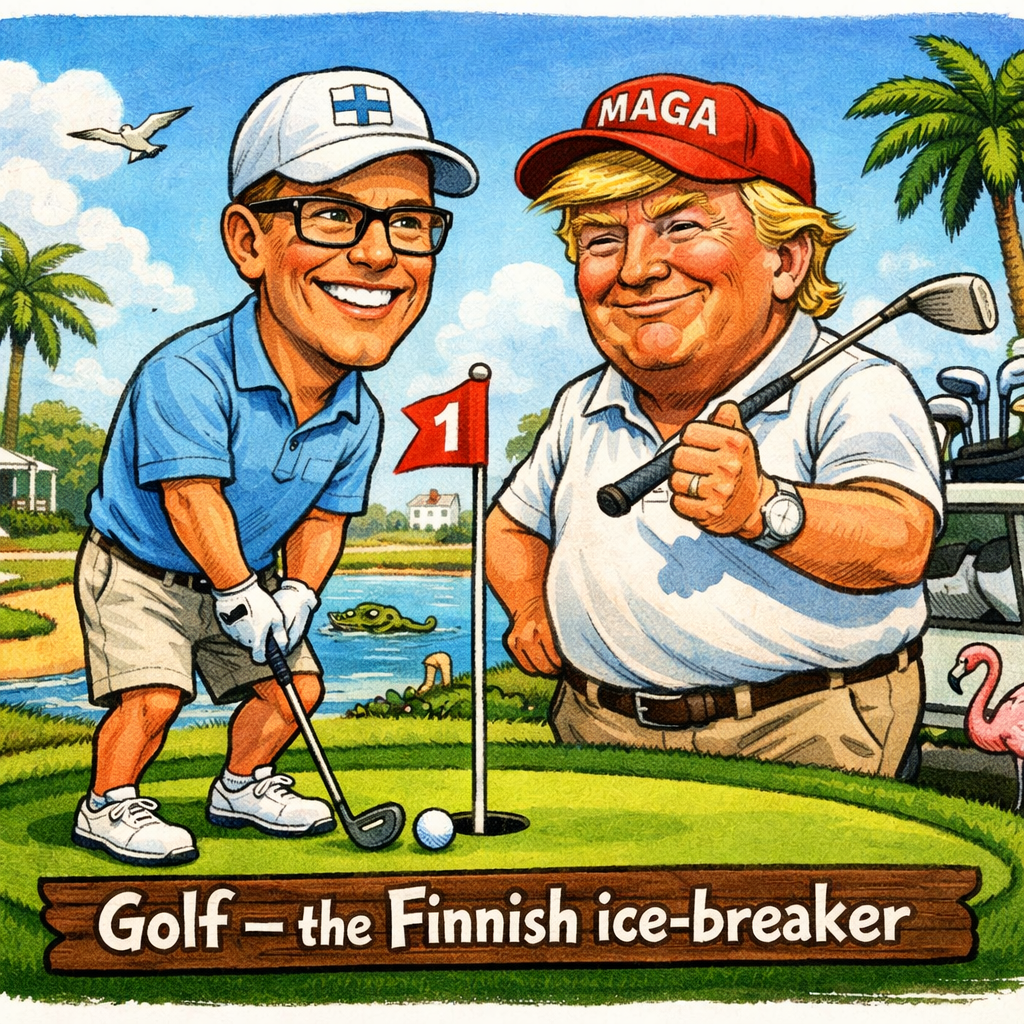
Trump and Stubb’s friendship is born around golf. “He’s a very good player”, Trump said (3) — indeed, he was in the Finnish national team in the 1980’s. They played together in the Spring of 2025 in Florida. And 7 hours together in a golf cart (3) might give time for some discussions other than green and hole-in-ones. Some experts commented on how Stubb influenced Trump’s decision-making about Vladimir Putin — “managing to put something in his head” — added journalist Rennie.
Humbly, Stubb explains: “well, I don’t want to inflate my role. After all, I come from a relatively small country of 5.6 million inhabitants, albeit the happiest country in the world” — he adds with a big smile.
He explains how he has disagreements with some things, and agrees with others. Says that Trump is very much his own man, driven by a strong ideology, and now much more efficient than Trump one. The Finnish sends messages to the most powerful president in the world, “sometimes he listens, sometimes he doesn’t”. “If I can plant one idea out of ten, that’s good”.
“Finland and Stubb’s pragmatism, knowledge of Russia, consistent support for Ukraine, and the fact that it has specialised technological know-how in its icebreaker ecosystem, provide Finland a larger-than-expected, and certainly well deserved, role in the transatlantic relationship” — Jason Moyer, expert in transatlantic relationships at the Washington based Atlantic Council (3).
Europe can defend itself – Finland leads
In a context where Europe is being assessed by its inability to defend itself, by its defense weakness — Stubb states the opposite. And this “is not only strategic communication, but it’s reality”. Other than its large fleet of saunas, Finland counts with obligatory military service, 1 million men and women trained for Arctic conditions, long range missiles, and quite a lot of “F” Fighters — 62 F-18s and 64 new F-35s. “There’s a reason why we have the biggest artillery in Europe — and that reason it’s not Stockholm”.
Ukraine — colossal failure for Putin
Putin was looking for a more Russian-aligned Ukraine. Instead, it will become more European by joining the EU in the future. Putin wanted to prevent Nato’s enlargement, now Finland and Sweden have joined Nato (in 2023 and 2024 respectively). And now European countries are increasing defense expenditure up to 5% of GDP. For Stubb, it has clearly been a military failure: “in 4 years he has advanced 20% of Ukrainian territory, in the past year only 1%”. In terms of casualties, Ukraine killed 65,000 Russian soldiers during last December and January (compared to 18,000 in the war of Afghanistan that lasted 10 years for Soviets).
In terms of a ceasefire, the Finnish president explains things started to really take shape in Johannesburg in November 2025 at the G20 meeting. That was the beginning of today’s 3 documents: the 20 point plan (where territory is still the point to clear up), a security guarantee for the US and Europe, and the prosperity plan for Ukraine. “And I think we’re very close to a deal between the Ukrainians and the Americans. But you never know with the Russians”.
Dignified foreign policy — a recipe for reversal
After 80 years in which Western countries have been on the moral high ground with the rest of the world, since the times of colonialism, now the world is changing. Disparities in wealth, technology and society once allowed transatlantic dominance, but with the world turning into a crucial moment, the middle powers need to have a stronger say.
Dignified foreign policy — which sounds like a powerful complex diplomatic tool — is actually more simple: “instead of going down with excessive conditionality on the rest of the world, you start cooperating”. In other words, leave out the Western condescending attitude and start treating historically weaker countries like equals. “Perhaps we have an old-fashioned way of thinking of the relationship between the global north and the global South that is kind of based on some kind of alimony, some kind of goods and development aid” — says Stubb. The president has a clear idea: trade more, do more trade than development aid. And Finland here may find it easier to earn a hearing as it never had colonies (1).
Lecturing the global South – “dialogue rather than monologue”
Journalist David Rennie asks: “When I go to places like Africa, they say China is fantastic because it doesn’t talk about human rights, women’s rights or moving an indigenous tribe away. What do we have to give up if we’re dancing with these interests and not lecturing the global South?”.
Stubb mentions another instrument: values based realism. This means being true to one’s values (human rights, freedom, democracy, rule of law…), but at the same time being realistic “that you cannot solve all of the world’s problems”. To put an example, the question would be whether collaboration would be done with a country where homosexuality is a crime, or death penalty allowed. While these are not easy decisions — “pretty much case by case” — cooperation rather than dictation seems to be the clear path for the ex-golfer — “dialogue rather than monologue”.
A seat at the UN’s Security Council – for everyone?
One of the last questions is about giving a seat at the top table — UN or World Bank — to the South. The journalist puts it this way: “What are we actually willing to give them? I mean, if countries in the global south get that seat in the top table, they will say: great, now we’re going to pay with your money for climate change damage, climate reparations”.
Perhaps a little amused, the Finnish answers: “I think your approach is a little bit British. Mine is a little more Finnish”. If the UN’s Security Council is today incapable of peace mediation — dysfunctional to a certain extent — it is because, in Stubb’s opinion, it needs to be enlarged. For international institutions to work, the West cannot be the ones who dictates the power of these institutions. The rules created by these international institutions are common global rules — made for all to be respected — “and they should not be rules dictated by the West”. If the countries decide that money will go to climate reparations, then so be it, but decisions will be taken together, by all.
“India, which is becoming a big power, should have more agency and power in the IMF, the World Bank and the WTO”.
Institutions — hear Monet.
Stubb, who appears to be quite an optimist, believes in rationality of human beings. He has hope that “people will be reasonable”, but also accepts that now “we’re seeing human beings with rather rash behaviour”. This needs to be content in common rules, norms and institutions. He quotes here Europeanist Jean Monet: “nothing is possible without human beings, but nothing is lasting without institutions”.
The Economist titled its discussion with Alexander Stubb: “Finland’s President has a plan to save the liberal world order”. In a time when international collaboration is eroding, he brings up a refreshing set of ideas that bring forward realistic objectives rather than fatalism. The recipe for reversal is simple: work together, united. In today’s multipolar context, the Finnish believes unquestionably in multilateralism and institutions. In his words: “use the instruments of diplomacy and emotional intelligence, escalate to de-escalate and find a solution”. His beautiful expressions, hint of humor and powerful Nordic lure just seduce everyone — even the most powerful man in the world. Optimism and compelling ideas from a small nation of only 5.6m, a leader to watch and listen to — Alexander Stubb.
Edited by Maxime Pierre
References
The Economist. (2026, February 14th). Finland’s president has a plan to save the liberal world order. Official interview. https://www.economist.com/insider/inside-geopolitics/finlands-president-has-a-plan-to-save-the-liberal-world-order
The Economist. (2026, February 24). A stay-calm plan to save the world. (1) https://www.economist.com/international/2026/02/24/a-stay-calm-plan-to-save-the-world
Alexander Stubb (2025, December 2nd). The West’s last chance: How to build a new global order before it’s too late. Foreign Affairs. (2) https://www.foreignaffairs.com/united-states/wests-last-chance
BBC News (2025, October 11th). Icebreakers and golf spark Trump and Finnish leader’s unlikely friendship.(3) https://www.bbc.com/news/articles/c4g7nl35nz2o
Cover picture: https://commons.wikimedia.org/wiki/File:Alexander_Stubb_EPP_October_2018_(44474967285)_(cropped).jpg
Inside the article picture: AI made.


_(cropped).jpg)
Leave a comment