
By Maxime Pierre and Cyprien Guillot de Suduiraut
“It is medieval brutality.”
Zarina Zabrisky is a U.S. journalist and documentary filmmaker based in Ukraine, reporting from frontline regions since Russia’s full-scale invasion in 2022. She focuses on war crimes, drone warfare, civilian targeting, and Russian information operations. Working as a war correspondent for Byline Times and Euromaidan Press, her reporting has been published and broadcasted internationally by the BBC, The Sunday Post, ABC Australia, TVP World, Voice of America, The Kyiv Independent, and The Kyiv Post.
In 2024, as the only foreign journalist based in Kherson – a southern port city near Odesa – she identified and defined the tactic of the “human safari” — the deliberate use of FPV drones to target civilians and first responders with explosives, mines, and incendiary devices. Her findings contributed to the 2025 United Nations and Human Rights Watch reports classifying “human safari” attacks as war crimes and crimes against humanity. She has presented her research at the German Bundestag, U.S. Congressional offices, and on Capitol Hill.
Her feature documentary, Kherson: Human Safari, was featured in the MSC Cinema Series and is endorsed by the Kherson Military Administration, the Ukrainian Armed Forces, and the Ukrainian Navy. It has been screened in more than 20 countries and translated into ten languages. For her investigative work exposing Russian disinformation networks like Doppelgänger, Zabrisky has been sanctioned by the Ministry of Foreign Affairs of the Russian Federation. She is currently documenting the humanitarian crisis within occupied Ukrainian territories near Kherson.
Maxime Pierre, EIPS’ (ESCP International Politics Society) Editor in Chief, and Cyprien Guillot de Suduiraut, EIPS Contributing Writer with expertise in the region, sat with Zarina Zabrisky to discuss life in Kherson, the situation in Ukraine’s southern front, and the realities of reporting from the front lines of modern warfare.
Maxime: Zarina, thank you for being here with us. I wanted to start by learning more about you and your relationship with Ukraine. Looking back to the start of the full-scale invasion in February 2022, where were you, and what compelled you to embed yourself indefinitely in frontline regions?
Zarina Zabrisky: Today, the war in Ukraine is hardly a popular subject in the international press; it is still raging, yet it has faded from the headlines. At this very moment, there are at least ten missiles heading our way, yet it is hard to find coverage of this ongoing tragedy abroad. That is precisely why I am here.
My background is somewhat convoluted. I am an American citizen — I chose it as my country, lived there most of my conscious life, and call San Francisco home. However, I was born in the Soviet Union, in Leningrad, to a family of Ukrainian Jewish background very similar to President Zelenskyy’s. When the full-scale invasion began, I was in California. Having spent a decade tracking Kremlin narratives, hybrid warfare, and Russian imperial ambitions, I knew this invasion was the logical, brutal culmination of those efforts. The next step for me was to transition from writing books to working as a war correspondent. I studied the reporters I respected, reshaped my writing into hard reporting, and headed to the front lines.
Cyprien: So, you are essentially a self-taught war reporter?
Zarina Zabrisky: Most people on the ground are. Just recently in Kherson, I met someone who went to college for four years specifically to be a military correspondent, but they are the absolute exception. You do not need a diploma; you need experience.
Maxime: Did you have personal ties to Ukraine before moving there permanently?
Zarina Zabrisky: Yes, my ancestors came from the south — from Uman and Odesa. Many were murdered by the Nazis during World War II and buried in unmarked mass graves. I spent a lot of time in Odesa when I was young, so the region feels like home.
When I operate here, I have two distinct advantages: I am a freelancer, meaning I have absolute editorial freedom over where I go, and I speak Russian, Ukrainian, and local dialects fluently. I do not travel with a translator or corporate insurance that blocks me from high-risk zones. That freedom is how I ended up entering Kherson immediately after its liberation in November 2022. I fell in love with the city’s resilience and simply found myself incapable of staying away.
Cyprien: Can you take us through the chronology of Kherson during this war, from the initial occupation to the current reality?
Zarina Zabrisky: It is mentally straightforward to map out, but emotionally exhausting. At the start of the full-scale invasion, the Ukrainian military perimeter was understaffed, and a strategic decision was made to pull official forces back. Kherson was left defended primarily by a volunteer brigade of Territorial Defence forces — civilians who for some never held rifles, armed with nothing but a handful of bullets and small arms. They tried to stop an avalanche of Russian tanks, armoured vehicles, and attack helicopters. They were overwhelmed. Many were killed, others fled into the swamps, and countless others were captured and subjected to systematic torture in local basements.
For nine months, the city endured a genocidal horror. In my documentary, we verified that Russian forces used city dumps to incinerate the bodies of fallen Ukrainians alongside their own dead to conceal casualties. It is medieval brutality.
Maxime: That section of the documentary was deeply shocking — the fact that the resulting stench engulfed the entire city, and civilian bodies were initially left scattered in the streets.
Zarina Zabrisky: We must remember that these events are not confined to the past. The situation is actively deteriorating right now on the occupied side of the Dnipro River, in towns like Oleshky, which sit less than a kilometre away from us. Russian forces consistently refuse to let Ukrainians bury their dead, and they leave their own fallen soldiers abandoned in the fields. It is a massive, completely unreported reality of this front line.
Following Kherson’s liberation, the city was spared a siege but immediately subjected to relentless, retaliatory artillery shelling. Then came the ecocide of June 6, 2023, when Russian forces detonated the Nova Kakhovka dam. Investigations have since then proven the Russian army’s culpability in this man-made disaster. The human and ecological toll was catastrophic; our local sources estimate the sudden flooding claimed tens of thousands of lives on both sides of the river, leaving bodies swept away or unburied. But the true cost of this tragedy will only be fully known and documented once the Ukrainians army can claim back the occupied territories and gather testimonies from survivors.
Cyprien: Given the total communications blackout and severe Russian censorship in occupied areas like Oleshky or Melitopol, how do you securely source reliable information?
Zarina Zabrisky: It is an incredibly delicate task. Russian soldiers actively scan civilian phones at checkpoints using specialised forensic software designed to recover deleted data and erased chat histories. Anyone caught saving photos or communicating with Ukrainian lines is taken to a basement and tortured.
Because of this, my absolute priority is to protect my sources; war reporting carries the same ethical weight as medical or legal privilege. You operate under a strict code of “do no harm” as Hippocrates’ oath outlines. Over three years of living in Kherson, I have built deep communal trust. I work closely with displaced local authorities who maintain clandestine channels into the occupied zones. Currently, I am compiling firsthand evidence from a recent expedition near the line, though I must remain highly cautious — I am personally sanctioned by the Russian Federation, and capture would mean immediate torture.
Maxime: The shift toward systematic drone warfare against civilians seemed to spike significantly after the 2023 flooding. Can you explain how this tactical shift occurred and how your investigation coined the infamous “human safari” term?
Zarina Zabrisky: The Russian military explicitly treats Kherson as an experimental laboratory, testing every evolving metric of modern warfare. When their massive campaign of guided aerial bombs in late 2023 proved too costly and inefficient to dislodge the population, they shifted tactics.
Out of resource desperation, the Ukrainian army pioneered the use of highly agile, low-cost FPV (First-Person View) drones to strike military targets. Russian forces immediately co-opted this innovation, weaponising it against military and civilian targets alike. Drones were rigged with plastic bottles filled with explosives or Molotov cocktails, dropping them directly onto pedestrians.
Now drones are fullfilling nearly every role on the front lines: from suicide drone with small explosive heads attached to them, to incendiary ones that launches deadly flames to dislodge soldiers from dense vegetation, to larger bomber drones capable of dropping heavier ordenance or mines. Not all are for offensive purposes, some do conduct resupply missions for front line troops, either on land with rovers or by sky. But the numbers are breathtaking: Over 95% of casualties are caused by drones (https://www.aljazeera.com/news/2026/4/10/ukraine-says-russia-suffers-record-losses-of-soldiers).
When I began compiling the evidence that the Russian army was systematically targeting civilians to train their drone pilots in late 2023, major international editors openly disbelieved my reports, demanding direct video footage of a drone targeting me — to which I replied that providing such footage would likely mean my death. Eventually, The Kyiv Post, The Kyiv Independent, and Forbes verified the findings. Today, there are over 400 global publications documenting the reality of the human safari.*
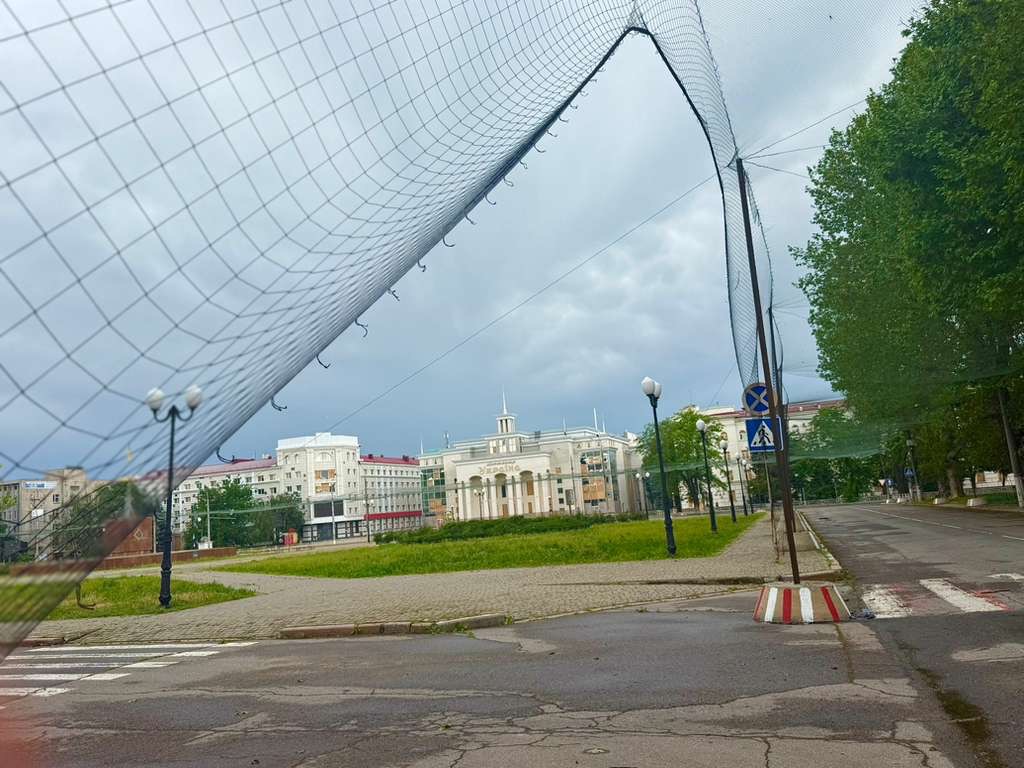
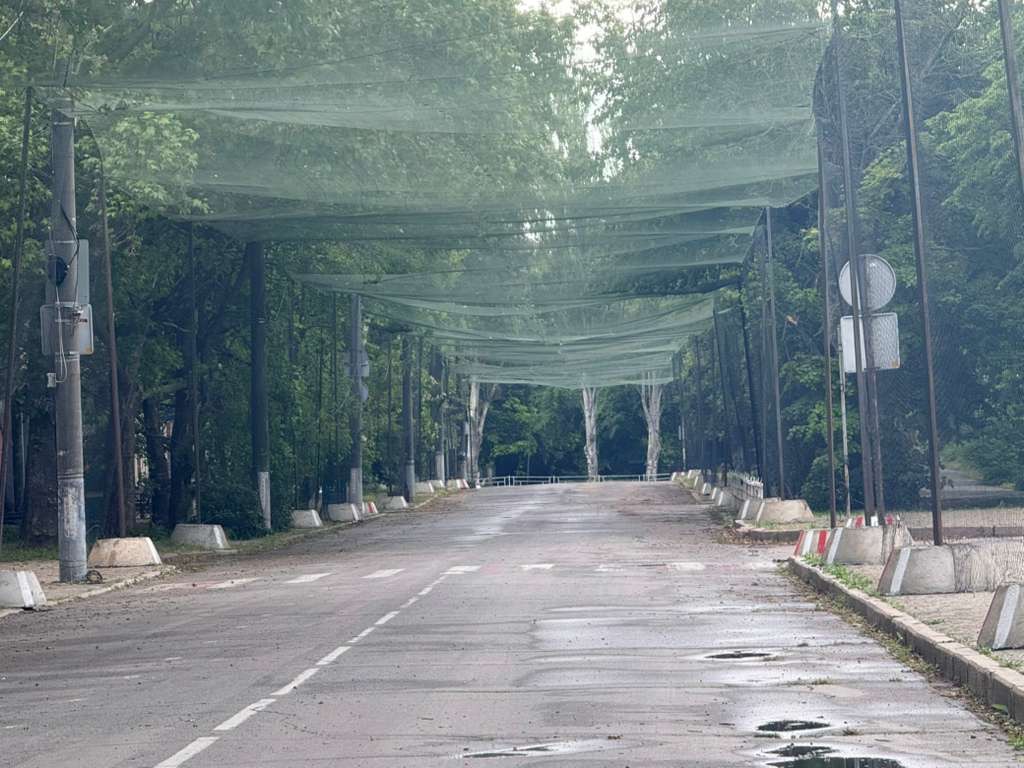
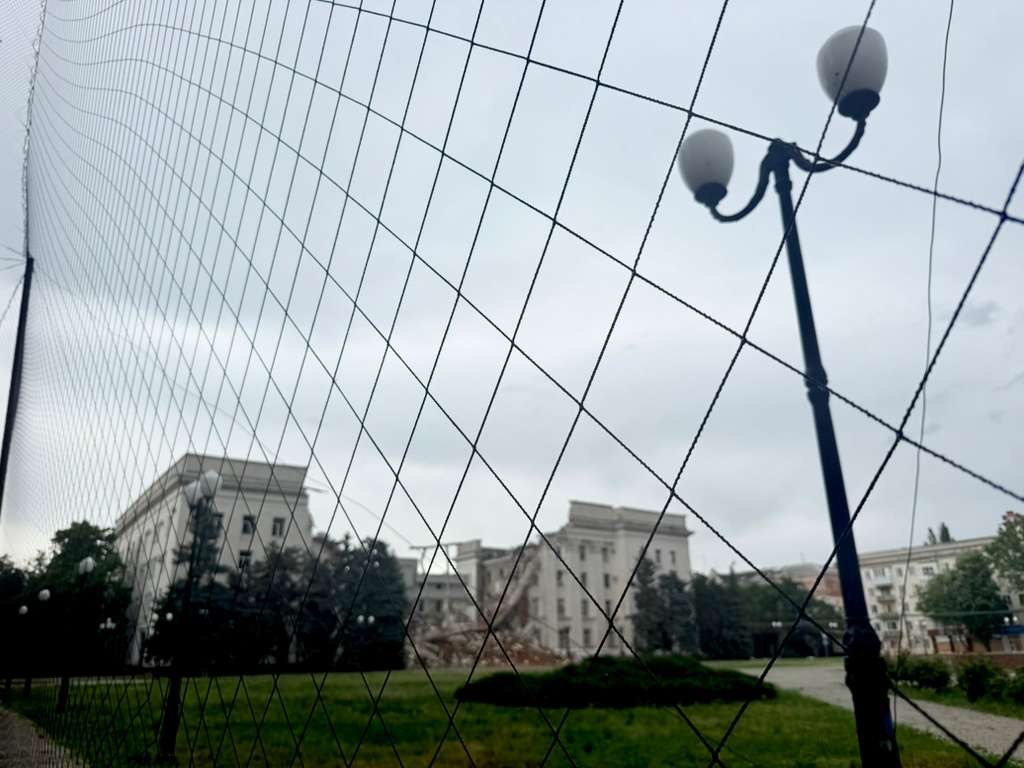
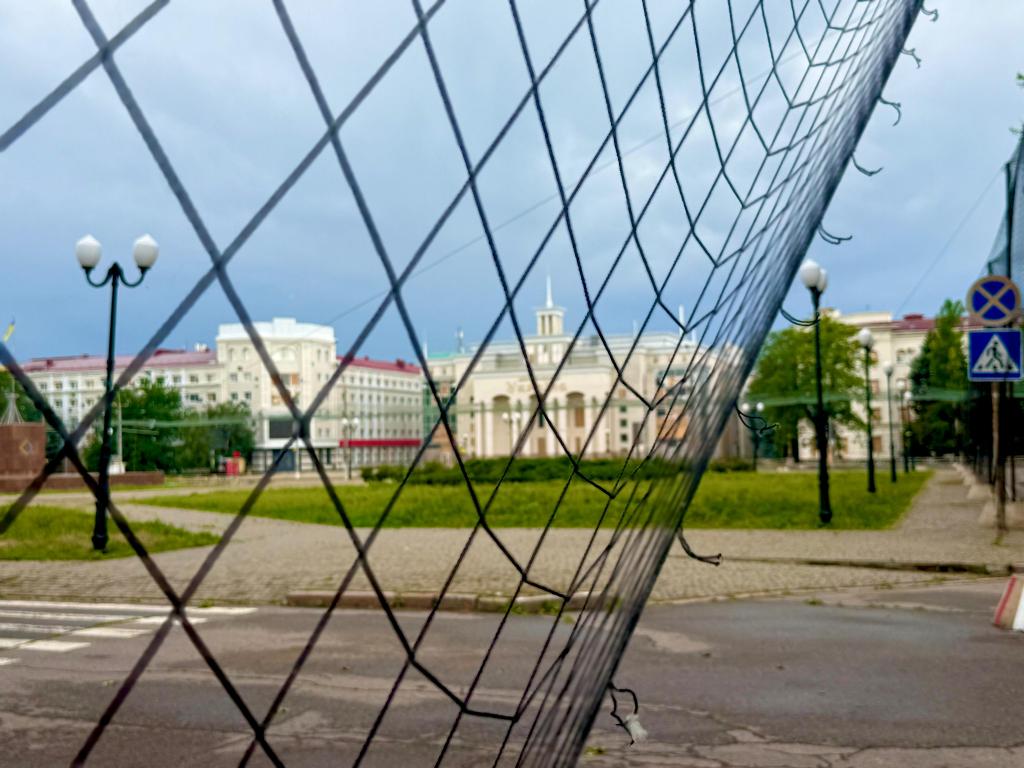
(Pictures of Kherson’s street covered in protective netting against FPV drones, Kherson 2026, image rights granted by Zarina Zabrisky)
Maxime: To put this into perspective using concrete data, electronic warfare commanders stationed in Kherson noted that while the initial phase saw 30 to 50 FPV drones launched daily, that number skyrocketed to an average of 300 daily attacks by late 2025.
Zarina Zabrisky: The latest official data shows that numbers have escalated to over 660 drone launches per day. The sky is an uninterrupted, buzzing grid of hostility. You cannot walk between buildings without tracking the sky. Just yesterday, dozens of civilian vehicles were incinerated, and a public bus was struck just before we began this interview.
Military analysts confirm that Russia is attempting a total drone siege to forcefully depopulate Kherson. When they tried to sever our primary highway link to Mykolaiv, the Ukrainian military responded rapidly by constructing physical anti-drone netting tunnels over major roads and deploying mobile electronic warfare (EW) units. However, offensive innovation moves faster than defensive countermeasures.
The majority of drones currently deployed against us are fibre-optic. Because they trail a literal thread of glass fibre back to the pilot rather than transmitting a radio frequency, they emit zero electromagnetic signals. They cannot be jammed, intercepted, or detected by standard commercial detectors. Furthermore, we are now seeing the integration of Artificial Intelligence targets — drones nicknamed Zhdun (“The One Who Waits”). These units sit quietly in disguise on rooftops or beneath netting, waiting autonomously for a target, such as a civilian vehicle, to pass before automatically launching a lethal strike.
Maxime: It is an extraordinarily grim reality. Mainstream media networks are increasingly pulling correspondents from active front lines due to soaring operational costs and safety liabilities. In this landscape, how vital is the role of independent journalism?
Zarina Zabrisky: We are living through a profound paradigm shift in global warfare; it is a digital “Guernica” moment. Simultaneously, the traditional mainstream media architecture is under profound stress, especially in the US under the current administration. In the US, Europe, and the UK, independent news ecosystems face intense pressure, and foreign state actors are aggressively financing localized disinformation networks.
Take the Tenet media campaigns investigated by the FBI, where dozens of prominent Western influencers were covertly paid millions to distribute Kremlin narratives.
I personally do not trust major institutions — not in a conspiracy sense, but based on the documented reality of large-scale foreign influence operations. As independent journalists, we are on our own to locate valid, verified sources. Everyone is struggling with this, not just media professionals but the consuming public. I am certain you face similar challenges within the ESCP International Politics Society. Our role as independents is becoming more critical than ever. While I do not have millions of followers, my reporting reaches hundreds of thousands who share it, and it ultimately makes an impact because our findings are regularly weaponised by larger organisations with consequential financial and editorial firepower. When I attended the Munich Security Conference, I was stunned to see how many global delegates had read my field reports.
Zarina briefly goes offline as her location is affected by regional power cuts — a routine disruption of daily Ukrainian life. The interview resumes via a mobile data connection.
Maxime: We can hear you clearly again. Unfortunately, network disruptions are a reality of reporting from Ukraine right now. To conclude, I first learned of your work through a United24 piece regarding operational survival in modern war zones. How do you navigate frontline journalism under a sky dominated by autonomous weapon systems, and how do you view the debate over journalists carrying active means of self-defence?
Zarina Zabrisky: It goes back to the paradigm shift. According to international humanitarian law, civilians — including journalists — must never be targeted by either belligerent. But when an aggressor explicitly tears up the Geneva Conventions, the rules must adapt to reality, or reporting becomes impossible. If I do not carry a drone detector, I am giving up my life. The debate around carrying a firearm for self-defence is evolving among frontline reporters; practically, it is nearly impossible to operate a camera and a rifle simultaneously, but the legal and ethical framework regarding civilian self-defence in a zone of total lawlessness must be modernised.
Cyprien: Given that Russia shows no intent of halting its campaign, do you see an eventual path out of this war? What does a post-war Kherson look like to you?
Zarina Zabrisky: Words matter immensely here: this is not a “conflict.” A conflict implies a mutual disagreement between two parties. This is a clear war of imperial aggression and systematic genocide. The single issue being contested is whether Ukraine has the right to exist and whether its people have the right to remain alive.
Russia is utilizing near-infinite human and material resources to sustain this assault. If the European Union, the UK, and our global allies fail to fully comprehend that drone-dominated, AI-driven warfare is the definitive future of global combat, this aggression will spread far beyond Ukraine’s borders. As NATO’s recent Hedgehog military exercises demonstrated, Western conventional forces remain profoundly underprepared for modern, decentralized digital warfare; an entire tank battalion can now be permanently neutralized by ten $200 commercial drones.
My urgent message from the front line is that we must move out of the ‘industrial’ mindset of warfare and move pressingly towards this new digital-age of warfare. If the international community does not act collectively to enforce international law and halt this aggression at its source, the security architecture of the entire world is fundamentally compromised.


Leave a comment