
By Cyprien Guillot de Suduiraut
Part 3: The Roots of the Georgian Conflicts and the Five-Day War
Part 1: The West’s Fateful Hesitation (Published May 12)
Part 2: Western Blindness: From the Bucharest Appeasement to the Abandonment of Tbilisi (Published June 16)
Part 3: The Roots of the Georgian Conflicts and the Five-Day War
Part 4: The Unlearned Lessons of the Georgian Case
Back to the Georgian conflicts
Letting Georgia fall by the wayside for all these years constituted a significant strategic error because two critical lessons were never properly heeded from its case.
(a) First, the Caucasian country happened to be the place where Russian imperialism was officially revived in 2008, in the momentum created by the subjugation of Chechnya under Moscow’s thumb. That renewed imperialism then threatened Ukraine, culminating in the present conflict. Should the current military stalemate ultimately turn to the Kremlin’s advantage, it may well progressively rear its head on EU and NATO countries like the Baltic states or even Poland – not to mention Moldova, which arguably constitutes the most geopolitically exposed state in Europe at the moment. Georgia being instrumentalized as Russia’s guinea pig to devise new ways of asserting dominance in its self-designated ‘near abroad’ is nothing new. At the 2025 Warsaw Security Forum, President Salome Zourabichvili stated that “as a rule, we [the Georgians] are Russia’s testing ground for how to try to revive the influence of Russian imperialism around it and beyond”. [61]

This implies that Europe could have anticipated the return of a Russian threat in its eastern neighbourhood way earlier than it effectively did; in reality, it preferred to bury its head in the sand, mostly for the sake of economic relations with Moscow. The ‘business as usual’ tacit policy represented a huge discrepancy vis-à-vis Russia’s assumed perception of having “turned back on direct rivalry” with the West – namely NATO – formulated at the time by President Dmitry Medvedev (2008–2012). [62] This undoubtedly reinforced the Kremlin’s conviction that international relations could be approached through a sphere-of-influence lens, since ‘NATO had been successfully pushed back’ [63] without any meaningful Western retaliation. The ground was therefore fertile for further operations of the same kind as that of 2008.
(b) Second and foremost, the Georgia case provided early evidence of Russia’s considerable capacity to disseminate disinformation and pro-Kremlin narratives abroad, permeating not only domestic Western public opinions but also institutional spheres. Some historical grounding is required to substantiate this claim.
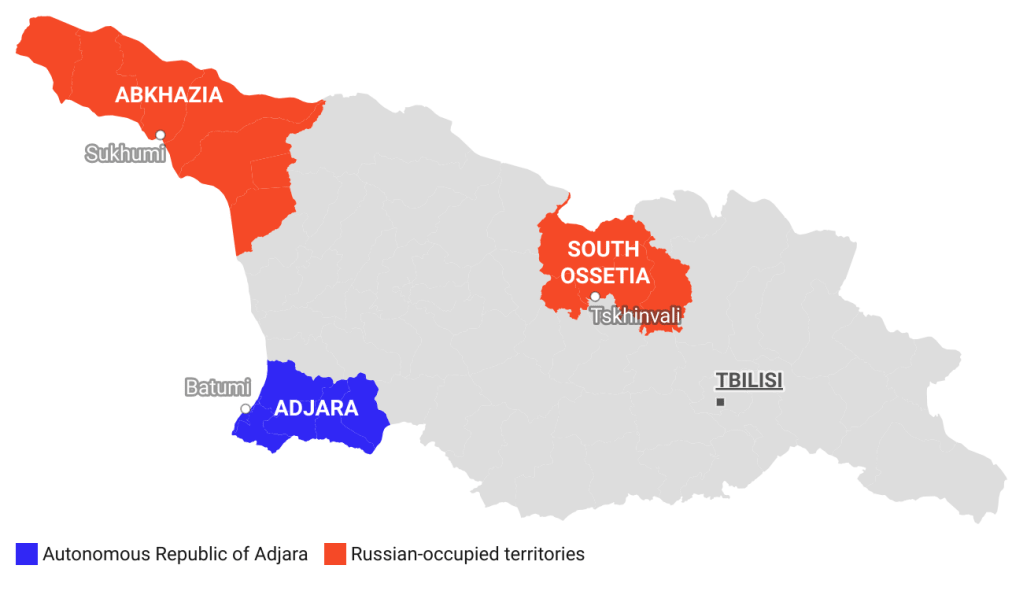
The territory of contemporary Georgia was annexed to Russia between the early 19th century and the late 1870s, as part of the Empire’s conquest of the Caucasus. [64] It includes the homeland of three distinct peoples: the Abkhazians, the Ossetians, and the Adjarians.
Abkhazia. The Abkhaz are a Caucasian people whose territory is located in the northwest of modern Georgia. Following the Russian Revolution of 1917 and the subsequent collapse of the Romanov dynasty, Georgia broke free and proclaimed a Menshevik-led republic [65] in May 1918. Abkhazia was incorporated into the new state in the summer and granted autonomy the next year. [66] Both its population and national movement suffered repression orchestrated by Tbilisi until the Bolsheviks’ invasion of 1921 overthrew the republic. The Mensheviks’ harsh treatment of Abkhaz minorities interestingly generated sympathy for their cause in Moscow, hence the proclamation of their own Soviet Socialist Republic (SSR Abkhazia) immediately afterwards. However, a late-1921 agreement associated it with the newly formed Georgian SSR, as a sui generis ‘contractual republic’. That unique status then raised concerns among both Soviet and Georgian authorities, which dreaded potential calls from less autonomous regions for a similar ‘contract’. Abkhazia was thus downgraded in 1931, when the SSR Abkhazia was reformed as the Abkhaz Autonomous Soviet Socialist Republic (Abkhaz ASSR) and folded into the Georgian SSR. Given that Abkhazians were already resentful of their ‘association’ with Tbilisi, this deepened subordination only served to exacerbate tensions. As for the Georgians – one of the most hostile groups towards the Bolsheviks – these manoeuvres ordered by Moscow were interpreted as a ploy to divert their attention from Soviet authorities to the Abkhaz. In other words, administrative arrangements were partly instrumentalized by USSR’s central power to sustain inter-ethnic tensions and deflect anti-Bolshevik sentiment, in accordance with the divide et impera principle. [67]
Under Stalin, the Georgian leadership pursued discriminatory policies against the Abkhazian population, most notably through the systematic displacement of the Abkhazian language in favour of Georgian. Throughout the Soviet rule, state-sponsored migration of ethnic Georgians into Abkhazia also aggravated the demographic imbalance between Georgians and Abkhaz, with the latter being reduced to an ever-smaller minority within their own autonomous entity. According to Sergey Markedonov, these policies had “an extremely negative impact”, creating among Abkhazian elites the perception that the Georgian SSR was “ensuring the large-scale resettlement of ethnic Georgians in Abkhazia with the aim of changing the ethno-demographic balance to the detriment of the Abkhaz people”. [68] In this oppressive context, these elites repeatedly petitioned Moscow to secede from the Georgian SSR, seeking either to join the Russian SFSR or to form a separate SSR independent of Tbilisi. Every single of their appeals fell on deaf ears. [69]
Ossetia. The Ossetians are an Iranian-speaking ethnic group indigenous to a region straddling the Caucasus Mountains, which has naturally divided it in two parts since its incorporation into Tsarist Russia. Under the Soviet Union, North Ossetia was attached to the Russian SFSR while South Ossetia was elevated to the rank of autonomous region (South Ossetian Autonomous Oblast; SOAO) of the Georgian SSR. [70]
Like Abkhazia, South Ossetia was part of Menshevik Georgia during the Russian Civil War and saw its Bolshevik-backed peasant population suppressed by Tbilisi between 1918 and 1920. [71] In recognition of the Ossetians’ loyalty to Moscow and the support they had lent to the invading forces that deposed the Mensheviks in 1921, the Soviet leadership rewarded them with autonomous status within the newly constituted Georgian SSR. [72] It is worth noting that a significant number of ethnic Georgian villages were incorporated into the SOAO despite vigorous protests of Georgian locals. Most strikingly, the predominantly Georgian city of Tskhinvali was designated as the capital of the new administrative unit. In this regard, South Ossetia appeared to be no exception to Moscow’s overarching strategy of deliberately fomenting tensions between ethnicities as an instrument of political control.
Nonetheless, contrary to Abkhazia, the SOAO was predominantly ethnic Ossetian in composition, with Georgians representing between a quarter and a third of the area’s population from the 1920s until the dissolution of the USSR. This precluded Tbilisi from enacting discriminatory policies of the kind pursued in the Abkhazian ASSR – paradoxically so, given that, in theory, Abkhazians living in the Georgian SSR enjoyed a higher degree of autonomy than their Ossetian counterparts. [70]
Adjara. Adjarians are an ethnic subgroup of Georgians living in southwestern Georgia. Historically, the majority of Adjara’s population was Christian. However, following the region’s conquest by the Ottomans in the 16th century, subsequent Turkish rule actively discriminated against Christians, allowing Islam to gain a strong foothold in the region. [73] Following reunification with the Georgian mainland three hundred years later, most Adjarians reverted to Christianity. Today, they are again predominantly Orthodox and have broadly identified as Georgians since the 1991 independence. During the Soviet era, they had autonomy from Tbilisi and lived under the Adjarian ASSR within the Georgian SSR.
The end of the USSR. Gorbachev’s political liberalization (1985–1991) created space for competing national projects that rapidly radicalized one another. The Georgian independence movement pushed to leave Moscow’s orbit whereas minority national movements in Abkhazia and South Ossetia simultaneously pressed for self-determination. The former endeavoured to reconstitute statehood within the borders of the Georgian SSR, but its leaders treated the autonomous regions with suspicion, seeing them as artificial constructs and historical instruments of Moscow’s influence rather than legitimate partners. This mistrust led to the exclusion of national minorities from a potential broader civic-democratic coalition, rendering Georgian nationalism of the 1980s increasingly ethnically exclusive. [74]

On the other hand, Abkhaz leaders drew on the precedent of the SSR Abkhazia (1921–1931), calling for its restoration as it grew increasingly clear that the USSR was on the verge of collapse. South Ossetians, for their part, had not forgotten Tbilisi’s suppression of the late 1910s and harboured deep fears of institutionalized discrimination upon absorption into a new independent Georgian state. They accordingly sought a way to preserve some degree of autonomy, which they regarded as a guarantee for the protection of their national rights. [75]
Additional factors contributed to fuel the latent ethnic tensions of the period. In the final years of the USSR, the Soviet government strategically backed separatist movements within Union republics seeking independence – particularly in South Ossetia and Abkhazia against Georgia – as a pressure tactic to deter attempts to break free from Moscow. For example, an April 1990 law [76] equated certain rights of autonomous oblasts and republics (e.g. the Abkhaz ASSR and the SOAO) with those of Union republics (e.g. the Georgian SSR). One of its corollaries was to effectively grant these sub-entities a degree of leverage in the negotiations over the New Union Treaty, [77] irrespective of their parent SSR’s stance on the matter. The idea behind Gorbachev’s policy was that by empowering autonomous regions to bypass recalcitrant Union republics seeking independence to deal directly with Moscow, he could then brandish the spectre of ethnic fragmentation right under the nose of these republics’ national movements and thus compel them back into line with the centre. Georgia and Moldova were the main targets, as their territories were home to peoples with separatist longings (the Abkhaz and the Ossetians for Tbilisi, the Russian-speaking Gagauz for Chișinău). [78] Even more concretely, the Kremlin also provided direct military and financial support to the Abkhaz and Ossetian national movements. [79]
Within Georgia proper, the reciprocal mistrust between proponents of a new Georgian state and Abkhaz and Ossetian national movements alike was further compounded by the rise of what the latter perceived as ‘Georgian chauvinism’ threatening their ethno-cultural identities. [80] According to Tracey German, their suspicions were reinforced when nationalist Zviad Gamsakhurdia [81] effectively became the leader of Georgia following the parliamentary elections of October-November 1990 (the first free elections since the fall of Menshevik Georgia), “predominantly on the basis of his support for the rights of Georgians, promulgated under the slogan ‘Georgia for Georgians’”. [82] Once in office, Gamsakhurdia swiftly “stripped South Ossetia of its autonomy and introduced a state of emergency”* while openly championing “the cleansing of Ossetians from the country with the aim of driving them back to North Ossetia”. At that point, efforts had already been made in Tbilisi since the summer of 1989 to designate Georgian as the country’s sole official language, a decision South Ossetian authorities promptly ruled out. It thus goes without saying that “ [Gamsakhurdia’s] election triggered a sharp deterioration of relations between the Georgian government and ethnic minorities” who then “began to view independence as the only way to retain their cultural rights and autonomy”. [83] Overall, Gamsakhurdia “contributed to the alienation of Abkhazians and South Ossetians from the new Georgian national project with his exclusionary rhetoric and discourse on minorities”. [84]
Finally, in the specific case of South Ossetia, the existence of a kin ethno-national entity on the other side of the Caucasus Mountains (then known as the North Ossetian ASSR, subsequently renamed the Republic of North Ossetia-Alania under the Russian Federation) proved a significant factor in South Ossetian leaders’ drive to secede from Tbilisi and reunify with their northern counterparts by joining Russia. [85]
Against the background of Gorbachev’s perestroika, the Communist Party’s power grip progressively loosened in the Union republics and their subdivisions. That enabled many SSRs, and some of the autonomies placed under their authority, to assert the primacy of republican local power over central authority within their respective territories. Between the autumn of 1988 and the summer of 1989, Estonia, Lithuania, Latvia, and Azerbaijan each declared ‘state sovereignty’. The remaining Union republics – Russia included – swiftly fell into step in 1990, in what came to be known as the parade of sovereignties.
The Georgian SSR passed its declaration of sovereignty on 9 March, 1990. [86] In response, Abkhaz nationalists adopted a similar ‘Declaration of State Sovereignty’ in late August of the same year. [87] Shortly after, in September, Ossetian nationalists went even further by proclaiming a South Ossetian state loyal to Moscow and independent from Tbilisi. [88] At the end of the year, they organised elections to their own parliament (in deliberate contrast to the Georgian parliamentary elections of October–November, which they boycotted), as a means of tangibly manifesting that independence. [89] The Gamsakhurdia-led Georgian SSR reacted by annulling the autonomy of South Ossetia and declaring a state of emergency to restore order in the region (cf. three paragraphs above*). Georgian troops entered Tskhinvali in the first days of 1991 to enforce the decision, leading to the First South Ossetia War (1991–1992) which ended with a victory for the Kremlin-backed separatists. In Abkhazia, ethnic tensions escalated into armed conflict in the summer of 1992, when representatives of the Abkhaz ASSR dissolved the autonomous entity and proclaimed Abkhazian independence, citing the precedent of the SSR Abkhazia (1921–1931). [90] The war lasted until 1993, when Georgian troops were equally repelled with Moscow’s help. Both Abkhazia and South Ossetia subsequently became de facto independent states, albeit with incomplete control over their Soviet-era administrative boundaries.
The Abkhazia War completely inverted the demographics of the region. According to the US-based Genocide Watch, while “Georgians made up the plurality of people living in Abkhazia at an estimated 240,000 people” prior to the conflict, the war led to “mass expulsion and massacres of Georgians by Abkhazian separatists, reducing the Georgian population to less than 50,000”. [91] In all, an estimated 250,000 Georgian civilians were displaced. [92] The OSCE repeatedly condemned these events throughout the 1990s, explicitly characterising them as ethnic cleansing. [93]
From a legal standpoint, it is worth noting that Abkhaz secessionists attempted to leverage the March 1991 referendum held throughout the USSR as a basis for invoking Soviet legislation passed in the previously discussed context of the Kremlin’s use of minority separatist movements against SSRs aspiring to break free in the late 1980s. The said referendum had been submitted by Moscow to the peoples of the Union republics to gauge their stance on a potential transformation of the USSR into a more flexible federation under the New Union Treaty. [77] The pro-independence authorities of the Georgian SSR (elected in the 1990 parliamentary elections) boycotted it. Conversely, both Tskhinvali and Sukhumi (Abkhazia’s capital) sanctioned it, resulting in an almost unanimous vote in the two regions in favour of becoming a part of a remodelled Soviet Union. According to Abkhaz leaders, this unambiguous popular mandate enabled them to appeal to Soviet secession legislation, especially following Tbilisi’s own referendum on the ‘restoration of independence of Georgia’ [94] – convened a few days later – that led to the country’s formal declaration of independence in early April. [95] Indeed, Gorbachev’s 1990 law “On the procedure of secession of a Soviet Republic from the USSR” stated that, in the event of a Union republic’s secession (in this case, Georgia’s), autonomous entities within its borders were entitled to hold separate referendums to determine independently whether to follow the seceding republic or remain within the USSR. [96] Thus, the rationale behind the Abkhazians seizing the opportunity of the New Union Treaty referendum to vote massively in favour of sticking with the Kremlin was that doing so would legally afford them the right to break with Tbilisi. [97]
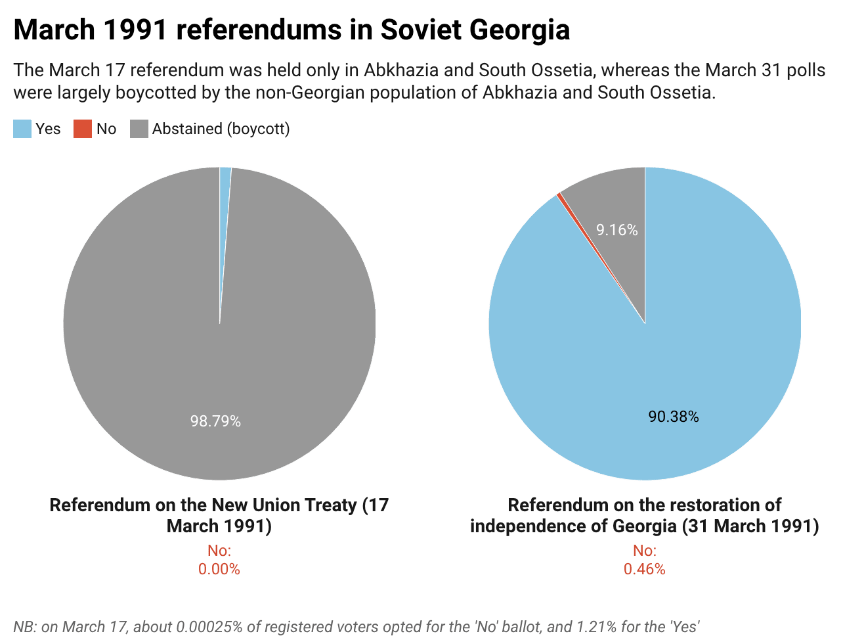
Figure 3 Results of the two March 1991 referendums held in the Georgian SSR.
Source: Direct Democracy (https://www.sudd.ch/index.php?lang=en)
Towards the 2008 war
Between the early 1990s and 2008, the situations in Abkhazia and South Ossetia remained relatively stable, underpinned by a broadly holding status quo shaped by the ceasefires of the 1991–1993 wars. [98] At the political level, Georgia experienced a civil war running concurrently with the two ethnic conflicts (1991–1992; 1992–1993) in which President Gamsakhurdia [99] was ousted by disaffected opponents and replaced by Eduard Shevardnadze [100] following a brief interregnum under warlord-led military rule. Heading a provisional government that organised new elections in the fall of 1992, Shevardnadze was subsequently elected chairman of parliament and acting head of state unopposed, before formally assuming the Georgian presidency in 1995. He was then re-elected for a second five-year term as president in 2000.
In late 2003, parliamentary elections results were deemed falsified by both the opposition and international observers, [101] sparking widespread protests that left Shevardnadze with no choice but to resign in a bloodless change of power commonly referred to as the Rose Revolution. Pro-Western opposition leader Mikheil Saakashvili was elected to the presidency in January 2004, before his party and allies secured a parliamentary majority in the repeat elections of March of that same year.
Immediately after coming into office, President Saakashvili set out to resolve once and for all Georgia’s lasting sovereignty issues, starting with Adjara. Back in the early 1990s, Aslan Abashidze – a former Soviet-era municipal official appointed chairman of Adjara’s parliament by then-President Gamsakhurdia – exploited the chaos of Georgia’s simultaneous civil and secessionist wars to consolidate unilateral control over the region, severing its fiscal ties with Tbilisi and appropriating its considerable resources for his own profit. After presiding over the small republic as a strongman for roughly fifteen years (sustained by Moscow’s patronage), a ‘second Rose Revolution’ saw thousands of Adjarians take to the streets of Batumi (Adjara’s capital) in May 2004 against his separatist and militaristic rule. Despite his attempts to suppress the protests by force, Georgian special forces entered the region and secured his withdrawal without bloodshed. Adjara was rapidly reintegrated within the Georgian state but retained its traditional autonomy. [102]
The fall of Abashidze was a significant political success for Saakashvili, which he saw as the “beginning of Georgia’s territorial integrity”. [103] It emboldened his paramount ambition of restoring Tbilisi’s authority over the breakaway regions of Abkhazia and South Ossetia. A few weeks after the events in Adjara, he notably declared: “As long as I live, I will not reconcile myself to accepting the breakup of Georgia”. [104] This vision implied a willingness to consider compromises – including the prospect of an asymmetric federal system granting substantial autonomy to Sukhumi and Tskhinvali – while never fully ruling out the option of restoring order manu militari in the two separatist provinces. [105]
Over time, it is actually this idea that gained the most traction in the president’s strategic thinking. The Rose Revolution and his overwhelming electoral victory of 2004 somewhat reignited the Georgian nationalist impetus of the 1980s, with the country’s new leadership driven by a desire to overcome and redress what it perceived as a national humiliation in South Ossetia and Abkhazia. This assertive posture was also inflamed by a domestic public deeply disillusioned with the Shevardnadze era and hungry for a strong, reunified Georgia. Besides, American military assistance and growing NATO ties of the 2000s further spurred Tbilisi, leading it to believe the West would tacitly endorse – or at least overlook – a sudden push for reintegration of the breakaway territories. [106]
Tbilisi’s demeanour provoked a shift in the Kremlin’s self-assigned role in the Georgian conflicts. From the end of the Soviet Union to 2004, Russia had acted largely as a mediator and officially backed Georgia’s territorial integrity while endorsing the separatists under the table. The main reason behind this policy was Moscow’s concern for stability in the Caucasus against the backdrop of the Chechen conflict. After Saakashvili rose to power, the Kremlin progressively abandoned its arbiter posture and repositioned itself as an outright patron of the secessionist entities on Georgian territory. [107]
The five-day Russian invasion of Georgia
It is in this context that South Ossetian–Georgian tensions started to escalate in the spring of 2008. Skirmishes finally erupted between separatists and the Georgian military around June. In the early hours of August, South Ossetian troops began shelling ethnic-Georgian villages of the region that had remained in Tbilisi’s hands after 1992. [108] A week later, President Saakashvili announced on television that he had ordered the army not to return fire despite facing heavy bombardments. He called for immediate multilateral talks to resolve the conflict and extended a full amnesty to separatist fighters. [109] However, according to political scientist Vladimir Socor, “the brazen attacks during the night of August 7 to 8 in South Ossetia left Tbilisi with no choice but to respond” since “continuing Georgian restraint would have resulted in irreparable human, territorial, and political losses”. [110] Tbilisi’s army entered the breakaway province upon presidential injunction to ‘restore constitutional order’.
Tskhinvali was captured on the morning on 8 August. Moscow accused Georgia of ‘aggression against South Ossetia’ [111] and illegally sent troops into the region. A five-day war ensued. On 9 August, Russian-supported Abkhaz forces opened a second front to secure control over the remaining portions of Abkhazia that had stayed outside their grasp since the 1992–1993 war. The Georgian military withdrew from Tskhinvali on the evening of 10 August, after which Russia occupied the city. By 11 August, it had retreated from the entirety of South Ossetia. On the same day, Moscow’s troops advanced into western Georgia from Abkhazia, launching a third front. On 13 August, an EU-brokered ceasefire negotiated by French President Nicolas Sarkozy was agreed to by both sides. This did not, however, prevent Russian forces from making the most of the hours preceding the agreement’s entry into force to push into undisputed Georgian territory from South Ossetia, advancing to within some fifty kilometres of Tbilisi and occupying major cities on the way like Gori. On 17 August, despite the truce, they completed their occupation of the former SOAO by advancing into the city of Akhalgori, [112] thereby fulfilling the territorial claims of South Ossetian separatists. On their side, Abkhaz forces had similarly secured the remainder of the former Abkhaz ASSR by 12 August.
Ten days after the official end of hostilities, the Russian troops withdrew from undisputed Georgia and redeployed behind the Soviet-era borders of Abkhazia and South Ossetia. [113] The occupation of both regions still goes on as of today. On 26 August, President Medvedev issued decrees marking the recognition of the independence of the two secessionist ‘republics’ by Russia. [114] Three days later, Moscow and Tbilisi formally cut all diplomatic ties. [115]
Around 20,000 ethnic Georgians fled South Ossetia amidst the combats. [116] Various reports characterised their treatment by South Ossetian forces (both during and after the war) as constituting ethnic cleansing, in a manner reminiscent of the events in Abkhazia in the 1990s. [117] This is still an ongoing issue, as a 2025 United Nations report recorded that nearly 300,000 internally displaced persons (IDPs) from the breakaway regions remained in non-occupied Georgia. The persistence of this situation has lent displacement a generational dimension, with de facto authorities in both Abkhazia and South Ossetia persisting in systematically denying Georgian IDPs the right of return to their areas of origin (save for limited districts in Abkhazia). [118]

Edited by Félix Dubé
References
[62] See “Russia’s 2008 war with Georgia prevented NATO growth – Medvedev” RIA Novosti, November 21, 2011. https://web.archive.org/web/20111124020351/http://en.rian.ru/russia/20111121/168901195.html
[63] Ibid.
[64] “Les Russes et leur Empire” [“Russians and their Empire”] L’Histoire n°485-486, 54-55 & 60, 2021.
[65] Known as the Democratic Republic of Georgia (DRG).
[66] This autonomous status was later enshrined in the 1921 DRG’s constitution. Tbilisi also accorded it to Adjara, mentioned in the text as ‘Muslim Georgia’ or ‘Batumi district’ (Article 107).
[67] Sergey Markedonov, “’Frozen conflicts’ in Europe” 1st ed., Verlag Barbara Budrich, 71-106, 2015. https://doi.org/10.2307/j.ctvdf0bmg
[68] Ibid.
[69] Ibid.
[70] NB: under the USSR, the status of ‘Autonomous Oblast’ was inferior to that of ‘Autonomous SSR’.
[71] Sergey Markedonov, op. cit., 111-118.
[72] John Kohan, “Hastening The End of the Empire” TIME, January 28, 1991. https://time.com/archive/6716965/hastening-the-end-of-the-empire/
[73] This explains the misnomer of ‘Muslim Georgians’ that is sometimes used to designate Adjarians despite their return to Orthodox Christianity following the region’s passage into Russian control in the 19th century. See also footnote n°66.
[74] Markedonov, op. cit., 71-106 & 111-118.
[75] Ibid.
[76] The full text of the law can be found at: https://lawrussia.ru/texts/legal_346/doc346a546x159.htm (in Russian)
[77] A mid-1990 Gorbachev-led initiative aimed at salvaging and reforming the USSR by altering it into a confederation. Six out of fifteen Union republics (the three Baltic SSRs, Armenia, Georgia and Moldova) immediately rejected the project, which was eventually abandoned following the 1991 August Coup. During the negotiation process, some autonomies expressed the desire to raise their status and become direct parties to the agreement. By widening the scope of their competences, the Kremlin hoped that those placed under the jurisdiction of the Georgian SSR, Abkhazia and South Ossetia, would seize the opportunity, thereby creating a domestic counterweight designed to deter Tbilisi from pressing its independentist ventures further.
[78] Ben Fowkes, “The Disintegration of the Soviet Union” Palgrave Macmillan, 180, 1997.
[79] Nodar Asatiani & Otar Janelidze, “History of Georgia: From Ancient Times to the Present Day” Publishing House Petite, 428, 2009. Downloadable at https://dspace.nplg.gov.ge/handle/1234/325092
[80] The Georgian national movement underwent a marked radicalization in the late 1980s, driven in no small part by the Soviet repression of April 9, 1989, when Soviet troops violently suppressed a nationalist pro-independence demonstration in Tbilisi. For more information on the rise of ethnic tensions in the final years of the Georgian SSR or on the broader Abkhazia and South Ossetia conflicts, see the Princeton Encyclopaedia on Self-Determination’s entry on Georgia: https://pesd.princeton.edu/node/706
[81] Under the Soviet Union, Gamsakhurdia had also been a dissident and human rights activist who notably co-founded the Georgian branch of Helsinki Watch, an US-based NGO monitoring the USSR’s compliance with the Helsinki Accords of 1975 and which eventually became Human Rights Watch in the late 1980s.
[82] Tracey German, “Abkhazia and South Ossetia: Collision of Georgian and Russian Interests” Institut français des relations internationales (IFRI), 6, June 2006. https://www.ifri.org/sites/default/files/migrated_files/documents/atoms/files/germananglais.pdf Gamsakhurdia also fanned the flames of Georgian inter-ethnic tensions with similar polemical statements such as “an ‘Abkhazian people’ never existed historically” on the steps of Parliament Building in Tbilisi in 1989. For archival material, see https://www.youtube.com/watch?v=DfSYvAZAfN0 (with English subtitles)
[83] Ibid.
[84] Natia Chankvetadze & Ketevan Murusidze, “Re-examining the Radicalizing Narratives of Georgia’s Conflicts” Carnegie Endowment for International Peace, May 12, 2021. https://assets.carnegieendowment.org/static/files/05-2021-Chankvetadze_Murusidze_Georgia_Conflicts.pdf
[85] Markedonov, op. cit., 112. For a more general approach on the Georgian conflicts, see also Le Dessous des Cartes, “La Géorgie après la guerre” [“Georgia After the War”] Arte, May 15, 2010. Archive available at: https://www.youtube.com/watch?v=W39LJRa0leg (in French)
[86] Daniel Pineye, “URSS : chronique d’un démembrement amorcé” [“USSR: Chronicle of a Dissolution Foretold”] International Economics, Vol. 48, 87-98, 1991. https://www.cepii.fr/IE/PDF/EI_48-7.pdf
[87] Markedonov, op. cit., 80.
[88] Dennis Sammut & Nikola Cvetkovski, “Confidence-building Matters: The Georgia-South Ossetia Conflict” Verification Technology Information Centre (VERTIC), 11, March 1996. https://www.vertic.org/media/Archived_Publications/Matters/Confidence_Building_Matters_No6.pdf
[89] Ibid.
[90] Markedonov, op. cit., 83.
[91] See Genocide Watch’s report on Abkhazia (October 2021): https://www.genocidewatch.com/single-post/genocide-watch-abkhazia
[92] See “Georgia/Abkhazia: Violations of the Laws of War and Russia’s Role in the Conflict” Human Rights Watch, 43, March 1995. https://www.hrw.org/reports/georgia953.pdf
[93] See for example OSCE’s Istanbul Document 1999, 49, 1999. https://cdn.osce.org/sites/default/files/f/documents/6/5/39569.pdf
[94] The idea of ‘restoration’ of Georgian independence is rooted in the precedent set by the DRG (1918–1921).
[95] The text of the Act of Restoration of State Independence of Georgia of April 9, 1991 can be accessed at: https://matsne.gov.ge/en/document/view/32362 (translated to English from Georgian)
[96] The full text of the law (see in particular Article 3) can be accessed at: https://en.wikisource.org/wiki/Concerning_the_procedure_of_secession_of_a_Soviet_Republic_from_the_Union_of_Soviet_Socialist_Republics (translated to English from Russian)
[97] Markedonov, op. cit., 81.
[98] Growing tensions nevertheless periodically escalated into armed clashes, as in 1998 in Abkhazia and in 2004 and 2006–2007 in South Ossetia. Moreover, Georgia violated the 1994 Moscow Agreement in 2006 by taking control of the Kodori Gorge, a part of Abkhazia that had previously been designated a ‘demilitarized zone’.
[99] The office of President of Georgia was instituted in April 1991 by the Georgian parliament at the request of Gamsakhurdia himself. Presidential elections were held a month later, with the latter securing an overwhelming majority, thereby acceding to the presidency.
[100] Under the Soviet Union, Shevardnadze had served as First Secretary of the Communist Party of Georgia from 1972 to 1985, where he became known for economic reforms and anti-corruption campaigns. He was then appointed Minister of Foreign Affairs by Gorbachev in 1985, becoming the international face of perestroika and one of the most influential figures in Soviet foreign policy during the twilight years of the USSR.
[101] See OSCE’s press release “Georgian parliamentary elections marred by confusion over voter lists” November 3, 2003. https://web.archive.org/web/20070720052235/https://www.osce.org/item/7881.html
[102] De jure, the Soviet-era Adjarian ASSR had been replaced in 1991 by the ‘Autonomous Republic of Adjara’.
[103] See https://civil.ge/archives/105865
[104] Jean-Christophe Peuch, “Georgia: Saakashvili Offers To Open Reunification Talks With Abkhazia, South Ossetia” RFE/RL, May 26, 2004. https://www.rferl.org/a/1052980.html
[105] Ibid.
[106] Markedonov, op. cit., 115-116. Following the same reasoning, President Saakashvili and his government similarly assumed that Georgia’s Western partners would turn a blind eye on potential excesses, including violations of the 1990s ceasefires (see footnote n°98) or the violent police crackdown on peaceful protesters that occurred on November 7, 2007.
[107] Ibid., 117.
[108] Eka Tsamalashvili & Brian Whitmore, “Eyewitness Accounts Confirm Shelling Of Georgian Villages” RFE/RL, November 14, 2008. https://www.rferl.org/a/Eyewitness_Accounts_Confirm_Shelling_Of_Georgian_Villages/1349256.html
[109] See “Saakashvili Appeals for Peace in Televised Address” Civil Georgia, August 7, 2008. https://old.civil.ge/eng/article.php?id=18931
[110] Vladimir Socor, “The Goals Behind Moscow’s Proxy Offensive in South Ossetia” Jamestown Foundation, August 8, 2008. https://jamestown.org/the-goals-behind-moscows-proxy-offensive-in-south-ossetia/
[111] See the Kremlin’s “Statement on the Situation in South Ossetia” of August 8, 2008: http://en.kremlin.ru/events/president/transcripts/1042
[112] Luke Harding, “Tanks and Katyushas bristle round isolated Tbilisi” The Guardian, August 18, 2008. https://www.theguardian.com/world/2008/aug/18/georgia.russia1
[113] Luke Harding, “Russia begins troop withdrawal from Georgia” The Guardian, August 22, 2008. https://www.theguardian.com/world/2008/aug/22/georgia.russia2
[114] See http://en.kremlin.ru/events/president/news/1223
[115] Andrew E. Kramer, “Georgia and Russia Cut Diplomatic Ties” The New York Times, August 29, 2008. https://www.nytimes.com/2008/08/30/world/europe/30russia.html
[116] See the executive summary of “South Ossetia: The Burden of Recognition” International Crisis Group (Europe Report n°205), June 2010. https://www.crisisgroup.org/sites/default/files/205-south-ossetia-the-burden-of-recognition.pdf
[117] See “Up in Flames: Humanitarian Law Violations and Civilian Victims in the Conflict over South Ossetia” Human Rights Watch, 3, January 2009. https://www.hrw.org/sites/default/files/reports/georgia0109web.pdf
“[South Ossetian forces] looted, beat, threatened, and unlawfully detained numerous ethnic Georgian civilians, and killed several, on the basis of the ethnicity […], with the express purpose of forcing those who remained to leave and ensuring that no former residents would return. From this, Human Rights Watch has concluded that South Ossetian forces attempted to ethnically cleanse these villages.”
[118] See https://docs.un.org/en/A/79/892


Leave a comment