
From pacifism to pragmatism.
On April 21, 2026, the Japanese government announced it would lift its long-standing ban on lethal weapons exports [1]. This represents a turning point in the Japanese political scene, as it had, since the end of the Second World War, limited its use of the military to defensive purposes [2]. The decision comes as Sino-Japanese relations have worsened, and tensions around Taiwan have increased, while the country has taken on a more active role in regional security [1].
Pacifism remains a key element of modern Japan’s political ideology. The 1947 Constitution renounced the concept of war as a sovereign right and rejected the use of force in international conflicts [2]. When in 1954 a new interpretation of the Constitution allowed Japan to maintain a Self-Defense Force, pacifism continued to be a significant element of Japan’s political culture and the attitudes and perceptions of its people [3]. According to this foreign and security policy, Japan has deliberately chosen to avoid an independent defence posture and has been hesitant to take on leadership roles in regional security affairs. Instead, Japan has developed a special security relationship with the US, and a military designed and sized exclusively for defensive warfare [3].
Step-by-step policy changes that took place since 2014.
Japan’s policy developments in the domain of defence and security are not a sudden rupture with decades of pacifist principles; they are the result of a slow and gradual process of development. In 2014 a major turning point came when Prime Minister Shinzo Abe reinterpreted Japan’s post-1945 constitution to permit “limited collective self-defence” [3]. Since then, this has allowed Japan to consider using its military to assist allies under attack. The reinterpretation of pacifism thus made a major step in Japan’s evolving security position.
In 2023, Japanese Prime Minister Fumio Kishida permitted the export of arms and related defence technologies to countries and parties for which there is a good reason to believe that it does not constitute a threat to peace and security [1]. Japan will also expand their rules governing defence exports, with further expansion of these rules expected [1]. A number of policy developments over several years have influenced Japan’s rules on arms export, as they reflect different political views on how defence industry transfers can support broader foreign policy goals. These events show the start of a shift in Japanese politics, which precedes the recent relaxation of arms export regulations.
China, Taiwan, and the security dilemma.
At a time when the security landscape in East Asia is shifting, a number of important interests are under pressure. The modernisation of the Chinese military creates challenges for other nations [1]. China’s increasing activity in East Asia has raised concerns in Tokyo [1]. Both China’s naval exercises around Taiwan, and the incursions of Chinese ships in Japanese waters have been heavily reported by Japanese media, despite not receiving the same attention in China [1].
The rising tensions between China and Taiwan have played a role in Japan’s shifting military policies [1]. Despite the risk of a military conflict involving China and the US remaining limited, the risk of a conflict with China over territory or resources remains significant. In addition, North Korea’s ballistic missile tests and nuclear developments also incentivise the Japanese government to lean away from a purely defensive posture [3].
From passive actor to security provider.
Japan has been increasing its military presence in the area, as security issues surge. It is now doing this through partnerships with major countries such as the US and Australia, including cooperation in defence. Furthermore, Tokyo is ramping up joint military drills with key partners like the United States and the Philippines, including recent trilateral exercises with the two countries’ naval forces [4].
Japan also plans to increase defence spending, with a target of around 2% of GDP, up from roughly 1.4% today [3]. By doing so, Japan aims to strengthen deterrence while reducing its heavy reliance on the United States.
The Japanese military has shifted from being purely defensive to increasingly acting as a regional power. Japan also acts as a more conventional power which balances the risks associated with the rise of the North Korean threat and China’s growing military assertiveness.
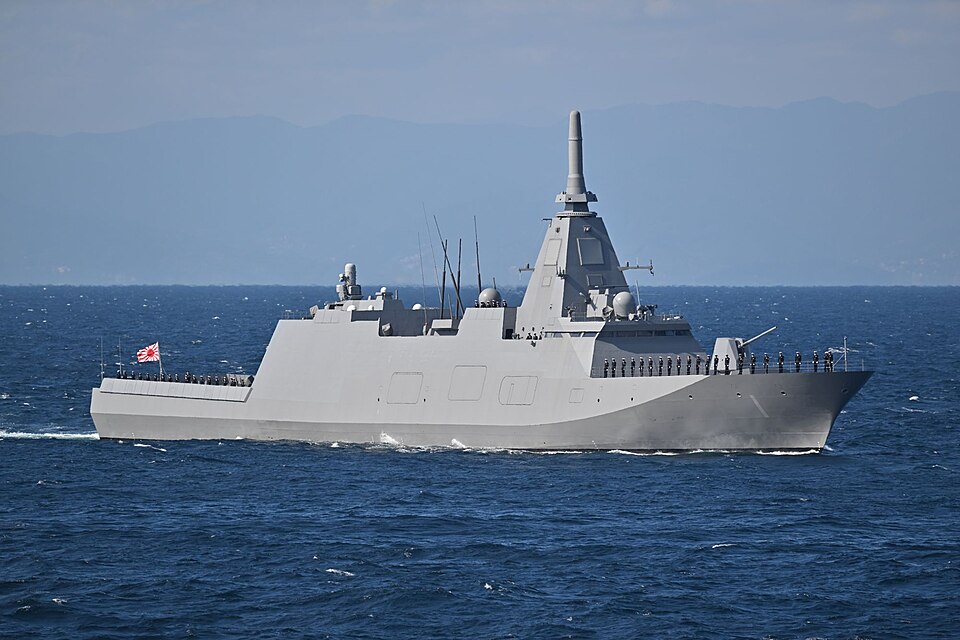
Apart from taking part in drills, Japan has in the last month also decided to build and sell warships to Australia, in what is expected to become Japan’s largest postwar defence export deal, worth more than $7bn. The agreement includes the supply of upgraded Mogami-class frigates to the Australian Navy, and further strengthens military and industrial cooperation between the two countries.
Regional reactions and chronic debates.
This shift has divided the Japanese political scene. While on one hand, supporters of the change argue that it is necessary for Japan to respond to the growing security threats and to take on a more active role in maintaining regional peace, on the other, critics warn that such developments run the risk of undermining the country’s pacifist identity and could contribute to rising tensions in East Asia. Some also raise concern that a gradual expansion of military capabilities may lead Japan further away from the principles that have guided its post-war foreign policy.
These concerns are not limited to Japan itself and are also reflected in reactions from neighbouring countries. China has expressed “serious concern” over Japan’s plans to shift its defence strategy, and South Korea has warned its neighbour that any move to alter its posture must be carefully considered given the country’s sensitive history with Japan [1].
Conclusion.
The 2026 decision to lift restrictions on lethal arms exports represents an important cornerstone in Japan’s shift away from a purely pacifist position. However, it does not represent a complete abandonment of this ideology; rather, it represents a reaction to increasing regional pressures.
As security issues are increasingly addressed at a regional level, nations are increasingly addressing them through security alliances in the face of rapidly changing geopolitics. In this sense, the 2026 reform illustrates how Japan is adapting its long-standing security approach to a new geopolitical reality.
Edited by Adrian Kai Fraile Itagaki
References
[1] Le Monde – Japan lifts ban on lethal arms exports
https://www.lemonde.fr/en/international/article/2026/04/22/japan-lifts-ban-on-lethal-arms-exports_6752730_4.html?
[2] Constitution of Japan (House of Representatives)
https://japan.kantei.go.jp/
[3] Ministry of Defense (Japan) – Defence Policy & Budget
https://www.mod.go.jp/en/d_act/d_budget/index.html?
[4] Embassy of Japan in the Philippines – Trilateral Exercises
https://www.ph.emb-japan.go.jp/itpr_en/11_000001_01727.html?
[Cover picture] Wikimedia Commons. (n.d.). MediaSearch results for “JP mogami”. Wikimedia Foundation. https://commons.wikimedia.org/w/index.php?search=JP+mogami&title=Special%3AMediaSearch&type=image


Leave a comment