By Jacques Jourdain de Thieulloy
The upward trend in defence budgets appears not only unstoppable but also increasingly accelerated by the widespread sense of insecurity that defines our times. On the one hand, the North Atlantic Treaty Organization (NATO) has set an immediate objective for all its members to allocate 5% of GDP to defence by 2035 [1] [2]. At the same time, U.S. President Donald Trump has submitted to Congress a proposal to raise the military budget to $1.5 trillion representing an increase of nearly 40% compared to the previous year while French President Emmanuel Macron has announced that he has ordered an expansion in the number of nuclear warheads within France’s strategic arsenals [3]. Meanwhile, German Chancellor Friedrich Merz continues to insist that the Bundeswehr will become the most powerful military in Europe by the end of this decade.
This dynamic further intensifies a pattern of behaviour that remains, regrettably, anchored in the traditional mantra of si vis pacem, para bellum even as efforts are made to obscure the fact that such spending will come at the expense of essential public policies needed to sustain social stability and in the unfounded belief that more weapons automatically translate into greater security [4].
While Trump’s proposal makes clear what he understands by “peace through strength,” [5] and Macron appears to overlook the fact that his decision directly contravenes the Non-Proliferation Treaty, the German case revives a debate in which the ghosts of the past intertwine with a questionable assumption: that Europe’s security can be effectively guaranteed through the accumulation of national military capabilities rather than through genuine defence integration at the EU level. Historically, NATO was conceived around the idea of keeping “the United States in, the Soviet Union out, and Germany down,” reflecting fears of a renewed German rearmament that could alarm its neighbors.
For its part, the process of European integration beginning with the European Coal and Steel Community (ECSC) and later the European Economic Community (EEC) was designed in part to embed West Germany within a supranational framework capable of channeling its industrial and economic power toward cooperative rather than competitive ends. The European Union ultimately emerged from this logic, encouraging Berlin to recognize that its security was best guaranteed through commitment to an increasingly integrated Europe. The Franco-German engine constituted the core of this project (no longer sufficient today, but still necessary), with an informal division of roles that granted political leadership to Paris and economic leadership to Bonn (now Berlin).
The path Germany has embarked upon inevitably arouses apprehension among many of its neighbors, shaped by a violent history rooted in the much-maligned concept of *Lebensraum* (“living space”), first coined in the late nineteenth century by the German geographer and ethnographer Friedrich Ratzel [6] and later reinterpreted in an expansionist sense by the Nazis. Likewise, it remains to be seen how France will respond to the prospect of Germany not only consolidating itself despite its current crisis as the leading economic power among the Twenty-Seven, but also daring to assume political and military leadership within the Union.
Nor is such unease dispelled by Berlin’s emphasis that its strategy is primarily aimed at addressing Russia as the principal threat, echoing intelligence reports that even point to the possibility of a large-scale direct conflict within a horizon of barely three years. The concern is further compounded by repeated assurances that the effort is solely intended to build what Chancellor Merz has repeatedly described as the strongest conventional army in Europe. Yet such assurances do not amount to an explicit renunciation of acquiring nuclear weapons in the future, particularly in light of fears that the U.S. nuclear umbrella may lose credibility or that cooperation with France in this domain may ultimately fall short.
In any case, the most serious problem posed by the plan advanced by the governing coalition led by Merz is, once again, that it constitutes a strictly national program. Much like the EU’s Rearmament Plan 2030 (now renamed Readiness 2030), approved in March of last year and in which the bulk of the effort falls on the member states, Berlin once again demonstrates its limited enthusiasm for advancing a European Defence Union through joint planning and the burden-sharing to be assumed.
As if it were not already sufficiently clear that none of the Twenty-Seven has any real capacity to neutralize the threats they face individually, and as if NATO were not already displaying troubling signs of dysfunction, the German approach (as well as that of many other EU members) proves inadequate. Indeed, it calls into question the very project of enabling the EU to become, one day, an actor with its own voice on the international stage equipped with the means to defend its own interests.
Continuing to think and act at the national level merely calculating how to cope with an openly anti-European United States while seeking to preserve a national-scale defence industrial sector not only does little to strengthen the European Union, but leads directly to irrelevance. And Germany, which should be setting and leading the course to follow, unfortunately does not appear willing to assume that responsibility.
Edited by Dimitri Gellé
References
[1] NATO. (2026, April 10). Defence expenditures and NATO’s 5% commitment. https://www.nato.int/en/what-we-do/introduction-to-nato/defence-expenditures-and-natos-5-commitment
[2] Hari, R. (2025, June 24). NATO’s new 5% defence spending target and what it means | Explained. LiveMint. https://www.livemint.com/news/world/natos-new-5-defence-spending-target-and-what-it-means-explained-11750713442834.html
[3] Henley, J. (2026, March 2). France to increase nuclear arsenal and European weapons cooperation, Macron says. The Guardian. https://www.theguardian.com/world/2026/mar/02/france-increase-nuclear-arsenal-european-weapons-cooperation-macron-says
[4] Del Amo, P. (2025, July 16). Gastar más ¿gastar mejor? El espejismo del 5% y la política de defensa europea ante la presión de Trump. Real Instituto Elcano. https://www.realinstitutoelcano.org/comentarios/gastar-mas-gastar-mejor-el-espejismo-del-5-y-la-politica-de-defensa-europea-ante-la-presion-de-trump/
[5] The White House. (2025, March 4). President Trump is Leading with Peace Through Strength. https://www.whitehouse.gov/releases/2025/03/president-trump-is-leading-with-peace-through-strength/
[6] Wikipedia contributors. (n.d.). Friedrich Ratzel. Wikipedia. Retrieved June 12, 2026, from https://en.wikipedia.org/wiki/Friedrich_Ratzel
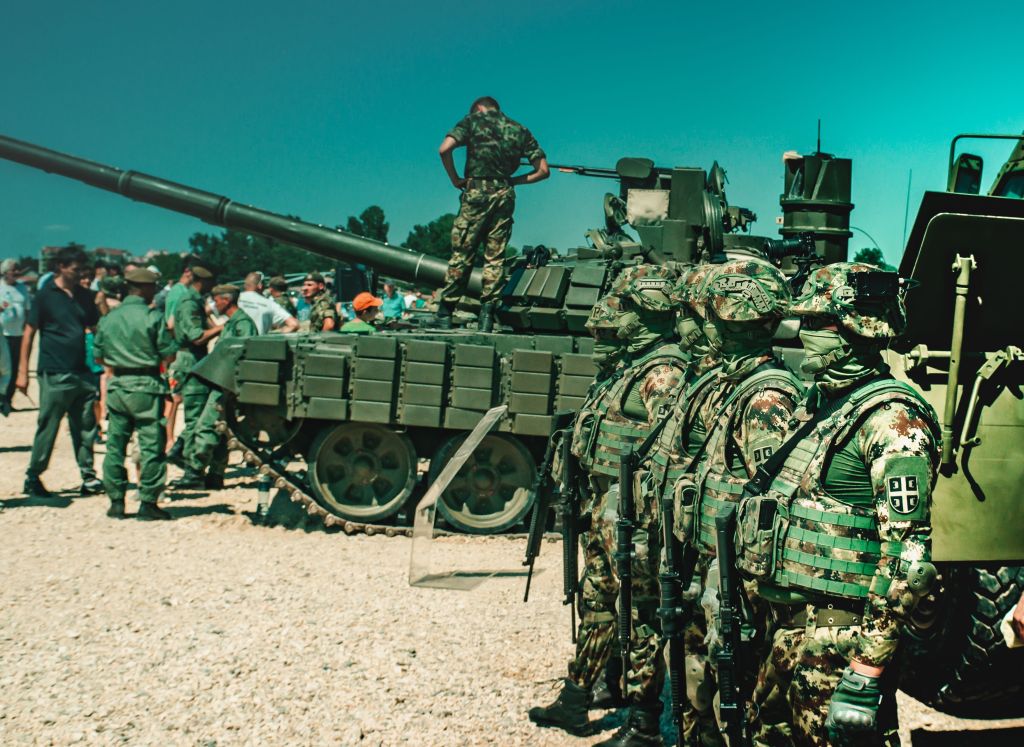
[Cover picture] Milic, B. (n.d.). Photo gratuite de armée, camouflage, combat, défense, entrainement militaire, équipement, équipement militaire, espace extérieur, exercice militaire, exercice sur le terrain, forces armées, formation, formation de groupe, formation de soldat, guerre, infanterie, jour, la discipline, militaire, motif de camouflage, opération militaire, personnel militaire, réservoir, sécurité, soldats, stratégie militaire, uniformes, uniformes camouflés, véhicule citerne, veículos militares [Photograph]. Pexels. Retrieved June 12, 2026, from https://www.pexels.com/fr-fr/photo/hommes-militaire-equipement-materiel-12357501/


Leave a comment