
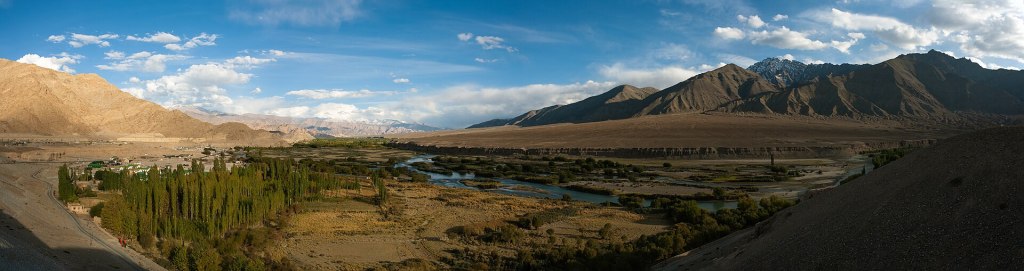
The Indus River flows from southwestern Tibet through the disputed Kashmir region and the Sindh province of Pakistan, before emptying into the Arabian Sea. Civilisations have organised themselves around it since the 3rd millennium BCE, and the word ‘India’ itself carries its namesake. Local cultures and livelihoods have been inextricably tied to the river system since time immemorial. Today, it provides critical water resources for energy and food production in the Punjab and Sindh plains of north western India and south eastern Pakistan, which otherwise receive little rainfall.
Under the British Raj, canal systems were constructed and modernised along the river for irrigation. The partition of British India in 1947, which created independent India and West Pakistan (later Pakistan), meant that the headworks of the water system now sat in India while the canals ran through Pakistan. After several years of stopgap measures, negotiations, and the World Bank’s intervention, the Indus Waters Treaty (IWT) was signed in 1960 between the two newly formed states. The treaty gave the waters of the western rivers to Pakistan and those of the eastern rivers to India, provided infrastructure funding, and established the Permanent Indus Commission as a channel for cooperation and dispute resolution. The treaty held for six decades, surviving periods of acute tension between the nuclear-armed neighbours and acting as a stabilising force in one of the world’s most volatile bilateral relationships [1].
Then, in April 2025, Islamist terrorists killed 26 civilians in India-administered Kashmir in one of the deadliest attacks against Indian civilians. The Resistance Front (TRF), a proxy for the Pakistan-based Lashkar-e-Taiba terrorist group, initially claimed responsibility which they later retracted. In an initial statement, TRF cited non-local settlement of the region as the motivation for the attack. The group had previously claimed responsibility for other attacks against religious minorities in the region. India attributed blame for the attack to Pakistan and unilaterally announced that the IWT would be held in abeyance “with immediate effect, until Pakistan credibly and irrevocably abjures its support for cross-border terrorism.” Islamabad denied any involvement.
For Pakistan, the suspension of the treaty constitutes “a serious violation of international legal obligations, with far-reaching humanitarian, environmental, and peace and security implications”, as stated by Pakistan’s Ministry of Foreign Affairs [2]. Supporters of India’s position counter that the treaty’s allocation was never equitable to begin with — Pakistan, as the lower riparian state, receives 79% of the available water in the basin [3] — and that Islamabad has long resisted revising terms to reflect modern regional conditions [4].
The dispute is unfolding against a backdrop of deepening environmental crisis. Climate change is fundamentally altering the hydrology of the Indus basin: the Hindu Kush, Karakoram, and Himalayan glaciers that feed the river and act as natural water storage are melting at accelerating rates, producing short-term surges in flow followed by long-term decline. Pakistan’s catastrophic 2022 floods, which submerged a third of the country, offered a grim preview of this volatility. As seasonal patterns grow increasingly unpredictable, the agricultural communities of Punjab and Sindh face simultaneous threats of drought and inundation, while rising temperatures intensify water demand and compress the window in which the river can reliably sustain the hundreds of millions who depend on it.
The practical consequences of the abeyance are already being felt. India has been withholding hydrological data crucial to Pakistan’s agriculture sector, which makes up a quarter of GDP and employs 37% of the workforce, hampering irrigation management and heightening flood risks [5]. India’s options for escalation are constrained: redirecting the western rivers toward its own use would require massive infrastructure construction in a geologically unstable region and risk serious reputational damage to its standing as an international law-abiding state [6]. Meanwhile, China continues to invest in Pakistan’s hydro infrastructure and has positioned itself as a counterweight to Indian influence in the region, meaning that a prolonged crisis risks deepening the broader China-India rivalry [7].
On the legal front, India has rejected the most recent May 2026 ruling issued by the Hague-based Court of Arbitration (CoA), describing the court as “illegally constituted.” The arbitration tribunal had been established by the World Bank in 2016 at Pakistan’s request, over India’s preference for a Neutral Expert. Two months after India’s abeyance of the 1960s IWT, the CoA issued a procedural ruling that India’s suspension would not affect the tribunal’s jurisdiction — a finding India dismissed as “null and void,” insisting it had “never recognised the establishment of this so-called CoA” [8]. The standoff is set to test the capabilities and limits of international arbitration when it comes to water rights.
As water governance falters around the world in the era of mounting climate risk [9], reestablishing and reforming the treaty to account for climate change, population growth, and the communities most directly affected is more important than ever [10]. The stakes of this impasse extend well beyond the subcontinent. For six decades, the IWT stood as a hallmark of mutual cooperation between deeply adversarial states, reflecting the collective, enduring, and transboundary nature of water rights. Its prolonged suspension should not be allowed to signal to the world that even the most durable water-sharing agreements can be weaponised in times of political crisis.
Edited by Adrian Kai Fraile Itagaki
References
[Cover Image]: “Indus Valley near Leh” by KennyOMG, via Wikimedia Commons, licensed under CC BY-SA 3.0.
1. Mosello, B., & Bharadwaj, B. (2026, April 17). India and Pakistan still cannot agree to restore the Indus Waters Treaty – but re-engagement could help bring lasting peace. Chatham House. https://www.chathamhouse.org/2026/04/india-and-pakistan-still-cannot-agree-restore-indus-waters-treaty-re-engagement-could-help
2. Ministry of Foreign Affairs, Government of Pakistan. (2026, January 31). UN Security Council meeting (Arria formula) on upholding the sanctity of treaties for the maintenance of international peace and security. https://mofa.gov.pk/press-releases/un-security-council-meeting-arria-formula-on-upholding-the-sanctity-of-treaties-for-the-maintenance-of-international-peace-and-security
3. Bhattacharjee, D. (2025, June 19). The suspension of the Indus Water Treaty: Its implications for India. Indian Council of World Affairs. https://www.icwa.in/show_content.php?lang=1&level=3&ls_id=13109&lid=8004
4. Singh, A., & von Lossow, T. (2025, July). Indus Water Treaty 2025: A pause of cooperation, not an end. Clingendael Institute. https://www.clingendael.org/sites/default/files/2025-07/Indus%20Water%20Treaty%202025.pdf
5. Das, A., ur-Rehman, Z., & Kumar, H. (2025, May 31). India and Pakistan’s air battle is over. Their water war has begun. The New York Times. https://www.nytimes.com/2025/05/31/world/asia/india-pakistan-indus-water-dispute.html
6. Singh, A., & von Lossow, T. (2025, July). Indus Water Treaty 2025: A pause of cooperation, not an end. Clingendael Institute. https://www.clingendael.org/sites/default/files/2025-07/Indus%20Water%20Treaty%202025.pdf
7. Hashmi, S. (2025, May 21). China is playing saviour for Pakistan. This time, with water diplomacy. ThePrint. https://theprint.in/opinion/eye-on-china/china-is-playing-saviour-for-pakistan-this-time-with-water-diplomacy/2632115/
8. Indus Waters Treaty: India rejects latest arbitration award as “null & void.” (2026, May 16). The Wire. https://thewire.in/diplomacy/indus-waters-treaty-india-rejects-latest-arbitration-award-as-null-void
9. The global water governance gap is becoming untenable. (2026, May 16). Geopolitical Monitor. https://www.geopoliticalmonitor.com/the-global-water-governance-gap-is-becoming-untenable/
10. Singh, A., & von Lossow, T. (2025, July). Indus Water Treaty 2025: A pause of cooperation, not an end. Clingendael Institute. https://www.clingendael.org/sites/default/files/2025-07/Indus%20Water%20Treaty%202025.pdf


Leave a comment